
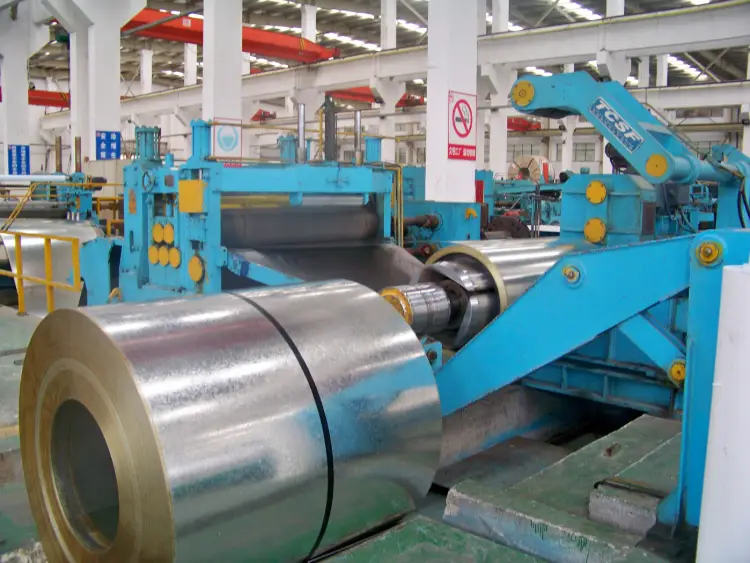
GL E32 Shipbuilding Steel Coil
GL E32 Shipbuilding Steel Coil - High Strength Hull Structural Steel for Arctic and Marine Environments
Explore GL E32 shipbuilding steel coil, a high strength hull structural steel designed to meet Germanischer Lloyd rules with guaranteed impact toughness at -40°C. Ideal for ships and offshore structures operating in cold climates.
Hot rolling, controlled rolling, normalizing, thermo-mechanically controlled rolling (TMCP)
- Phone : +8618037372205
- Email : [email protected]
- WhatsApp: Contact via Whtsapp
- WeChat: +8618037372205
GL E32 Shipbuilding Steel Coil Introduction
GL E32 is a high strength hull structural steel classified under the rules of Germanischer Lloyd (now DNV GL) and harmonized with IACS UR W11 as EH32. It is primarily designed for critical ship and offshore structures that require a minimum yield strength of 315 MPa and excellent low-temperature toughness down to -40°C. The steel is supplied in the form of coils, plates, and wide flats, and can be delivered in various conditions such as normalized, thermo-mechanically controlled rolled (TMCP), or as-rolled, depending on thickness and end application. Its chemical composition is tightly controlled, with micro-alloying elements like Niobium, Vanadium, and Titanium often added to refine grain structure and enhance strength without compromising weldability. The material exhibits good ductility, formability, and resistance to brittle fracture, making it a reliable choice for primary hull members such as shell plating, strength deck, and bottom structures of vessels operating in cold or ice-classed waters. Compliance with GL rules ensures traceability, material certification, and consistent quality, which are essential for classification and safe marine operations.
GL E32 Shipbuilding Steel Coil Chemical Composition
The chemical composition of GL E32 steel must comply with the limits specified in the Germanischer Lloyd Rules and IACS UR W11 for EH32 grade. Micro-alloying elements such as Nb, V, and Ti are optionally added to achieve the required mechanical properties through grain refinement and precipitation strengthening. The carbon equivalent (CEV) is typically controlled to ensure good weldability, generally not exceeding 0.38% for thicknesses up to 50 mm. All values are in weight percent unless otherwise noted.
| Element | Specified Value (%) | Remarks |
|---|---|---|
| Carbon (C) | ≤ 0.18 | Maximum |
| Manganese (Mn) | 0.90 - 1.60 | Range |
| Silicon (Si) | ≤ 0.50 | Maximum |
| Phosphorus (P) | ≤ 0.035 | Maximum |
| Sulfur (S) | ≤ 0.035 | Maximum |
| Aluminum (Al total) | ≥ 0.015 | Minimum acid soluble; sufficient for grain refinement |
| Niobium (Nb) | 0.02 - 0.05 | Optional micro-alloy; if added |
| Vanadium (V) | 0.05 - 0.10 | Optional micro-alloy; if added |
| Titanium (Ti) | ≤ 0.02 | Optional; if added |
| Copper (Cu) | ≤ 0.35 | Residual element |
| Chromium (Cr) | ≤ 0.20 | Residual element |
| Nickel (Ni) | ≤ 0.40 | Residual element |
| Molybdenum (Mo) | ≤ 0.08 | Residual element |
| Nitrogen (N) | ≤ 0.009 | Applicable if insufficient Al |
GL E32 Shipbuilding Steel Coil Physical and Thermal Properties
The following physical and thermal properties are typical for GL E32 type carbon-manganese structural steel. These values are not part of the delivery specification but serve as reliable engineering data for design and thermal analysis. The properties are similar to those of standard high strength low alloy steels.
| Property | Typical Value | Unit | Condition / Temperature |
|---|---|---|---|
| Density (ρ) | 7.85 | g/cm³ | 20 °C |
| Modulus of Elasticity (E) | 205 - 210 | GPa | 20 °C |
| Shear Modulus (G) | 79 - 81 | GPa | 20 °C |
| Poisson's Ratio (ν) | 0.30 | - | Elastic range |
| Thermal Expansion Coefficient (α) | 11.1 | 10⁻⁶/°C | 20 °C to 100 °C |
| Thermal Expansion Coefficient (α) | 11.9 | 10⁻⁶/°C | 20 °C to 200 °C |
| Thermal Expansion Coefficient (α) | 12.7 | 10⁻⁶/°C | 20 °C to 300 °C |
| Thermal Conductivity (λ) | 42 - 54 | W/(m·K) | 20 °C to 100 °C |
| Specific Heat Capacity (c) | 460 - 480 | J/(kg·K) | 20 °C to 100 °C |
| Electrical Resistivity (ρₑ) | 0.15 - 0.25 | μΩ·m | 20 °C |
GL E32 Shipbuilding Steel Coil Mechanical Properties
Mechanical properties of GL E32 are verified by tensile and impact testing in accordance with GL rules. Tests are usually conducted on samples taken in the transverse or longitudinal direction, as specified by the purchaser. The values below represent the minimum requirements for thicknesses ≤ 50 mm; reduced impact energy values may apply for thicker sections. The steel must exhibit a ductile fracture at the designated test temperature of -40°C.
| Property | Specified Value | Unit | Test Condition / Remarks |
|---|---|---|---|
| Yield Strength (ReH) | ≥ 315 | MPa | For thickness ≤ 50 mm; longitudinal or transverse |
| Tensile Strength (Rm) | 440 - 590 | MPa | For thickness ≤ 50 mm |
| Elongation (A) | ≥ 22 | % | Gauge length L₀ = 5.65√S₀ (A5) or 200 mm; for thickness ≤ 50 mm |
| Impact Energy (KV²) | ≥ 31 (average) | J | Longitudinal specimen, test temperature -40 °C; thickness ≤ 50 mm; single minimum 22 J |
| Impact Energy (KV²), transverse | ≥ 22 (average) | J | Transverse specimen, test temperature -40 °C; thickness ≤ 50 mm; if specified |
| Bend Test | 180° no cracks | - | Mandrel diameter 3t (t = specimen thickness) for t ≤ 25 mm; 4t for t > 25 mm (typical) |
GL E32 Shipbuilding Steel Coil Full Equivalents – International Classification Society Standards for EH32
| Country / Region | Standard / Classification Society | Equivalent Grade | Remarks |
|---|---|---|---|
| International | IACS UR W11 | EH32 | Unified requirement; identical technical intent |
| USA | American Bureau of Shipping (ABS) | ABS EH32 | Fully equivalent |
| UK | Lloyd's Register (LR) | LR EH32 | Fully equivalent |
| Norway/Germany | DNV GL | DNV EH32 (GL EH32) | Post-merger designation; fully equivalent |
| France | Bureau Veritas (BV) | BV EH32 | Fully equivalent |
| China | China Classification Society (CCS) | CCS EH32 | Fully equivalent |
| Japan | Nippon Kaiji Kyokai (ClassNK) | NK EH32 | Fully equivalent |
| South Korea | Korean Register (KR) | KR EH32 | Fully equivalent |
| Italy | Registro Italiano Navale (RINA) | RINA EH32 | Fully equivalent |
| Russia | Russian Maritime Register of Shipping (RS) | RS E32 | Equivalent; designation may differ slightly |
GL E32 Shipbuilding Steel Coil Application Introduction
GL E32 (EH32) is engineered for primary structural components in shipbuilding and offshore engineering where high strength and reliable low-temperature toughness are mandatory. Its balanced composition and grain refinement provide excellent welding characteristics, which are critical in large-scale assembly. Typical applications include:
Product Applications: Hull shell plating (bottom, side, and deck), Strength deck and upper deck plating on large vessels, Bottom longitudinals and stiffeners, Transverse bulkheads and web frames, Bow and stern structural members subject to slamming loads, Offshore module support structures and helideck substructures
Processed into products: Cut-to-size plates for hull fabrication, Rolled beams, angles, and bulb flats for stiffening, Welded built-up girders and box structures, Flanges and webs in primary hull girders, Ice belts and ice-resistant inserts
Application industries: Merchant shipbuilding (bulk carriers, tankers, container ships), Naval vessel construction (frigates, supply ships), Offshore oil and gas (jack-up rigs, production platforms, FPSO hulls), Ice-classed and polar vessels (icebreakers, ice-going cargo ships), Coastal structures and heavy marine equipment
GL E32 Shipbuilding Steel Coil Similar Materials – Alternative High Strength and Low Temperature Grades
| Country / Region | Standard | Grade | Remarks / Comparative Analysis |
|---|---|---|---|
| International | IACS UR W11 | EH36 | Higher strength grade (min YS 355 MPa). Suitable where weight saving is critical; similar low temperature toughness (-40°C) but lower elongation. |
| International | IACS UR W11 | FH32 | Similar strength grade (min YS 315 MPa) but with more stringent impact requirement at -60°C. Used in extremely cold environments (e.g., Arctic service). |
| International | IACS UR W11 | Grade E (Normal Strength) | Normal strength hull steel (min YS 235 MPa) with impact test at -40°C. Lower strength but excellent ductility and weldability; may be a cost-effective alternative for secondary structures. |
| Europe | EN 10025-4 | S355ML | Thermomechanical rolled structural steel with min YS 355 MPa and impact at -50°C. Comparable toughness, but not approved by all classification societies for primary hull members. |
Notes:
Welding Guidelines: Due to the alloy design and low-temperature toughness requirement, welding of GL E32 should be performed with low-hydrogen consumables and a controlled heat input. Preheating may be required for thicker sections (typically above 30-40 mm) to prevent hydrogen-induced cracking. Post-weld heat treatment is generally not required.
Certification: All materials are supplied with full traceability and a 3.1 or 3.2 inspection certificate per EN 10204, endorsed by the classification society surveyor. The steel must be stamped with the grade, heat number, and classification mark as per GL Rules.
Surface Condition: Coils are usually supplied in the as-rolled or shot-blasted and primer-coated condition. Tolerances on thickness, width, and flatness follow EN 10029 or the corresponding specification referenced by GL.
- Share



