
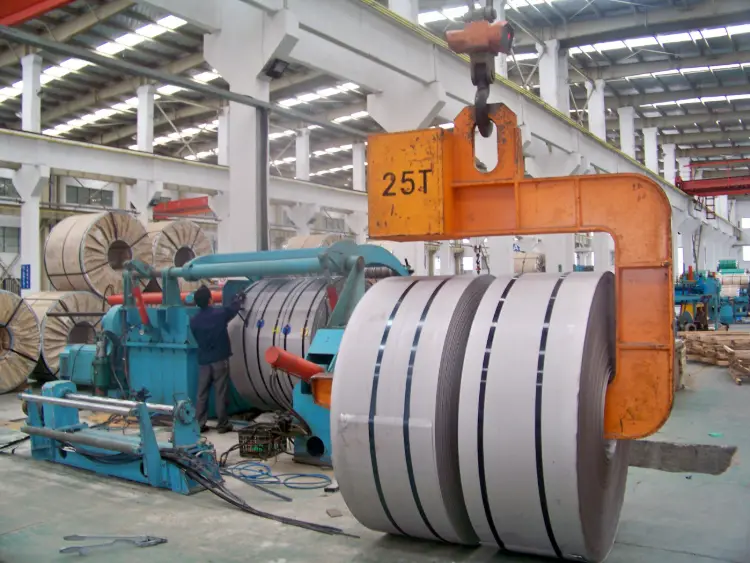
GL D32 Shipbuilding Steel Coil
GL D32 Shipbuilding Steel Coil | High Strength & Low Temperature Toughness for Marine Structures
Comprehensive technical data for GL D32 shipbuilding steel coil per GL/DNV GL rules, including chemical composition, mechanical properties, and thermal physics. Equivalent to ABS DH32, BV DH32, CCS DH32, etc.
Thermo-mechanical controlled processing (TMCP), normalizing, or controlled rolling. Workable by cold forming, welding, gas cutting, and machining (limited due to high toughness).
- Phone : +8618037372205
- Email : [email protected]
- WhatsApp: Contact via Whtsapp
- WeChat: +8618037372205
GL D32 Shipbuilding Steel Coil Introduction
GL D32 is a high strength structural steel for shipbuilding, certified by Germanischer Lloyd (now DNV GL). It belongs to the D32 strength grade with a minimum yield strength of 315 MPa and guaranteed impact toughness at -20°C. The steel is designed for critical ship structures requiring good weldability and low-temperature service.
The composition is carefully balanced with micro-alloy elements to achieve fine grain size and strength. Typical delivery condition is thermo-mechanically rolled (TMCP) or normalized, ensuring homogeneous mechanical properties across thicknesses up to approx. 50 mm.
Key features:
- Excellent low-temperature impact toughness at -20°C (min 31 J longitudinal)
- Good weldability thanks to low carbon equivalent (CEV ≤ 0.40)
- High resistance to lamellar tearing in thickness direction
- Compliant with IACS UR W11 and DNV GL Rules for Ships
GL D32 Shipbuilding Steel Coil Chemical Composition
The chemical composition of GL D32 is defined by DNV GL rules and IACS UR W11. Limits ensure a balance of strength, weldability, and toughness. Carbon equivalent (CEV) is calculated as CEV = C + Mn/6 + (Cr+Mo+V)/5 + (Ni+Cu)/15 and must not exceed 0.40% (typically ≤0.38%) for thicknesses ≤50 mm.
- Fine grain practice is mandatory; aluminium or other grain refining elements are used.
- Micro-alloying with Nb, V, Ti is permitted within the specified limits.
| Element | Specified Value (wt.%) | Remarks |
|---|---|---|
| Carbon (C) | ≤ 0.18 | Ladle analysis |
| Manganese (Mn) | 0.90 – 1.60 | Wide range for strength |
| Silicon (Si) | ≤ 0.50 | Deoxidation element |
| Phosphorus (P) | ≤ 0.035 | Max, higher requires caution |
| Sulfur (S) | ≤ 0.035 | Max, for toughness |
| Aluminium (Al, acid soluble) | ≥ 0.015 | Grain refinement, or equivalent effect by other elements |
| Niobium (Nb) | ≤ 0.05 | Optional micro-alloy (when used) |
| Vanadium (V) | ≤ 0.10 | Optional micro-alloy (when used) |
| Titanium (Ti) | ≤ 0.02 | Optional micro-alloy (when used) |
| Carbon Equivalent (CEV) | ≤ 0.40 | For thickness ≤ 50 mm; calculated value |
GL D32 Shipbuilding Steel Coil Thermal & Electrical Properties
The following data represent typical physical properties for low-carbon micro-alloyed steels similar to D32. These are not mandated by the classification society but are often used for design calculations.
- Values are for room temperature unless noted otherwise.
- Thermal conductivity decreases with increasing temperature; expansion coefficient increases.
| Property | Typical Value | Unit | Condition / Remarks |
|---|---|---|---|
| Density (ρ) | 7.85 | g/cm³ | Room temperature |
| Modulus of elasticity (E) | 205 | GPa | Ambient, longitudinal |
| Shear modulus (G) | ~80 | GPa | Calculated from E and ν |
| Poisson's ratio (ν) | 0.3 | – | Typical for steel |
| Thermal expansion coefficient (α) | 12 × 10⁻⁶ | K⁻¹ | 20 – 100 °C, linear average |
| Thermal conductivity (λ) | ~ 50 | W/(m·K) | At 20 °C |
| Specific heat capacity (cₚ) | ~ 460 | J/(kg·K) | Near room temperature |
| Electrical resistivity (ρₑ) | ~ 0.20 | μΩ·m | At 20 °C |
GL D32 Shipbuilding Steel Coil Mechanical Properties
Mechanical properties are determined on transverse test pieces unless longitudinal tests are specified for impact. Values shown comply with DNV GL Rules for D32 grade (thickness ≤ 50 mm, representative for coil product).
- Yield and tensile values may be slightly adjusted for greater thicknesses according to the standard.
- Bend test: 180° bending to a diameter related to thickness; no cracking allowed.
- Charpy impact energy requirement is an average of three tests; one individual value may be lower than the specified average but not less than 70% of it.
| Property | Required Value | Unit | Test Condition |
|---|---|---|---|
| Upper yield strength (ReH) | ≥ 315 | MPa | Transverse, ambient, t ≤ 50 mm |
| Tensile strength (Rm) | 440 – 570 | MPa | Transverse, ambient, t ≤ 50 mm |
| Elongation after fracture (A) | ≥ 22 | % | Gauge length 5.65√S₀ (A5), transverse, t ≤ 50 mm |
| Charpy V-notch impact energy (KV₂) | ≥ 31 (avg.) / ≥ 22 (single) | J | Longitudinal, test temperature -20 °C |
| Bend test (180°) | d = 3t (t ≤ 25 mm) | No cracks or defects, t = thickness | |
| Bend test (180°) | d = 4t (25 < t ≤ 50 mm) | No cracks or defects, t = thickness |
GL D32 Shipbuilding Steel Coil Fully Equivalent Grades & Replacement Standards
| Country/Region | Standard / Classification Society | Equivalent Grade | Remarks |
|---|---|---|---|
| International (DNV) | DNV GL Rules Pt.2 Ch.2 | D32 (also DNV D32) | Identical to GL D32 |
| USA | ABS Rules | DH32 | Same strength and -20°C impact |
| France | BV Rules | DH32 | Same specification |
| China | CCS Rules | DH32 | Chinese Classification Society, equivalent |
| UK | LR Rules | DH32 | Lloyd's Register, identical requirements |
| Korea | KR Rules | DH32 | Korean Register, equivalent |
| Italy | RINA Rules | DH32 | Registro Italiano Navale, same grade |
| Japan | NK Rules | DH32 | ClassNK, same mechanical/impact |
GL D32 Shipbuilding Steel Coil Application Introduction
GL D32 coil is predominantly used in shipbuilding and marine engineering where a balance of strength and low-temperature toughness is required. The steel is processed into plates, profiles, and welded fabrications.
- Ship structures: decks, bottom plating, side shells, transverse/longitudinal bulkheads, stiffeners, and web frames.
- Offshore: legs of self-elevating platforms, structural members of semi-submersibles, modules, and jackets exposed to cold water.
- Bridges & heavy civil: cold-region bridges, crane booms, heavy machinery where Charpy -20°C is specified.
Product Applications: Hull plates (coil converted to sheets/plates), Welded beams (built-up H, box girders), Deck plating kits, Stiffening ribs and stringers, Cut parts for ship blocks
Processed into products: Bottom shell plates, Side shell plates, Main deck plates, Bulkhead plates, Girder webs and flanges, Transverse frames, Engine room structures, Offshore platform legs (for jack-ups)
Application industries: Shipbuilding (merchant vessels, navy, fishing, offshore support), Marine & offshore platforms (oil & gas, wind turbines), Bridge construction (cold climate), Pressure vessels & storage tanks (limited cryogenic service, down to -20°C), Heavy machinery (structural parts)
GL D32 Shipbuilding Steel Coil Similar & Alternative Steel Grades for Consideration
| Country/Region | Standard / Source | Grade | Remarks |
|---|---|---|---|
| Germany / Europe | DNV GL / IACS | EH32 | Even lower temperature toughness (-40°C); can replace D32 where extra low-temperature safety is needed, but costlier. |
| Germany / Europe | DNV GL | AH32 | Same strength, but impact only guaranteed at 0°C. Limited to non-arctic applications; not direct replacement for cold service. |
| China | GB/T 712 | DH32 | Chinese national shipbuilding steel, essentially identical. |
| China | GB/T 1591 | Q345D | General structural steel with 345 MPa yield and -20°C impact; composition differs slightly (higher P/S). Not a certified shipbuilding steel but similar mechanical level. |
| Russia | GOST 5521 | D32 | Similar category within Russian Maritime Register, comparable properties. |
Notes:
GL D32 can be supplied with additional requirements such as Z-quality (lamellar tearing resistance) per DNV GL Standard DNVGL-CP-0036. Surface condition: as-rolled or pickled and oiled for coil. Dimensional tolerances conform to EN 10051 or equivalent.
For welding, low-hydrogen practices are recommended; preheat may be needed for thicker sections depending on CEV. The steel is fully recyclable.
- Share



