
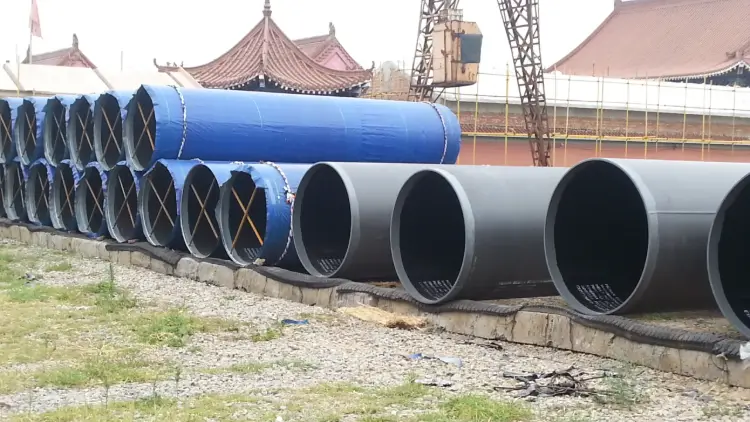
GB/T1591 Q420C LSAW Steel Pipe
GB/T1591 Q420C LSAW Steel Pipe: High-Strength Low-Alloy Structural Steel
Comprehensive material properties and specifications for Q420C low-alloy structural steel for LSAW pipes under GB/T 1591 standard. Contains chemical composition, mechanical properties, physical data, and global equivalents.
Welding, Hot Rolling, Controlled Rolling, Normalizing, Cold Forming
- Phone : +8618037372205
- Email : [email protected]
- WhatsApp: Contact via Whtsapp
- WeChat: +8618037372205
GB/T1591 Q420C LSAW Steel Pipe Introduction
Q420C is a weldable high-strength low-alloy structural steel grade specified in the Chinese standard GB/T 1591-2018. The "C" designation indicates a requirement for Charpy V-notch impact testing at 0°C. This grade is a fine-grain steel with a minimum yield strength of 420 MPa for thicknesses ≤16 mm, offering an excellent combination of high strength, good weldability, and low-temperature toughness.
Commonly used in the form of Longitudinally Submerged Arc Welded (LSAW) pipe, it is particularly suited for demanding large-diameter structural applications. The steel is typically supplied in a hot-rolled, controlled-rolling, or normalized condition, ensuring uniform mechanical properties. Its controlled carbon equivalent value enhances its weldability, making it a reliable choice for critical welded structures in challenging environments.
GB/T1591 Q420C LSAW Steel Pipe Chemical Composition
The chemical composition of Q420C is designed to provide a balance between high strength and excellent weldability. Key micro-alloying elements such as niobium (Nb), vanadium (V), and titanium (Ti) are used for grain refinement and precipitation strengthening. The carbon equivalent value (CEV) is controlled to ensure good field weldability. The values below are according to GB/T 1591-2018.
| Element | Standard Value (max % unless range specified) | Remarks |
|---|---|---|
| Carbon (C) | ≤ 0.20 | Key element for strength |
| Silicon (Si) | ≤ 0.50 | Deoxidizer and strength contributor |
| Manganese (Mn) | ≤ 1.70 | Major strengthening element |
| Phosphorus (P) | ≤ 0.030 | Deleterious element, controlled for toughness |
| Sulfur (S) | ≤ 0.030 | Deleterious element, controlled for toughness |
| Niobium (Nb) | ≤ 0.07 | Grain refiner, for strength and toughness |
| Vanadium (V) | ≤ 0.20 | Precipitation strengthening |
| Titanium (Ti) | ≤ 0.20 | Grain refinement and nitrogen control |
| Chromium (Cr) | ≤ 0.30 | Optional, for strength and hardenability |
| Nickel (Ni) | ≤ 0.80 | Optional, for toughness |
| Copper (Cu) | ≤ 0.30 | Optional, for atmospheric corrosion resistance |
| Nitrogen (N) | ≤ 0.015 | Controlled for Al-killed fine-grain steels |
| Molybdenum (Mo) | ≤ 0.10 | Optional, for high-temperature strength |
| Aluminum (Al) | ≥ 0.015 | Grain refiner, specifies minimum for fine-grain practice |
GB/T1591 Q420C LSAW Steel Pipe Physical Properties
Physical properties are essential for design calculations involving thermal expansion, heat transfer, and structural stiffness. These values are representative for this class of steel at room temperature unless a specific temperature is stated. Properties like density and elastic modulus are generally consistent for low-alloy steels, while thermal conductivity and expansion vary slightly with composition and temperature.
| Property | Typical Value | Unit | Test Condition |
|---|---|---|---|
| Density (ρ) | Approx. 7.85 | g/cm³ | At 20 °C |
| Elastic Modulus (E) | 205 - 210 | GPa | At 20 °C |
| Shear Modulus (G) | Approx. 80 | GPa | At 20 °C, Calculated |
| Poisson's Ratio (ν) | 0.29 - 0.30 | - | At 20 °C |
| Thermal Expansion Coefficient (α) | 11.5 - 12.0 | 10⁻⁶/K | Between 20 °C and 100 °C |
| Thermal Expansion Coefficient (α) | 12.5 - 13.0 | 10⁻⁶/K | Between 20 °C and 200 °C |
| Thermal Expansion Coefficient (α) | 13.5 - 14.0 | 10⁻⁶/K | Between 20 °C and 400 °C |
| Thermal Conductivity (λ) | 40 - 45 | W/(m·K) | At 20 °C |
| Thermal Conductivity (λ) | 38 - 42 | W/(m·K) | At 200 °C |
| Specific Heat Capacity (cp) | 460 - 480 | J/(kg·K) | At 20 °C |
| Specific Heat Capacity (cp) | 500 - 520 | J/(kg·K) | At 200 °C |
| Electrical Resistivity (ρₑ) | 0.20 - 0.25 | Ω·mm²/m | At 20 °C |
GB/T1591 Q420C LSAW Steel Pipe Mechanical Properties
The mechanical properties of Q420C steel are guaranteed for a range of product thicknesses. The tensile test is the primary acceptance test. For LSAW pipes made from hot-rolled plate, the properties below represent the base material before pipe forming, which may be modified by the forming and welding process.
Impact energy is a critical requirement for the "C" sub-grade, measured on longitudinal Charpy V-notch specimens at 0°C. Minimum impact energy values are typically 34J, but higher values of 47J or 55J can be agreed upon at the time of order.
| Property | Standard Requirement Value | Unit | Test Condition |
|---|---|---|---|
| Yield Strength (ReH) | ≥ 420 | MPa | Nominal thickness (t) ≤ 16 mm |
| Yield Strength (ReH) | ≥ 400 | MPa | Nominal thickness 16 < t ≤ 40 mm |
| Yield Strength (ReH) | ≥ 380 | MPa | Nominal thickness 40 < t ≤ 63 mm |
| Yield Strength (ReH) | ≥ 360 | MPa | Nominal thickness 63 < t ≤ 80 mm |
| Tensile Strength (Rm) | 520 - 680 | MPa | Nominal thickness t ≤ 40 mm |
| Tensile Strength (Rm) | 500 - 650 | MPa | Nominal thickness 40 < t ≤ 80 mm |
| Elongation after Fracture (A) | ≥ 19 | % | Longitudinal, 5.65√S₀, t ≤ 40 mm |
| Elongation after Fracture (A) | ≥ 18 | % | Longitudinal, 5.65√S₀, t > 40 mm |
| Impact Energy (KV₂) | ≥ 34 | J | 0 °C, Longitudinal, 10x10 mm specimen |
| Bending Test | d=3a | - | Bend angle 180°, for nominal thickness ≤ 16 mm |
GB/T1591 Q420C LSAW Steel Pipe Complete Equivalent Material Standards and Substitutable Grades
| Country/Region | Standard | Grade | Remarks |
|---|---|---|---|
| Europe | EN 10025-3 | S420NL | Normalized fine-grain structural steel with impact guaranteed at -50°C, superior low-temp toughness. |
| International | ISO 4950-2 | S420NL | Direct equivalent to the European standard. |
| USA | ASTM A572/A572M | Grade 60 [420] Type 2 | Must specify supplementary requirement S5 for Charpy testing at 0°C to match Q420C. |
| India | IS 2062 | E420 C | High strength micro-alloyed steel with impact requirement at 0°C. |
| Japan | JIS G 3106 | SM520C | Rolled steel for welded structure. SM520 has lower min. yield (365 MPa), but is functionally similar for many applications. |
GB/T1591 Q420C LSAW Steel Pipe Application Introduction
Q420C in LSAW pipe form is an economical and high-performance solution for large-scale structural applications where high strength, good low-temperature toughness, and excellent weldability are required. Its delivery condition (typically hot-rolled or normalized) makes it suitable for direct use. The LSAW manufacturing process allows for thick-walled, large-diameter pipes (16-64 inch OD) with a high degree of dimensional accuracy.
Key considerations include:
- Weldability: Low carbon equivalent (CEV) allows for conventional welding processes without extensive preheating, saving time and cost.
- Design Flexibility: The high yield strength of 420 MPa allows engineers to reduce wall thickness, leading to lighter structures and lower overall project costs compared to using S355 or Grade 50 materials.
- Toughness: The guaranteed impact energy at 0°C makes it suitable for outdoor structures in temperate climates.
Product Applications: Long-distance gas and oil transmission pipelines, Large-diameter water diversion penstocks, Structural columns and trusses for high-rise buildings, Offshore jacket platform legs and bracing, Bridge arch tubes and box girder sections, Wind turbine tower base sections (inner mast)
Processed into products: LSAW pipe pile segments for port and bridge foundations, Welded nodes and transition cones for offshore wind jackets, Camshafts and connecting rods in heavy machinery (from plate), Main longitudinal stiffeners and bulkhead plates in shipbuilding (from plate), Flanges and webs of heavy-duty crane girders (from plate)
Application industries: Civil Engineering and Construction (stadiums, airport terminals, high-rise building columns), Bridge Engineering (arch ribs, main truss chords, bridge piers), Offshore and Marine Engineering (jacket legs, topside modules, flare booms), Energy Sector (penstocks for hydropower, large-diameter water and oil/gas transmission pipelines), Heavy Machinery and Port Equipment (crane booms, large excavator arms, conveyor gantry structures)
GB/T1591 Q420C LSAW Steel Pipe Similar Alternative Material Recommendations
| Country/Region | Standard | Grade | Remarks |
|---|---|---|---|
| Europe | EN 10025-4 | S420ML | Thermomechanically rolled (M) version. Excellent weldability with lower carbon equivalent due to low alloy content. Impact at -50°C. |
| USA | ASTM A572/A572M | Grade 65 [450] | Higher 450 MPa yield strength, but impact testing is an optional supplementary requirement. |
| China | GB/T 19879 | Q420GJC | Specifically for building structures, with guaranteed through-thickness properties (Z-grade) and often tighter composition control. |
| Russia | GOST 19281 | 14G2AF | Historical grade with similar base chemistry (Mn-V-N) and mechanical properties for structural use. |
| Europe | EN 10025-6 | S460QL | Quenched and tempered steel. Significantly higher strength (460 MPa yield) but requires stricter welding procedures, offering a high-strength alternative. |
Notes:
The data provided for base material is based on standard requirements from GB/T 1591-2018. For LSAW pipe specifically, the final property requirements (especially tensile and impact) should be confirmed against the pipe product standard, such as GB/T 9711 for petroleum industry line pipe or SY/T 5040 for structural pipe piles. A flattening test and guided-bend test on the weld seam are mandatory for the finished LSAW pipe. Non-destructive testing (NDT) of the weld seam by ultrasonic (UT) or radiographic (RT) methods is a standard requirement to ensure weld integrity. Steels for pressure purposes must also comply with GB/T 713 and have defined elevated-temperature yield strength values.
- Share



