
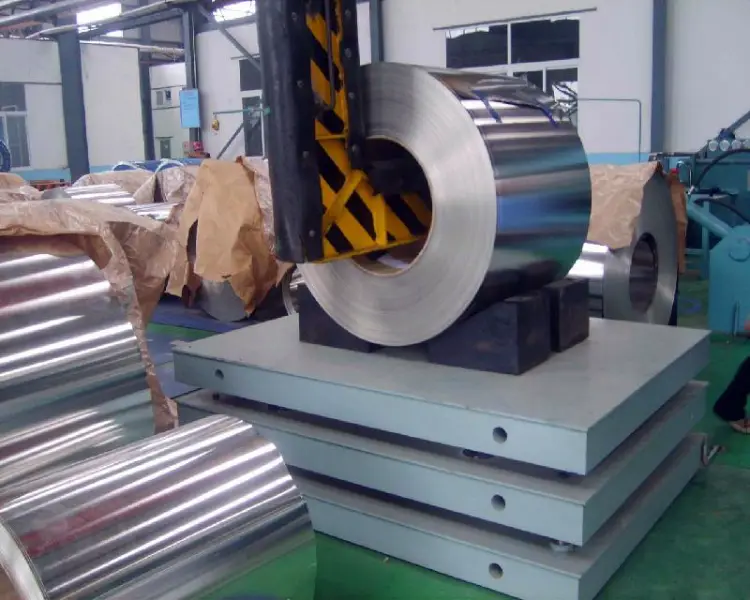
ABS Grade EQ51 Shipbuilding Steel Coil
ABS Grade EQ51 Shipbuilding Steel Coil - High Strength Quenched & Tempered Marine Plate
Comprehensive material data for ABS Grade EQ51 steel coil: chemical composition, mechanical and thermal properties, global equivalents, and application guidelines.
Hot rolling, quenching + tempering, cold forming, welding, cutting
- Phone : +8618037372205
- Email : [email protected]
- WhatsApp: Contact via Whtsapp
- WeChat: +8618037372205
ABS Grade EQ51 Shipbuilding Steel Coil Introduction
ABS Grade EQ51 is a high-strength quenched and tempered steel for ship and offshore structures, classified under the American Bureau of Shipping (ABS) rules. It exhibits a minimum yield strength of 51 ksi (355 MPa) and offers excellent toughness at temperatures as low as -40 °C (grade "E"). The steel is specified in coil form, suitable for heavy-gauge structural components where superior notch toughness, weldability, and resistance to brittle fracture are essential. Key attributes:
- Yield strength ≥ 355 MPa (51 ksi)
- Charpy impact ≥ 34 J at -40 °C
- Low carbon equivalent for good weldability
- Quenched and tempered condition (Q+T)
- Supplied as coil, plate, or strip
ABS Grade EQ51 Shipbuilding Steel Coil Chemical Composition
The chemical composition of ABS EQ51 is controlled to achieve the required balance of strength, toughness, and weldability after quenching and tempering. Grain-refining elements (Nb, V, Ti, Al) are often added to obtain a fine austenite grain size. The carbon equivalent (Ceq) is typically kept ≤ 0.43% for good weldability. Remarks:
- When aluminum is used as grain refiner, total Al ≥ 0.020% or acid-soluble Al ≥ 0.015%.
- Nb, V, and Ti may be added singly or in combination; combined content (Nb+V+Ti) ≤ 0.12%.
- Nitrogen is limited when aluminum is present to avoid detrimental precipitates.
| Element | Content (wt%) | Remarks |
|---|---|---|
| Carbon (C) | ≤ 0.18 | Key hardenability element |
| Silicon (Si) | 0.10 – 0.50 | Deoxidation and strength |
| Manganese (Mn) | 0.90 – 1.60 | Hardenability and toughness |
| Phosphorus (P) | ≤ 0.025 | Strict control for low-temperature toughness |
| Sulfur (S) | ≤ 0.025 | Minimized for clean steel |
| Copper (Cu) | ≤ 0.35 | Residual element |
| Chromium (Cr) | ≤ 0.25 | Hardenability, controlled to avoid weld cracking |
| Nickel (Ni) | ≤ 0.40 | Improves toughness |
| Molybdenum (Mo) | ≤ 0.08 | Hardenability, optional |
| Nitrogen (N) | ≤ 0.012 | Limited when Al is present; otherwise as agreed |
| Aluminum (Al) | ≥ 0.020 (total) | When used for grain refinement |
| Niobium (Nb) | 0.02 – 0.05 | Grain refiner (optional) |
| Vanadium (V) | 0.05 – 0.10 | Grain refiner (optional) |
| Titanium (Ti) | 0.007 – 0.05 | Grain refiner (optional) |
ABS Grade EQ51 Shipbuilding Steel Coil Thermal and Electrical Physical Properties
The physical properties correspond to typical low-alloy quenched and tempered shipbuilding steel. Values are indicative at room temperature unless otherwise stated. Notes:
- Density may vary slightly with alloy content; 7.85 g/cm³ is standard for calculation.
- Thermal expansion coefficient depends on the temperature range; values for 20–100 °C and 20–200 °C are given.
- Electrical resistivity is representative for magnetic steel.
| Property | Value | Unit | Test Condition |
|---|---|---|---|
| Density (ρ) | 7.85 | g/cm³ | 20 °C |
| Elastic Modulus (E) | 205 | GPa | 20 °C, dynamic method |
| Shear Modulus (G) | 80 | GPa | 20 °C, calculated |
| Poisson's Ratio (ν) | 0.30 | – | 20 °C, within elastic range |
| Thermal Expansion (α) | 11.5 × 10⁻⁶ | 1/K | 20–100 °C |
| Thermal Expansion (α) | 12.2 × 10⁻⁶ | 1/K | 20–200 °C |
| Thermal Conductivity (λ) | 42 | W/(m·K) | 20 °C |
| Specific Heat Capacity (cₚ) | 460 | J/(kg·K) | 20 °C |
| Electrical Resistivity (ρe) | 0.20 | μΩ·m | 20 °C |
ABS Grade EQ51 Shipbuilding Steel Coil Mechanical Properties
Mechanical testing is performed on transverse specimens according to ABS requirements. Charpy V-notch impact tests are conducted at -40 °C for grade "E". Bending tests confirm the steel's formability without cracking. Notes:
- Elongation measured on gauge length 5.65√S0 (A5).
- For thicknesses > 50 mm up to 100 mm, the 180° bend test uses a mandrel diameter of 4a.
- Impact energy values are longitudinal (KV2). Transverse values may be required for thinner gauges.
- Minimum impact energy is 34 J for standard 10×10 mm specimens; proportional values for subsize specimens.
| Property | Required Value | Unit | Test Condition / Remarks |
|---|---|---|---|
| Yield Strength (ReH) | ≥ 355 | MPa | Transverse, 0.2% offset, room temperature |
| Tensile Strength (Rm) | 490 – 620 | MPa | Transverse, room temperature |
| Elongation (A5) | ≥ 19 | % | t ≤ 50 mm, gauge length 5.65√S0 |
| Elongation (A5) | ≥ 17 | % | 50 < t ≤ 100 mm, gauge length 5.65√S0 |
| Bend Test (180°) | d = 3a | – | t ≤ 50 mm, no cracks |
| Bend Test (180°) | d = 4a | – | 50 < t ≤ 100 mm |
| Charpy Impact (KV2, L) | ≥ 34 | J | -40 °C, 10×10 mm specimen |
| Charpy Impact (KV2, L) | ≥ 24 | J | -40 °C, 7.5×10 mm subsize |
| Charpy Impact (KV2, L) | ≥ 17 | J | -40 °C, 5×10 mm subsize |
ABS Grade EQ51 Shipbuilding Steel Coil Direct Equivalent Grades
| Country / Region | Standard / Classification Society | Grade | Remarks |
|---|---|---|---|
| China | CCS (China Classification Society) | EQ51 | Identical to ABS EQ51 requirements |
| UK | LR (Lloyd's Register) | EQ51 | Directly recognized equivalent |
| France | BV (Bureau Veritas) | EQ51 | Same quenched and tempered high strength steel |
| Japan | NK (ClassNK) | EQ51 | Adopts IACS UR W11; fully interchangeable |
| Italy | RINA | EQ51 | Equivalent grade for marine structures |
| Norway / Germany | DNV GL | E36 (Q+T) | Meets same strength (355 MPa) and low-temperature impact; requires agreement for Q+T condition |
ABS Grade EQ51 Shipbuilding Steel Coil Application Introduction
ABS EQ51 coil is engineered for critical ship and offshore structural applications where high strength, reliable low-temperature toughness, and good weldability are mandatory. It is typically delivered in the quenched and tempered condition, making it suitable for heavy fabrication without loss of mechanical properties.
Product Applications: Ship hull shell plates and stiffeners, Deck plates and bulkheads, Transverse frames and stringers, Ice belt and bow structures, Offshore platform legs and bracing, Welded girders and box columns
Processed into products: Welded plate assemblies, Cut and formed brackets and knees, Flame-cut parts for ship blocks, Longitudinal profiles (with subsequent forming), Cold-formed stiffeners and corrugated panels, Welded T-joints and cruciform joints
Application industries: Shipbuilding (hull plates, reinforcement members), Offshore engineering (jack-up rigs, semisubmersibles, platform decks), Polar and ice-class vessel construction, Structural steelwork for heavy machinery and cranes, Pressure vessels and storage tanks operating at low ambient temperatures
ABS Grade EQ51 Shipbuilding Steel Coil Similar / Alternative Materials with Comparable Performance
| Country / Region | Standard | Grade | Remarks |
|---|---|---|---|
| Europe | EN 10025-6 | S460Q / S460QL | Higher strength (min. 460 MPa) but similar Q+T processing; suitable for thicker sections |
| Europe | EN 10025-3 | S355N / S355NL | Normalised or normalised rolled, 355 MPa class; equivalent toughness at lower cost, but limited thickness |
| International | ABS | EH36 | Normalised / TMCP steel with min. yield 355 MPa and -40°C impact; similar structural use but not quenched and tempered |
| China | GB/T 712 | EH36 | Close in strength and toughness, often used interchangeably in shipbuilding projects |
Notes:
- Preheating and interpass temperature control are recommended during welding; typically 100–150 °C depending on thickness and hydrogen level.
- Post-weld heat treatment (PWHT) is generally not required for thicknesses up to 50 mm but may be specified for stress relief of heavy weldments.
- The steel can be supplied with ABS type approval certificates in coil form up to agreed widths and thicknesses; decoiling and flattening processes should not degrade the quenched and tempered structure.
- Consult the latest ABS Rules for updates; the data herein reflects common industry practice based on published specifications.
- Share



