
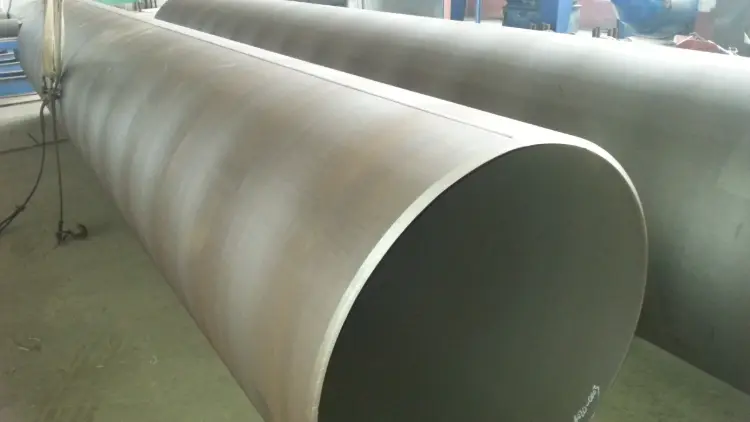
GB/T 1591 Q420B Steel for LSAW Pipe
GB/T 1591 Q420B Steel for LSAW Pipe - High Strength Low Alloy Structural Steel Data
Complete material datasheet for Q420B steel according to GB/T 1591-2018, applied in LSAW pipe manufacturing. Covers chemical composition, mechanical properties, thermal and electrical physical properties, international equivalents, and application guidance.
Welding (LSAW, spiral welding), hot rolling, normalizing rolling, thermomechanical rolling (TMCP), cold forming, bending, machining.
- Phone : +8618037372205
- Email : [email protected]
- WhatsApp: Contact via Whtsapp
- WeChat: +8618037372205
GB/T 1591 Q420B Steel for LSAW Pipe Introduction
Q420B is a Chinese low-alloy high-strength structural steel grade specified in GB/T 1591-2018. It belongs to the Q420 strength class with a minimum yield strength of 420 MPa for thin sections. The "B" designation indicates that the steel guarantees impact toughness at 0°C (minimum 34 J longitudinal Charpy V-notch). Q420B is engineered for welded structures and is commonly supplied as plates and strips for producing LSAW (Longitudinal Submerged Arc Welded) pipes, which are used in oil and gas transmission pipelines, structural piles, and heavy-duty mechanical components.
- Excellent weldability due to controlled carbon equivalent and micro-alloying with Nb, V, Ti.
- Fine-grain microstructure provides a good combination of strength, ductility, and toughness.
- Available in various delivery conditions: hot-rolled, normalizing rolled, or thermomechanical rolled (TMCP) as per order requirement.
- Suitable for cold forming, bending, and welding operations common in pipe manufacturing.
GB/T 1591 Q420B Steel for LSAW Pipe Chemical Composition
The chemical composition limits for Q420B steel as per GB/T 1591-2018, applicable to products with thickness ≤ 150 mm. Micro-alloying elements Nb, V, and Ti are used singly or in combination to refine the grain size and provide precipitation strengthening. A minimum of 0.015% acid-soluble aluminum (or equivalent total Al) is required for grain refinement and deoxidation. Stricter limits on P and S improve weldability and toughness.
- Carbon equivalent (CEV) limits are often specified by purchasers to ensure good weldability.
- Residual elements (Cr, Ni, Cu, Mo) are held within the levels shown to maintain consistent properties.
| Element | Standard Value (%) | Remarks |
|---|---|---|
| C | ≤ 0.20 | Maximum |
| Si | ≤ 0.50 | Maximum |
| Mn | ≤ 1.70 | Maximum |
| P | ≤ 0.030 | Maximum |
| S | ≤ 0.030 | Maximum |
| Nb | ≤ 0.07 | Grain refining element; can be used alone or with V, Ti |
| V | ≤ 0.20 | Grain refining element; can be used alone or with Nb, Ti |
| Ti | ≤ 0.20 | Grain refining element; can be used alone or with Nb, V |
| Cr | ≤ 0.30 | Residual element |
| Ni | ≤ 0.80 | Residual element |
| Cu | ≤ 0.30 | Residual element |
| Mo | ≤ 0.20 | Residual element |
| N | ≤ 0.015 | Maximum nitrogen content |
| Al (acid soluble) | ≥ 0.015 | Grain refinement and deoxidation; total Al may be used |
GB/T 1591 Q420B Steel for LSAW Pipe Thermal and Electrical Physical Properties
Typical physical properties for Q420B low-alloy structural steel at room temperature (20°C) unless otherwise noted. These values are representative of carbon-manganese-microalloyed steels and are not directly specified in GB/T 1591 but are widely documented for this class of steel.
- Properties may vary slightly with precise chemical composition and heat treatment condition.
- Thermal expansion coefficient is averaged for the temperature range 20°C to 100°C.
| Property | Typical Value | Unit | Test Conditions |
|---|---|---|---|
| Density (ρ) | 7.85 | g/cm³ | At 20°C |
| Modulus of elasticity (E) | 205 | GPa | At 20°C |
| Shear modulus (G) | 80 | GPa | At 20°C |
| Poisson's ratio (ν) | 0.30 | – | At 20°C |
| Thermal expansion coefficient (α) | 11.5 × 10⁻⁶ | /K | 20 – 100°C |
| Thermal conductivity (λ) | 50 | W/(m·K) | At 100°C |
| Specific heat capacity (c) | 460 | J/(kg·K) | At 20°C |
| Electrical resistivity (ρ_e) | 0.20 | μΩ·m | At 20°C |
GB/T 1591 Q420B Steel for LSAW Pipe Mechanical Properties
Mechanical properties of Q420B steel determined on transverse test pieces in accordance with GB/T 1591-2018. The yield strength and elongation depend on product thickness, with the highest strength achieved in the thinnest sections. Impact energy is specified for Charpy V-notch test at 0°C, and bending performance is guaranteed by the minimum bend diameter ratios.
- Tensile test specimens taken from products, with gauge lengths appropriate to thickness.
- Impact energy values refer to full-size 10×10 mm specimens; if subsize specimens are used, the minimum absorbed energy is proportionally reduced.
- Bend test performed at 180° (the specimen bent through 180° without cracking).
| Property | Required Value | Unit | Test Conditions |
|---|---|---|---|
| Yield strength (ReH) | ≥ 420 | MPa | Thickness ≤ 16 mm |
| Yield strength (ReH) | ≥ 400 | MPa | 16 mm < thickness ≤ 40 mm |
| Yield strength (ReH) | ≥ 380 | MPa | 40 mm < thickness ≤ 63 mm |
| Yield strength (ReH) | ≥ 360 | MPa | 63 mm < thickness ≤ 80 mm |
| Yield strength (ReH) | ≥ 360 | MPa | 80 mm < thickness ≤ 100 mm |
| Yield strength (ReH) | ≥ 340 | MPa | 100 mm < thickness ≤ 150 mm |
| Tensile strength (Rm) | 470 – 630 | MPa | Thickness ≤ 100 mm |
| Tensile strength (Rm) | 450 – 600 | MPa | 100 mm < thickness ≤ 150 mm |
| Elongation after fracture (A) | ≥ 19 | % | ≤ 40 mm, gauge length 5.65√So |
| Elongation after fracture (A) | ≥ 18 | % | 40 mm < thickness ≤ 63 mm |
| Elongation after fracture (A) | ≥ 18 | % | 63 mm < thickness ≤ 100 mm |
| Elongation after fracture (A) | ≥ 18 | % | 100 mm < thickness ≤ 150 mm |
| Bend test (180°) – bend diameter ratio | d = 3a | – | Thickness ≤ 16 mm (a = specimen thickness) |
| Bend test (180°) – bend diameter ratio | d = 4a | – | 16 mm < thickness ≤ 40 mm |
| Bend test (180°) – bend diameter ratio | d = 5a | – | 40 mm < thickness ≤ 63 mm |
| Bend test (180°) – bend diameter ratio | d = 6a | – | 63 mm < thickness ≤ 80 mm |
| Bend test (180°) – bend diameter ratio | d = 7a | – | 80 mm < thickness ≤ 100 mm |
| Bend test (180°) – bend diameter ratio | d = 8a | – | 100 mm < thickness ≤ 150 mm |
| Impact energy (KV₂, 0°C) | ≥ 34 | J | Longitudinal, full-size specimen |
| Impact energy (KV₂, 0°C) | ≥ 27 | J | Transverse, full-size specimen, if specified |
GB/T 1591 Q420B Steel for LSAW Pipe Fully Equivalent Material Standards and Replaceable Grades
| Country/Region | Standard | Grade | Remarks |
|---|---|---|---|
| China | GB/T 1591-2018 | Q420B | Original grade, impact at 0°C, typical for LSAW pipe |
| Europe | EN 10025-4 | S420M + option impact at 0°C | Thermomechanical rolled, comparable yield strength; standard impact temperatures may differ, but 0°C option available |
| Europe | EN 10025-4 | S420ML | Impact at -20°C, providing tougher guarantee; suitable for more demanding conditions |
| International | ISO 4950-2 / ISO 4950-3 | E420 DD (as per thickness) | Structural steel with minimum yield 420 MPa, impact at -20°C; closely matches Q420B when 0°C is acceptable |
| USA | ASTM A572/A572M | Grade 65 [450] | Yield 450 MPa, slightly higher strength; requires careful review of toughness (impact not always mandatory) |
| USA | ASTM A572/A572M | Grade 60 [415] | Yield 415 MPa, slightly lower but often used in similar applications; impact testing optional |
GB/T 1591 Q420B Steel for LSAW Pipe Application Introduction
Q420B steel is extensively employed in welded structures that require an excellent combination of strength, toughness, and weldability. When rolled into plates for LSAW pipe production, it serves critical roles in long-distance energy transportation and large-scale infrastructure projects.
- The low carbon equivalent and grain refinement guarantee reliable weldability without preheating for moderate thicknesses.
- Good ductility permits cold forming into pipe shapes and hot induction bending for fittings.
- 0°C impact toughness ensures safe operation in temperate and cold climates.
- Standard Z-quality options (Z15, Z25, Z35) can be added for through-thickness ductility in restrained joints.
Product Applications: LSAW line pipes for oil and gas transmission, Spiral welded pipes for water and piling, Structural hollow sections for buildings, High-rise building columns and beams, Bridge girders and arches, Offshore jacket legs and piles, Pressure vessel shells, Wind turbine towers, Penstocks and hydro-power conduits
Processed into products: Pipe sections (straight pipe), Bends and elbows (hot-formed or welded), Reducers and tees, Flanges and fittings, Structural plates and stiffeners, Gusset plates and splice plates, Headers and manifolds, Pile shoes and drive connectors
Application industries: Oil & Gas, Construction, Bridge Engineering, Marine & Offshore, Mechanical Engineering, Wind Power, Petrochemical, Water Transmission
GB/T 1591 Q420B Steel for LSAW Pipe Comparable / Similar Substitute Materials
| Country/Region | Standard | Grade | Remarks |
|---|---|---|---|
| China | GB/T 1591-2018 | Q390B | Lower yield strength 390 MPa, same 0°C impact; ease of availability |
| China | GB/T 1591-2018 | Q460C | Higher yield strength 460 MPa, impact at 0°C (C grade); may require adjusted welding procedures |
| Europe | EN 10025-3 | S420N / S420NL | Normalized steel, yield 420 MPa, impact temperatures -20°C (NL) or -50°C; good for thicker sections |
| USA | ASTM A572/A572M | Grade 60 [415] | Similar yield, common structural steel; toughness requirements must be specified separately |
| Japan | JIS G3106 | SM570 | Higher tensile strength range (570–720 MPa), suitable for heavy welding; only approximate substitution with engineering assessment |
Notes:
For LSAW pipe production, Q420B plates are usually ordered in the thermomechanical rolled (TMCP) condition to achieve the specified strength and toughness while maintaining good weldability. Supplementary requirements such as ultrasonic testing (UT) of plates, through-thickness tensile properties (Z-quality), specific carbon equivalent (CEV) limits, and tighter sulfur/phosphorus control are commonly agreed upon between the pipe mill and the steel supplier. The plate surface quality and dimensional tolerances should comply with GB/T 709 or the relevant product standard to ensure proper forming and welding.
- Share



