
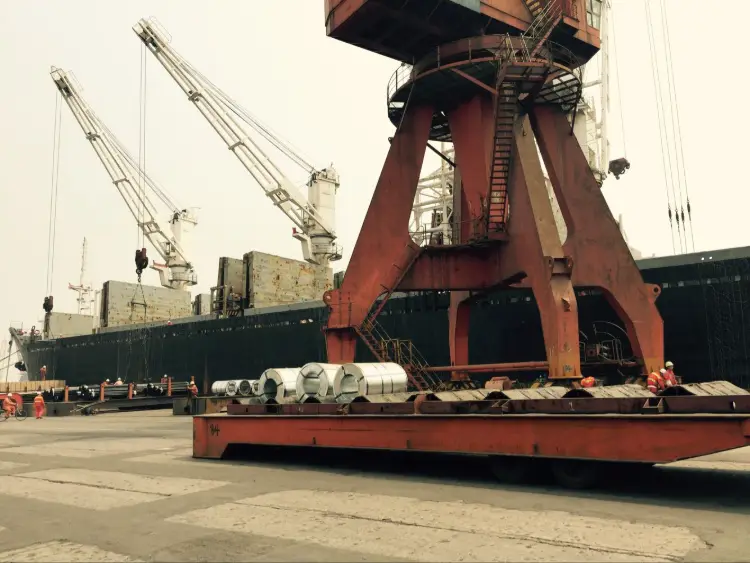
ABS Grade DQ51 Shipbuilding Steel Coil
ABS Grade DQ51 Shipbuilding Steel Coil - Quenched & Tempered High-Strength Marine-Grade Alloy
Comprehensive technical data for ABS Grade DQ51 shipbuilding steel coil: chemical composition, mechanical properties, physical characteristics, international equivalents, and application guidance.
Hot-rolling followed by quenching and tempering; suitable for cold forming, welding, cutting, and machining.
- Phone : +8618037372205
- Email : [email protected]
- WhatsApp: Contact via Whtsapp
- WeChat: +8618037372205
ABS Grade DQ51 Shipbuilding Steel Coil Introduction
ABS Grade DQ51 is a quenched and tempered high-strength structural steel designed for shipbuilding and offshore applications, complying with the American Bureau of Shipping (ABS) Rules for Materials and Welding. The 'D' designation indicates a minimum Charpy V-notch impact test temperature of -20°C, ensuring excellent toughness under moderate-low temperature service conditions. The 'Q' denotes quenched and tempered delivery condition, while '51' corresponds to a minimum yield strength of 500 MPa (51 kgf/mm²) for thicknesses up to 40 mm. This grade offers a balanced combination of high strength, good weldability, and reliable notch toughness, making it suitable for critical structural components in hulls, offshore platforms, and marine equipment. It is typically supplied in coil form, with surface quality and dimensional tolerances conforming to ABS and IACS UR W11 standards.
ABS Grade DQ51 Shipbuilding Steel Coil Chemical Composition
The chemical composition of ABS Grade DQ51 is controlled to achieve high strength after quenching and tempering while maintaining weldability and toughness. Maximum limits apply to elements like carbon, phosphorus, and sulfur to avoid brittleness and ensure homogeneity. Elements such as niobium, vanadium, and titanium are grain refiners. Carbon equivalent (Ceq) is typically limited to ≤ 0.46% for thickness ≤ 50 mm to guarantee good weldability without preheating.
| Chemical Element | Standard Value (max unless range/min given) | Remarks |
|---|---|---|
| Carbon (C) | 0.20 | Max for all thicknesses |
| Silicon (Si) | 0.10 – 0.55 | Killing element; ensures deoxidation |
| Manganese (Mn) | 0.90 – 1.60 | Strength and toughness balance |
| Phosphorus (P) | 0.025 | Max – low P for improved toughness |
| Sulfur (S) | 0.025 | Max – low S for cleanliness and formability |
| Aluminium (Al), acid soluble | ≥ 0.015 | Min for fine grain practice |
| Niobium (Nb) | 0.05 | Max – grain refinement |
| Vanadium (V) | 0.10 | Max – precipitation strengthening |
| Titanium (Ti) | 0.02 | Max – grain refinement |
| Copper (Cu) | 0.50 | Max – optional corrosion resistance |
| Chromium (Cr) | 0.35 | Max – optional alloying |
| Nickel (Ni) | 0.80 | Max – optional toughness enhancement |
| Molybdenum (Mo) | 0.50 | Max – optional hardenability |
| Nitrogen (N) | 0.009 | Max if intentionally added |
| Carbon Equivalent (Ceq) | 0.46 | Max (ladle, for t ≤ 50 mm), formula: C + Mn/6 + (Cr+Mo+V)/5 + (Ni+Cu)/15 |
ABS Grade DQ51 Shipbuilding Steel Coil Thermal and Electrical Physical Properties
These physical properties are representative of quenched and tempered low-alloy steels of the DQ51 class. Slight variations may occur depending on exact chemical composition and heat treatment. Values are provided at room temperature unless otherwise noted.
| Property | Standard Requirement / Typical Value | Unit | Test Condition / Remarks |
|---|---|---|---|
| Density (ρ) | 7850 | kg/m³ | 20°C, typical for steel |
| Elastic Modulus (E) | 210 | GPa | Room temperature, tension |
| Shear Modulus (G) | 81 | GPa | Room temperature |
| Poisson's Ratio (ν) | 0.3 | – | Elastic range |
| Thermal Expansion Coefficient (α) | 12.0 | 10⁻⁶ / K | 20 – 100°C |
| Thermal Conductivity (λ) | 50 | W/(m·K) | 20°C, typical annealed low-alloy steel |
| Specific Heat Capacity | 450 | J/(kg·K) | 20 – 100°C |
| Electrical Resistivity (ρ_e) | 0.22 | μΩ·m | 20°C, typical carbon-manganese steel |
ABS Grade DQ51 Shipbuilding Steel Coil Mechanical Properties
Mechanical properties are determined on quenched and tempered specimens in accordance with ABS requirements. The yield strength and tensile strength vary with product thickness, as does the minimum elongation. Impact testing is performed on Charpy V-notch specimens taken in the longitudinal direction at -20°C. Minimum average absorbed energy values are given for different thickness ranges; single values must not fall below 70% of the specified average.
| Property | Standard Requirement | Unit | Test Condition / Thickness Range |
|---|---|---|---|
| Yield Strength (ReH) | 500 min | MPa | t ≤ 40 mm |
| Yield Strength (ReH) | 490 min | MPa | 40 < t ≤ 50 mm |
| Yield Strength (ReH) | 470 min | MPa | 50 < t ≤ 100 mm |
| Yield Strength (ReH) | 460 min | MPa | 100 < t ≤ 150 mm |
| Tensile Strength (Rm) | 610 – 770 | MPa | t ≤ 100 mm |
| Tensile Strength (Rm) | 570 – 720 | MPa | 100 < t ≤ 150 mm |
| Elongation after Fracture (A50 mm) | 16 min | % | t ≤ 40 mm |
| Elongation after Fracture (A50 mm) | 15 min | % | 40 < t ≤ 100 mm |
| Charpy Impact Energy (KV2, longitudinal) | 50 min average (34 min single) | J | -20°C, t ≤ 50 mm |
| Charpy Impact Energy (KV2, longitudinal) | 59 min average | J | -20°C, 50 < t ≤ 70 mm |
| Charpy Impact Energy (KV2, longitudinal) | 68 min average | J | -20°C, 70 < t ≤ 100 mm |
ABS Grade DQ51 Shipbuilding Steel Coil Fully Equivalent Material Standards and Substitutable Grades
| Country/Region | Standard | Grade | Remarks |
|---|---|---|---|
| International (IACS) | UR W11 | DQ51 | Base specification identically adopted by all IACS members |
| USA | ABS Rules Part 2 Chapter 1 | DQ51 | Original classification society grade |
| Norway/Germany | DNV GL Rules | DQ51 | Identical chemical and mechanical requirements |
| United Kingdom | Lloyd's Register Rules | DQ51 | Identical grade definition |
| France | Bureau Veritas Rules | DQ51 | Fully interchangeable |
| China | CCS Rules | DQ51 | Same grade, Chinese classification society |
| Japan | NK Rules | KDQ51 | Nippon Kaiji Kyokai equivalent |
| Italy | RINA Rules | DQ51 | Registro Italiano Navale equivalent |
| Russia | RS Rules | DQ51 | Russian Maritime Register of Shipping |
ABS Grade DQ51 Shipbuilding Steel Coil Application Introduction
ABS DQ51 steel is engineered for demanding marine and offshore environments where high strength and reliable low-temperature toughness are critical. Its quenched and tempered condition offers excellent weldability when proper procedures are followed, making it ideal for large fabricated structures. The coil form enables efficient processing into longitudinally welded pipes, formed sections, and cut-to-length plates.
Product Applications: Ship hull plates and stiffeners, Deck plating for ice-class vessels, Jack-up rig legs and spudcans, Highly stressed structural members of crane booms, Piping systems for high-pressure marine service, Weldable connectors for offshore platforms
Processed into products: Longitudinal and transverse frames, Bulkheads and watertight doors, Reinforced shell plating for ice belts, Load-bearing nodes in tubular trusses, Foundation embedment rings for offshore wind turbines, Cleats and pad-eyes for mooring systems
Application industries: Shipbuilding (naval and commercial vessels), Offshore oil & gas platforms and FPSOs, Marine heavy lifting equipment (cranes, A-frames), Port and harbour infrastructure, Wind energy (offshore turbine foundations), Bridge engineering
ABS Grade DQ51 Shipbuilding Steel Coil Similar or Near-Equivalent Alternative Materials
| Country/Region | Standard | Grade | Remarks |
|---|---|---|---|
| Europe | EN 10025-6 | S500QL / S500QL1 | Quenched and tempered structural steel; minimum yield 500 MPa; impact at -40°C (QL) or -60°C (QL1); not identical but similar strength and toughness. May require additional certification for marine use. |
| International | ISO 4950-2 | S500Q | High yield strength flat steel products; comparable yield and tensile range; impact temperature may differ; suitable for structural applications but not ship-specific. |
| USA | ASTM A514 / A517 | Grade H, etc. | Quenched and tempered alloy steels with minimum yield 690 MPa; higher strength than DQ51; may be used where higher strength is needed, but different chemistry and welding requirements. |
Notes:
- For thicknesses above 40 mm, a reduction in yield strength is accepted; design codes typically use the lower values accordingly.
- When higher toughness at lower temperatures is required, EQ51 or FQ51 grades should be considered (impact at -40°C and -60°C respectively).
- Welding consumables must be matched to the steel grade, and preheat/interpass temperatures should be controlled based on thickness and carbon equivalent.
- Surface conditions and dimensional tolerances follow ABS Rule 2-1-1/3.5 or as agreed between the purchaser and manufacturer.
- The material is also available in 'TM' (thermo-mechanical controlled rolled) condition for certain thickness ranges, but for DQ51, only the quenched and tempered variant is defined.
- Share



