
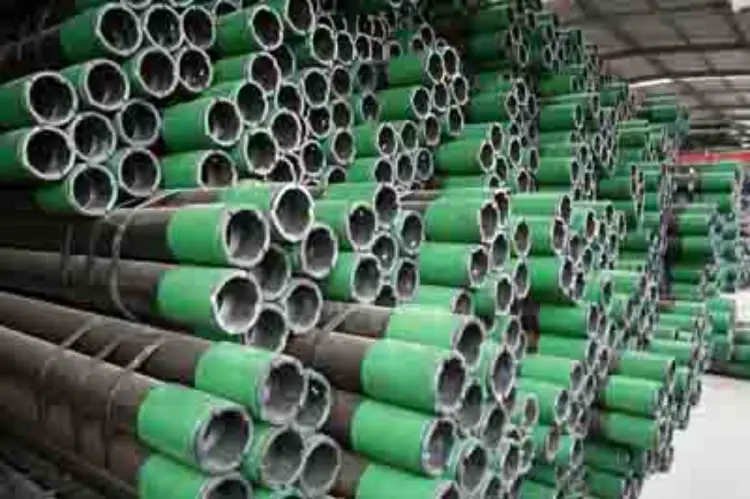
GB/T 1591 Q420D Steel LSAW Pipe
Q420D Steel for LSAW Pipe: High-Strength, Toughness & Weldability per GB/T 1591
Detailed material analysis of Q420D steel used in longitudinal submerged arc welded (LSAW) pipes, covering chemical composition, mechanical and physical properties, international equivalents, and applications.
Hot rolling, controlled rolling, normalising, TMCP, welding (SAW, SMAW, GMAW)
- Phone : +8618037372205
- Email : [email protected]
- WhatsApp: Contact via Whtsapp
- WeChat: +8618037372205
GB/T 1591 Q420D Steel LSAW Pipe Introduction
Q420D is a high-strength low-alloy (HSLA) structural steel defined in Chinese standard GB/T 1591-2018. It offers a minimum yield strength of 420 MPa and excellent toughness at temperatures down to -20°C, making it suitable for demanding welded structures such as LSAW pipes. The steel is microalloyed with elements like niobium, vanadium, and titanium to achieve fine grain strengthening and precipitation hardening, ensuring a good balance between strength, ductility, and weldability.
- Good low‑temperature impact toughness (≥34 J at -20°C)
- Excellent formability and weldability for thick‑walled pipe production
- High resistance to brittle fracture in critical structural applications
GB/T 1591 Q420D Steel LSAW Pipe Chemical Composition
The chemical composition of Q420D steel is governed by GB/T 1591-2018. The maximum limits ensure good weldability and low‑temperature toughness while the microalloying elements (Nb, V, Ti) provide the required strength. All values are ladle analysis unless otherwise stated.
| Element | Standard Value (max, % unless range given) | Remarks |
|---|---|---|
| C | ≤0.20 | Carbon, key hardenability element |
| Si | ≤0.55 | Silicon, deoxidiser and strength contributor |
| Mn | ≤1.70 | Manganese, improves strength and toughness |
| P | ≤0.025 | Phosphorus, kept low for toughness |
| S | ≤0.015 | Sulphur, kept low for ductility and weldability |
| Nb | ≤0.07 | Niobium, grain refinement and precipitation strengthening |
| V | ≤0.20 | Vanadium, precipitation hardening |
| Ti | ≤0.20 | Titanium, grain refinement and nitrogen fixation |
| Cr | ≤0.30 | Chromium, optional for hardenability |
| Ni | ≤0.80 | Nickel, improves low‑temperature toughness |
| Cu | ≤0.30 | Copper, optional for corrosion resistance |
| Mo | ≤0.30 | Molybdenum, optional for high temperature strength |
| N | ≤0.015 | Nitrogen, limited to avoid ageing effects |
| Als | ≥0.015 | Acid‑soluble aluminium, for deoxidation and grain refinement |
GB/T 1591 Q420D Steel LSAW Pipe Thermal and Electrical Physical Properties
Thermal and electrical properties are typical for a low‑alloy structural steel. Exact values can vary slightly with temperature and specific composition, but the data below provides a reliable basis for engineering calculations.
| Property | Typical Value | Unit | Test Condition / Remarks |
|---|---|---|---|
| Density (ρ) | 7.85 | g/cm³ | at room temperature |
| Modulus of elasticity (E) | 206 | GPa | at 20°C |
| Shear modulus (G) | 79.3 | GPa | at 20°C |
| Poisson's ratio (ν) | 0.30 | – | elastic range |
| Thermal expansion coefficient (α) | 12.0 | 10⁻⁶/K | 20–100°C |
| Thermal conductivity (λ) | 50 | W/(m·K) | at 20°C |
| Specific heat capacity (cp) | 480 | J/(kg·K) | at 20°C |
| Electrical resistivity (ρₑ) | 0.20 | μΩ·m | at 20°C |
GB/T 1591 Q420D Steel LSAW Pipe Mechanical Properties
Mechanical properties of Q420D are defined in GB/T 1591-2018 and vary with thickness. The table below shows the minimum requirements for transverse test pieces. For LSAW pipes, properties of the base metal are typically verified, while the weld seam properties are governed by the pipe manufacturing specification.
| Property | Standard Value | Unit | Test Condition / Thickness |
|---|---|---|---|
| Yield Strength (ReH) | ≥420 | MPa | t ≤ 16 mm |
| Yield Strength (ReH) | ≥400 | MPa | 16 < t ≤ 40 mm |
| Yield Strength (ReH) | ≥380 | MPa | 40 < t ≤ 63 mm |
| Tensile Strength (Rm) | 520 – 680 | MPa | t ≤ 100 mm |
| Elongation after fracture (A) | ≥19 | % | t ≤ 16 mm, gauge length 5.65√So |
| Elongation after fracture (A) | ≥18 | % | 16 < t ≤ 40 mm |
| Elongation after fracture (A) | ≥17 | % | 40 < t ≤ 63 mm |
| Impact energy (KV2) | ≥34 | J | -20°C, longitudinal, standard specimen |
| Bend test (180°) | d = 3a | - | t ≤ 16 mm, a = specimen thickness |
GB/T 1591 Q420D Steel LSAW Pipe Fully Equivalent Material Standards and Substitute Grades
| Country/Region | Standard | Grade | Remarks |
|---|---|---|---|
| China | GB/T 1591-2018 | Q420D | Original grade; -20°C impact, TMCP/ normalised |
| Europe | EN 10025-4 | S420ML | Thermomechanically rolled, -50°C impact (longitudinal ≥27 J); close strength match but different temperature designation |
| Europe | EN 10025-3 | S420NL | Normalised, -50°C impact; requires normalising heat treatment |
| International (ISO) | ISO 4950-2 | E420DD | High yield strength flat products; -20°C delivery condition, comparable to Q420D |
GB/T 1591 Q420D Steel LSAW Pipe Application Introduction
Q420D steel, especially in the form of LSAW pipes, is widely employed where high strength, good weldability, and reliable low‑temperature toughness are essential. Typical industries and products include:
Product Applications: Longitudinal Submerged Arc Welded (LSAW) pipes and tubes, Spiral submerged arc welded pipes (SSAW), Hot‑rolled structural plates and coils, Welded H‑beams and box columns, Pressure vessel shells and heads, Piling pipes for foundation works
Processed into products: LSAW pipe sections for oil and gas trunk lines, Offshore platform legs and brace members, Crane booms and heavy‑duty structural frames, Bridge diaphragms and stiffening ribs, Penstocks and hydropower spiral casings, Pressure vessel cylindrical shells (up to 63 mm wall thickness)
Application industries: Oil & gas transmission (long‑distance pipelines), Offshore and marine engineering (platform legs, jackets), Pressure vessel and boiler fabrication, Bridge construction (box girders, arches), Heavy machinery and cranes, Building and civil infrastructure (high‑rise columns, stadiums)
GB/T 1591 Q420D Steel LSAW Pipe Similar / Alternative Materials
| Country/Region | Standard | Grade | Remarks |
|---|---|---|---|
| China | GB/T 1591-2018 | Q460D | Higher yield strength (≥460 MPa) with similar toughness; suitable for weight‑sensitive designs |
| USA | ASTM A572/A572M | Grade 60 [415] | Yield strength ~415 MPa, slightly lower than Q420D; no specific impact temperature requirement |
| USA | ASTM A573/A573M | Grade 70 | Improved toughness but lower strength; for structural applications at low temperature |
| Europe | EN 10025-4 | S460ML | Higher strength with excellent toughness; often considered an upgrade from Q420D |
Notes:
For LSAW pipe production, the Q420D base metal is typically supplied in TMCP or normalised condition. Welding procedures must be qualified according to the applicable pipeline code (e.g., API 5L, DNVGL‑ST‑F101) to ensure the heat‑affected zone retains the required toughness. Supplementary requirements such as ultrasonic testing, through‑thickness properties (Z‑quality), or specific hardness limits may be specified in the purchase order.
- Share



