
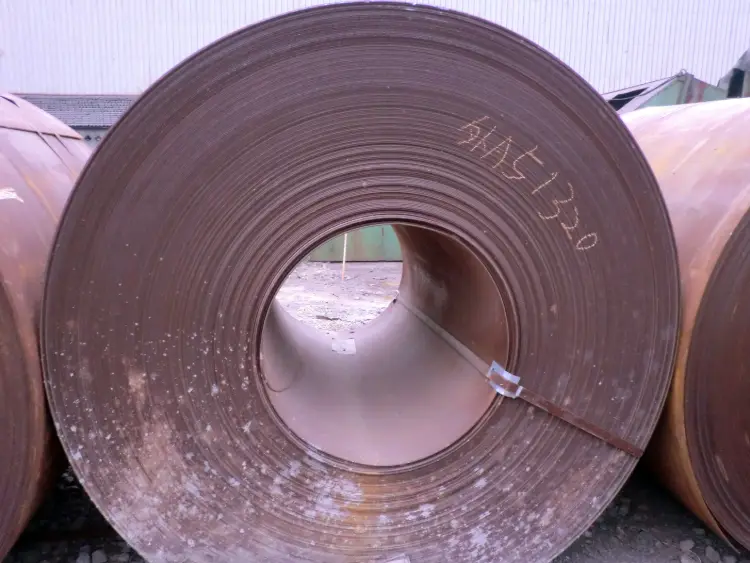
ABS Grade FQ51 Quenched & Tempered Shipbuilding Steel Coil
ABS Grade FQ51 Quenched & Tempered Shipbuilding Steel Coil - High Strength & Low-Temperature Toughness
ABS Grade FQ51 is a high-strength quenched and tempered shipbuilding steel with minimum yield strength of 500 MPa, excellent toughness at -60°C, and fine grain structure. Ideal for critical hull and offshore structural applications.
Basic oxygen/electric arc furnace steelmaking, controlled rolling, quenching and tempering (Q&T)
- Phone : +8618037372205
- Email : [email protected]
- WhatsApp: Contact via Whtsapp
- WeChat: +8618037372205
ABS Grade FQ51 Quenched & Tempered Shipbuilding Steel Coil Introduction
ABS Grade FQ51 is a high-strength quenched and tempered (Q&T) fine-grain shipbuilding steel specified by the American Bureau of Shipping (ABS). It belongs to the special series of Q&T hull structural steels, offering a minimum yield strength of 500 MPa (51 kgf/mm²) and outstanding low-temperature toughness, with Charpy impact test requirements at -60°C. The 'F' designation signifies fine-grain practice and exceptional notch toughness suitability for the most demanding Arctic or low-temperature service conditions.
Key features:
- High strength-to-weight ratio for weight-critical designs
- Excellent weldability under controlled procedures
- Superior resistance to brittle fracture in cold climates
- Typical delivery as coil in quenched and tempered condition
This grade is widely used in the construction of ship hulls, offshore platforms, and other marine structures requiring high structural integrity and safety.
ABS Grade FQ51 Quenched & Tempered Shipbuilding Steel Coil Chemical Composition
The chemical composition is strictly controlled to ensure high strength, good weldability, and low-temperature toughness. The steel is fully killed and fine-grained, with aluminum as the main grain-refining element. Microalloying elements such as Nb, V, Ti are added singly or in combination to achieve the required mechanical properties. The carbon equivalent (CEV) is limited to guarantee weldability.
| Element | Typical Requirement (max unless otherwise stated) | Remarks |
|---|---|---|
| Carbon (C) | ≤ 0.16 | Ladle analysis |
| Manganese (Mn) | 0.70 – 1.60 | Ladle analysis |
| Silicon (Si) | 0.10 – 0.50 | Ladle analysis |
| Phosphorus (P) | ≤ 0.025 | Ladle analysis |
| Sulfur (S) | ≤ 0.025 | Ladle analysis |
| Aluminum (Al) | ≥ 0.015 (acid soluble) | Grain refinement |
| Niobium (Nb) | ≤ 0.05 | Microalloying |
| Vanadium (V) | ≤ 0.10 | Microalloying |
| Titanium (Ti) | ≤ 0.02 | Microalloying |
| Copper (Cu) | ≤ 0.35 | Residual element |
| Nickel (Ni) | ≤ 0.80 | Residual element |
| Chromium (Cr) | ≤ 0.25 | Residual element |
| Molybdenum (Mo) | ≤ 0.08 | Residual element |
| Nitrogen (N) | ≤ 0.009 | Ladle analysis |
| Carbon Equivalent (CEV) | ≤ 0.43 | CEV = C+Mn/6+(Cr+Mo+V)/5+(Ni+Cu)/15 |
ABS Grade FQ51 Quenched & Tempered Shipbuilding Steel Coil Thermal and Electrical Physical Properties
The following thermal and electrical properties are typical for low-alloy quenched and tempered steels of this strength level. These values are not specified by ABS but are provided for design reference. They can vary slightly with exact chemical composition and heat treatment condition.
| Property | Typical Value | Unit | Test Condition / Reference |
|---|---|---|---|
| Density (ρ) | 7.85 | g/cm³ | At 20°C |
| Elastic Modulus (E) | 207 | GPa | At 20°C |
| Shear Modulus (G) | 80 | GPa | At 20°C |
| Poisson's Ratio (ν) | 0.3 | – | At 20°C |
| Thermal Expansion Coefficient (α) | 11.7 × 10⁻⁶ | K⁻¹ | 20–100°C |
| Thermal Conductivity (λ) | 51 | W/(m·K) | At 100°C |
| Specific Heat Capacity (c) | 460 | J/(kg·K) | At 20°C |
| Electrical Resistivity (ρ_e) | 0.17 × 10⁻⁶ | Ω·m | At 20°C |
ABS Grade FQ51 Quenched & Tempered Shipbuilding Steel Coil Mechanical Properties
Mechanical properties are verified by tensile, impact, and bend tests in accordance with ABS Rules. The values below apply to the quenched and tempered delivery condition for thickness ranges commonly supplied as coil. Actual values may exceed the minimums. Testing orientation is typically transverse for impact toughness.
| Property | Standard Requirement | Unit | Test Condition / Thickness Range |
|---|---|---|---|
| Yield Strength (ReH) | ≥ 500 | MPa | t ≤ 50 mm |
| Tensile Strength (Rm) | 610 – 770 | MPa | t ≤ 50 mm |
| Elongation (A5, longitudinal) | ≥ 16 | % | Gauge length 5.65√S0, t ≤ 50 mm |
| Impact Energy (KV, transverse) | ≥ 34 (average of 3) | J | Charpy V-notch, -60°C, t ≤ 50 mm |
| Impact Energy (KV, transverse) | ≥ 24 (individual minimum) | J | Charpy V-notch, -60°C, t ≤ 50 mm |
| Bend Test (180°) | No cracks | – | Mandrel dia. = 3 × t (t ≤ 25 mm) |
| Bend Test (180°) | No cracks | – | Mandrel dia. = 4 × t (25 < t ≤ 50 mm) |
ABS Grade FQ51 Quenched & Tempered Shipbuilding Steel Coil Fully Equivalent Material Standards and Replaceable Designations
| Country/Region | Standard/Governing Body | Designation | Remarks |
|---|---|---|---|
| United Kingdom | Lloyd's Register (LR) | LR Grade FQ51 | Same Q&T requirements, yield 500 MPa, -60°C impact |
| Norway/Germany | DNV (now DNV GL) | NV F500 | Designation based on yield strength in MPa |
| France | Bureau Veritas (BV) | BV Grade FQ51 | Identical designation and properties |
| China | China Classification Society (CCS) | CCS FQ51 | Harmonized with ABS requirements |
| South Korea | Korean Register (KR) | KR FQ51 | Same chemical and mechanical limits |
| Japan | Nippon Kaiji Kyokai (ClassNK) | NK FQ51 | Equivalent to ABS FQ51 |
| Italy | Registro Italiano Navale (RINA) | RINA FQ51 | Matching specification |
ABS Grade FQ51 Quenched & Tempered Shipbuilding Steel Coil Application Introduction
ABS Grade FQ51 is selected for the most severe structural applications where high strength, low weight, and guaranteed impact resistance at sub-zero temperatures are concurrent requirements. Thicknesses up to 50 mm are commonly supplied as hot-rolled coil and then flattened into plates. Components are joined using low-hydrogen welding processes with preheat and interpass temperature control to preserve the Q&T microstructure.
Product Applications: Hull shell plates, Deck plates and stringers, Bottom and side longitudinal stiffeners, Bulkhead panels, Hatch coamings and covers, Offshore topside structural modules, Jack-up rig leg components
Processed into products: Frames and web frames, Stiffeners (flat bar, bulb profiles, angles), Girders and transverses, Crane pedestals and booms, Transition joints and high-stress brackets, Heavy-lift pad eyes and lifting lugs, Ice belt plating
Application industries: Shipbuilding (naval and commercial), Offshore oil & gas (platforms, modules, living quarters), Marine engineering (docks, breakwaters, caissons), Heavy lifting and transport equipment (crane structures, straddle carriers), Arctic engineering (icebreakers, ice-resistant structures)
ABS Grade FQ51 Quenched & Tempered Shipbuilding Steel Coil Similar or Alternative Materials
| Country/Region | Standard | Designation | Remarks |
|---|---|---|---|
| International | ABS | AH36 / DH36 / EH36 / FH36 | Lower yield strength (min 355 MPa), no Q&T required; suitable for less demanding applications |
| International | ABS | FH40 | Yield 390 MPa, normalizing or TMCP, good toughness down to -60°C |
| International | ABS | FQ43 | Q&T steel with yield min 430 MPa; intermediate strength alternative |
| International | ABS | FQ56 | Q&T steel with yield min 550 MPa; higher strength grade with similar toughness |
Notes:
Delivery condition: Quenched and tempered; the steel is supplied with a test certificate attesting to compliance with ABS Rules.
Weldability: The CEV limit of ≤ 0.43 ensures good weldability with low-hydrogen consumables and appropriate heat input control. Post-weld heat treatment is generally not required.
Supplementary requirements: May include ultrasonic testing, through-thickness (Z-direction) properties, or PWHT simulation tests as per project specification.
Dimensional tolerances: Conform to ABS/EN 10029 or ASTM A6 for plates; coil tolerances by agreement.
- Share



