
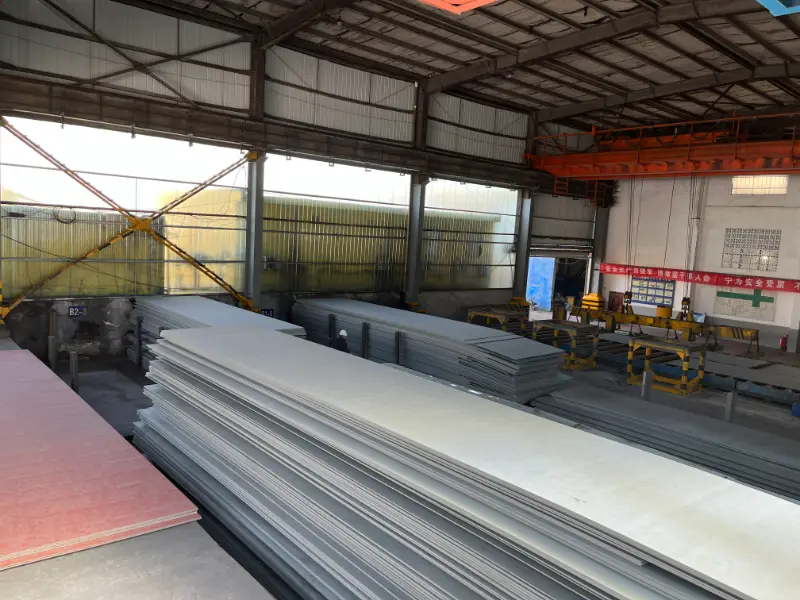
GB/T 1591 Q420E Structural Steel
Q420E Low-Alloy High-Strength Structural Steel for LSAW Pipes (GB/T 1591)
Comprehensive material data for Q420E steel according to GB/T 1591, including chemical composition, mechanical properties, thermal and electrical physical properties, international equivalents, and application guidance for LSAW pipes.
Hot rolling, controlled rolling, normalizing, TMCP; welding (SAW, GMAW, SMAW), cold forming, machining
- Phone : +8618037372205
- Email : [email protected]
- WhatsApp: Contact via Whtsapp
- WeChat: +8618037372205
GB/T 1591 Q420E Structural Steel Introduction
Q420E is a low-alloy high-strength structural steel specified in GB/T 1591, with a minimum yield strength of 420 MPa for thicknesses ≤16 mm. It belongs to quality grade E, requiring guaranteed impact toughness at -40°C. This steel exhibits excellent weldability, good cold formability, and high toughness at low temperatures, making it suitable for heavy structures and welded pipes such as LSAW (Longitudinal Submerged Arc Welded) pipes. It is typically delivered in hot-rolled, controlled-rolled, or normalized condition. The fine-grain microstructure is achieved through microalloying elements like Nb, V, Ti, and Al. Q420E is widely used in bridges, buildings, offshore platforms, pressure vessels, and line pipes for oil and gas transportation.
GB/T 1591 Q420E Structural Steel Chemical Composition
Typical chemical composition of Q420E according to GB/T 1591-2018. The steel is microalloyed with Nb, V, Ti, and Al for grain refinement and precipitation hardening. Phosphorus and sulfur are strictly controlled to ensure low-temperature toughness. Equivalent carbon content (CEV) is typically ≤0.47% for good weldability.
| Chemical Element | Standard Value (%) | Remarks |
|---|---|---|
| C | ≤0.20 | Maximum carbon content |
| Si | ≤0.60 | Maximum silicon content |
| Mn | ≤1.70 | Maximum manganese content |
| P | ≤0.025 | Maximum phosphorus content |
| S | ≤0.015 | Maximum sulfur content, low for grade E |
| Nb | ≤0.07 | Niobium for grain refinement |
| V | ≤0.20 | Vanadium for precipitation strengthening |
| Ti | ≤0.20 | Titanium for grain refinement |
| Cr | ≤0.30 | Maximum chromium content |
| Ni | ≤0.80 | Maximum nickel content |
| Cu | ≤0.40 | Maximum copper content |
| Mo | ≤0.20 | Maximum molybdenum content |
| N | ≤0.015 | Maximum nitrogen content |
| Al (total) | ≥0.015 | Minimum total aluminum, for deoxidation/grain size control |
GB/T 1591 Q420E Structural Steel Thermal and Electrical Physical Properties
Physical properties are typical values for hot-rolled Q420E steel, based on low-alloy structural steels with similar composition. These values may vary slightly depending on actual production and heat treatment condition. They are applicable at room temperature unless stated otherwise.
| Property | Standard Requirement Value | Unit | Test Condition |
|---|---|---|---|
| Density (ρ) | 7.85 | g/cm³ | 20°C |
| Modulus of Elasticity (E) | 206 | GPa | 20°C, typical for steel |
| Shear Modulus (G) | 79.3 | GPa | 20°C, calculated from E and ν |
| Poisson's Ratio (ν) | 0.3 | — | 20°C, typical |
| Thermal Expansion Coefficient (α) | 12.2 | 10⁻⁶/K | 20–100°C |
| Thermal Conductivity (λ) | 48 | W/(m·K) | 20°C |
| Specific Heat Capacity | 480 | J/(kg·K) | 20°C |
| Electrical Resistivity (ρ_e) | 0.16 | µΩ·m | 20°C |
GB/T 1591 Q420E Structural Steel Mechanical Properties
Mechanical properties of Q420E are dependent on product thickness and test direction (transverse or longitudinal). Values below are minimum requirements as per GB/T 1591-2018 for plates and strips, which also represent the base material properties for LSAW pipes. Impact test temperature is -40°C, with a minimum absorbed energy of 34 J for longitudinal specimens.
| Property | Standard Requirement Value | Unit | Test Condition / Thickness Range |
|---|---|---|---|
| Yield Strength (ReH) | ≥420 | MPa | Thickness ≤16 mm |
| Yield Strength (ReH) | ≥400 | MPa | Thickness >16~35 mm |
| Yield Strength (ReH) | ≥380 | MPa | Thickness >35~50 mm |
| Yield Strength (ReH) | ≥360 | MPa | Thickness >50~100 mm |
| Yield Strength (ReH) | ≥340 | MPa | Thickness >100~150 mm |
| Tensile Strength (Rm) | 520 to 680 | MPa | All thicknesses |
| Elongation after fracture (A) | ≥19 | % | Thickness ≤40 mm, longitudinal |
| Elongation after fracture (A) | ≥18 | % | Thickness >40~63 mm, longitudinal |
| Elongation after fracture (A) | ≥17 | % | Thickness >63~100 mm, longitudinal |
| Impact Energy (KV2) | ≥34 | J | -40°C, longitudinal, standard specimen |
| Bend Test (Mandrel diameter) | d = 2a | - | Thickness ≤16 mm, 180° bending |
| Bend Test (Mandrel diameter) | d = 3a | - | Thickness >16~100 mm, 180° bending |
GB/T 1591 Q420E Structural Steel Equivalent Material Standards and Substitutable Grades
| Country/Region | Standard | Grade | Remarks |
|---|---|---|---|
| Europe | EN 10025-4 | S420ML | Thermomechanical rolled, similar -50°C impact, CE limited. Close match to Q420E. |
| International | ISO 4951-2 | E420E | High yield strength steel, approx. match for grade E ( -40°C). |
| USA | ASTM A572/A709 | Grade 60/A709 Gr.60 | Not exact; A572 has lower toughness requirements; may require supplementary tests. |
| Japan | JIS G3106 | SM570 | Comparable strength level, but impact test at -5°C typically; specify low temp for match. |
GB/T 1591 Q420E Structural Steel Application Introduction
Q420E steel is particularly suited for heavy steel structures and line pipes that require high strength, excellent weldability, and guaranteed low-temperature toughness. It is commonly used in the form of LSAW pipes for transporting oil, gas, and water under high pressure. The steel can be fabricated into various engineering components through welding, bending, and machining.
Product Applications: Longitudinal Submerged Arc Welded (LSAW) pipes, Structural steel columns and beams, Bridge girders and truss members, Offshore platform jackets and decks, Pressure vessel shells, Piling pipes and monopiles
Processed into products: LSAW line pipe segments (straight sections), Pipe fittings (elbows, tees, reducers) from hot-formed plates, Box girder webs and flanges, Welded built-up sections for heavy columns, Node cans for jacket structures, Transition pieces in monopile foundations
Application industries: Oil & Gas (pipeline, storage tanks, offshore platforms), Civil Engineering (bridges, stadiums, high-rise buildings), Shipbuilding (hull structures, deck plates), Heavy Machinery (crane booms, excavator frames), Power Generation (penstocks, pressure vessels), Mining (structural supports, dragline buckets)
GB/T 1591 Q420E Structural Steel Similar and Closely Related Material Recommendations
| Country/Region | Standard | Grade | Remarks |
|---|---|---|---|
| China | GB/T 1591 | Q460E | Higher strength grade, same toughness class; suitable for heavier sections. |
| China | GB/T 1591 | Q390E | Lower strength grade, same low-temperature toughness; may be interchangeable for lighter loads. |
| Europe | EN 10025-4 | S460ML | Higher yield strength, similar impact requirements; suitable as upgrade material. |
| Europe | EN 10025-3 | S420N/NL | Normalized condition, similar strength; NL has -50°C impact, slightly better toughness. |
| USA | ASTM A913 | Grade 60 (420) | High-strength low-alloy structural steel, similar strength; typically used for shapes, not plates. |
| International | ISO 4951-2 | E460E | Higher strength, similar quality level for arctic applications. |
Notes:
- For LSAW pipe application, additional standards like GB/T 9711 (Petroleum and natural gas industries—Steel pipe for pipelines) or API Spec 5L may apply, requiring pipe-specific tests (e.g., hydrostatic test, weld toughness).
- Weldability: Preheating (≥50°C) and interpass temperature control recommended for thick sections. Low hydrogen welding processes preferred.
- Corrosion resistance: Q420E is not intended for severely corrosive environments; coatings or cathodic protection are needed for buried/submerged pipelines.
- Dimensional tolerances for plates should conform to GB/T 709, and for LSAW pipes to applicable pipe standards.
- Share



