
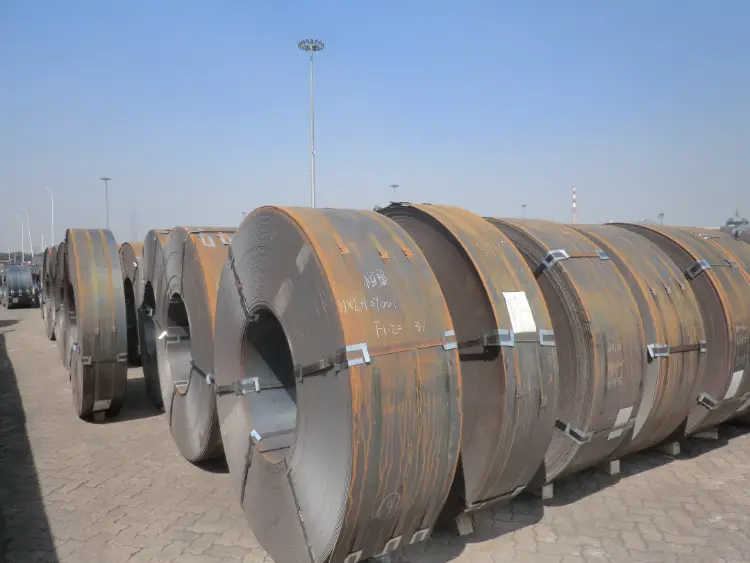
ABS Grade AQ56 Shipbuilding Steel Coil
ABS Grade AQ56 Shipbuilding Steel Coil | High-Strength Quenched & Tempered Plate for Offshore
Comprehensive material data for ABS Grade AQ56 shipbuilding steel coil: chemical composition, mechanical properties, thermal & electrical physical properties, international equivalents, similar grades, and application guidance for marine and offshore structures.
Hot rolling, Quenching and Tempering (Q&T), normalizing rolling upon request
- Phone : +8618037372205
- Email : [email protected]
- WhatsApp: Contact via Whtsapp
- WeChat: +8618037372205
ABS Grade AQ56 Shipbuilding Steel Coil Introduction
ABS Grade AQ56 is a high-strength quenched and tempered (Q&T) structural steel for shipbuilding and offshore applications, certified by the American Bureau of Shipping (ABS). It belongs to the family of extra-high-strength steels with a minimum yield strength of 420 MPa and excellent toughness at low temperatures. The designation 'A' indicates a Charpy impact test temperature of 0 °C, and 'Q' denotes the quenched and tempered delivery condition. The steel is produced as coil, plate, or sections, and is principally used in primary hull structures, decks, and structural members of offshore platforms, icebreakers, and naval vessels where high strength, weldability, and resistance to brittle fracture are critical. It offers good forming and welding characteristics while meeting strict ABS Rules for Materials and Welding (Part 2).
ABS Grade AQ56 Shipbuilding Steel Coil Chemical Composition
Chemical composition limits as per ABS Rules for Materials and Welding, Part 2, Chapter 3, Section 1, Table 1A for Grade AQ56. Micro-alloying elements such as Nb, V, Ti, and Al are added for grain refinement and precipitation hardening. The carbon equivalent (CEV) shall be controlled to ensure good weldability, typically CEV max. 0.45% or as agreed.
| Element | Standard Value (max, unless range) | Remarks |
|---|---|---|
| Carbon (C) | 0.18 | Maximum |
| Silicon (Si) | 0.10 – 0.55 | Range |
| Manganese (Mn) | 0.90 – 1.60 | Range |
| Phosphorus (P) | 0.030 | Maximum |
| Sulfur (S) | 0.030 | Maximum |
| Chromium (Cr) | 0.25 | Maximum |
| Nickel (Ni) | 0.40 | Maximum |
| Molybdenum (Mo) | 0.08 | Maximum |
| Copper (Cu) | 0.35 | Maximum |
| Aluminium (Al) | 0.020 min (total) | Minimum total Al |
| Niobium (Nb) | 0.05 | Maximum |
| Vanadium (V) | 0.10 | Maximum |
| Titanium (Ti) | 0.02 | Maximum |
| Nitrogen (N) | 0.012 | Maximum, if Al is used as grain refiner |
ABS Grade AQ56 Shipbuilding Steel Coil Thermal & Electrical Physical Properties
Typical physical property values for high-strength low-alloy quenched and tempered steel similar to ABS AQ56. These values are representative for room temperature unless otherwise stated. Actual values may vary slightly depending on exact composition and heat treatment.
| Property | Typical Value | Unit | Test Condition / Remarks |
|---|---|---|---|
| Density (ρ) | 7850 | kg/m³ | 20 °C |
| Modulus of Elasticity (E) | 205 | GPa | 20 °C, tension |
| Shear Modulus (G) | 80 | GPa | 20 °C, estimated |
| Poisson's Ratio (ν) | 0.3 | — | 20 °C |
| Thermal Expansion (α) | 12.0 | 10⁻⁶/K | 20 – 100 °C |
| Thermal Conductivity (λ) | 40 | W/(m·K) | 20 °C |
| Specific Heat Capacity (cp) | 460 | J/(kg·K) | 20 °C |
| Electrical Resistivity (ρe) | 0.25 – 0.30 | μΩ·m | 20 °C |
ABS Grade AQ56 Shipbuilding Steel Coil Mechanical Properties
Mechanical properties for ABS Grade AQ56 steel coil/plate as per ABS requirements for quenched and tempered condition. Tensile testing is performed in the transverse direction unless longitudinal is specified. Charpy V-notch impact tests are conducted at 0 °C on longitudinal specimens. Values apply for thickness ≤ 50 mm; for greater thickness partial reduction may occur subject to agreement.
| Property | Standard Requirement | Unit | Test Condition |
|---|---|---|---|
| Yield Strength (ReH) | ≥ 420 | MPa | Transverse, thickness ≤ 50 mm, ambient |
| Tensile Strength (Rm) | 530 – 680 | MPa | Transverse, ambient |
| Elongation (A5) | ≥ 18 | % | Gauge length 5.65√S₀, transverse |
| Charpy Impact Energy (KV) | ≥ 34 (longitudinal) | J | 0 °C, standard 10x10 mm specimen |
| Charpy Impact Energy (KV) | ≥ 24 (transverse) | J | 0 °C, standard 10x10 mm specimen |
| Bend Test (diameter) | 3t (t = thickness) | — | 180° bend, no cracking |
ABS Grade AQ56 Shipbuilding Steel Coil Fully Equivalent Material Standards & Substitutable Grades
| Country/Region | Standard | Grade | Remarks |
|---|---|---|---|
| International | ABS Rules | AQ56 (EH420) | Base designation; AQ56 is identical to EH420 in properties |
| USA / International | ASTM A131/A131M | Grade EH420 | Identical mechanical requirements; additional chemistry limits may apply |
| Europe | EN 10225 | S420G2+QT, S420G3+QT | Offshore structural steel equivalent |
| Norway / International | DNV Rules | NV E420 | Identical mechanical and impact requirements |
| France / International | BV Rules | E420 | Identical mechanical and impact requirements |
| UK / International | LR Rules | E420 | Identical mechanical and impact requirements |
| China | CCS Rules | E420 | Identical mechanical and impact requirements |
ABS Grade AQ56 Shipbuilding Steel Coil Application Introduction
ABS Grade AQ56 is a premium structural steel specifically developed for high-load marine and offshore structures that demand a combination of high strength, excellent low-temperature toughness, and reliable weldability. Its quenched and tempered condition ensures a fine-grained microstructure that provides superior resistance to brittle fracture, making it suitable for critical components in harsh environments. The following lists outline typical application areas.
Product Applications: Outer shell and inner bottom plating of large container ships and bulk carriers, Strength decks and hatch coamings, Offshore jacket legs, braces, and piles, Deck and topside modules for offshore platforms, Ice-strengthened hull structures, Crane booms and heavy-duty winch bases, Submarine pressure hulls and diving support equipment
Processed into products: Web frames and girders in hull midship section, Transverse bulkheads and deck stringers, Offshore platform nodes and tubular joints, Rudder horns and propeller brackets, Mooring equipment foundations (winch pads, bollards), Helicopter deck beams and supporting structures, Crane pedestal rings and slewing bearings, Structural reinforcements in stress concentration areas
Application industries: Shipbuilding (commercial and naval), Offshore oil & gas (platforms, FPSOs, subsea equipment), Renewable energy (offshore wind turbine foundations, transition pieces), Marine engineering (crane pedestals, heavy lift equipment), Ice-class vessels and icebreakers, Port and harbor equipment, Pressure vessel and storage tanks (ammonia, LPG, LNG on ships)
ABS Grade AQ56 Shipbuilding Steel Coil Near/Similar Substitute Material Recommendations
| Country/Region | Standard | Grade | Remarks |
|---|---|---|---|
| International | ABS Rules | AQ47 (EH420) | Slightly lower yield strength (420 MPa also common); AQ47 nominal yield 410 MPa but often overlaps with AQ56. AQ51 is a direct predecessor. |
| International | ABS Rules | EQ56 (EH420) | Enhanced toughness at -40 °C; can replace AQ56 where lower temperature service is required. |
| International | ABS Rules | DH36, EH36 | Lower strength (yield 355 MPa) but similar weldability; suitable when less strength is acceptable. |
| Europe | EN 10025-6 | S690QL | Higher strength but may be used with redesign; careful weld procedure required. |
| International | API 2W | Grade 50 (345 MPa) with CVN | Lower strength; for structural offshore use but requires section increase. |
Notes:
- Dimensional tolerances and surface quality shall comply with ABS Rules or equivalent international standards.
- Ultrasonic testing (UT) in accordance with ASTM A578 / EN 10160 can be specified for critical applications.
- Through-thickness properties (Z-grade) such as Z25 or Z35 may be ordered for welded connections subject to lamellar tearing risk.
- Chemical composition and mechanical properties may require adjustment for thickness > 50 mm; always refer to the latest ABS Rules.
- Welding consumables should be chosen to match the strength and toughness of the base metal; low-hydrogen procedures are mandatory.
- Share



