
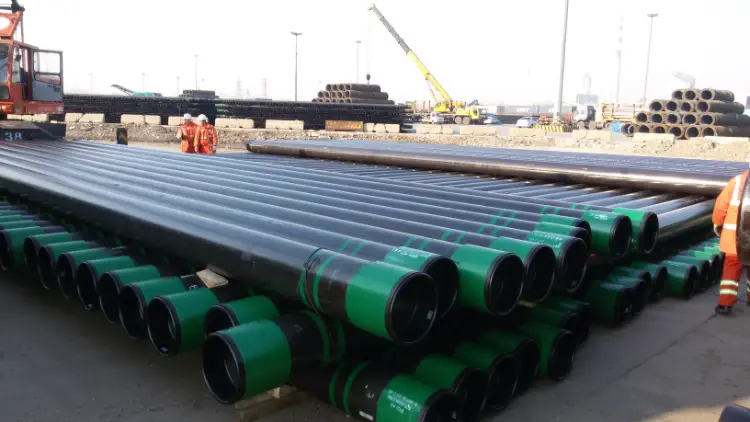
GB/T 1591 Q460C LSAW Steel Pipe
GB/T 1591 Q460C LSAW Steel Pipe: High-Strength Low-Alloy Structural Material
Detailed material data for Q460C steel used in longitudinal submerged arc welded (LSAW) pipes according to GB/T 1591, including chemical composition, mechanical and physical properties, and international equivalents.
Hot rolling, normalizing, TMCP, welding (LSAW, SAW, etc.)
- Phone : +8618037372205
- Email : [email protected]
- WhatsApp: Contact via Whtsapp
- WeChat: +8618037372205
GB/T 1591 Q460C LSAW Steel Pipe Introduction
Q460C is a Chinese standard high-strength low-alloy structural steel defined in GB/T 1591-2018. It is widely used in welded steel pipes, especially LSAW (Longitudinal Submerged Arc Welded) pipes for oil and gas transportation, pressure vessels, and structural applications. The material offers a minimum yield strength of 460 MPa, good weldability, and excellent low-temperature impact toughness at 0°C. Q460C is typically supplied in the hot-rolled, normalized, or TMCP (thermo-mechanical controlled process) condition. Due to its fine-grain structure achieved by microalloying elements (Nb, V, Ti), it provides a balanced combination of strength, ductility, and toughness for demanding engineering applications.
GB/T 1591 Q460C LSAW Steel Pipe Chemical Composition of Q460C
The chemical composition of Q460C steel must comply with GB/T 1591-2018. The steel is microalloyed with niobium, vanadium, and/or titanium to achieve grain refinement and precipitation strengthening.
- At least one grain-refining element (Nb, V, Ti, or Altotal) must be present in sufficient quantity.
- Carbon equivalent (CEV) is typically limited to ensure good weldability.
- Sulfur and phosphorus are strictly controlled to enhance toughness and resistance to cracking.
| Element | Standard Value (Max unless range given) | Remarks |
|---|---|---|
| Carbon (C) | ≤ 0.20% | Depends on product thickness; lower C improves weldability |
| Silicon (Si) | ≤ 0.60% | Deoxidizer, strength increase |
| Manganese (Mn) | ≤ 1.80% | Contributes to strength and toughness |
| Phosphorus (P) | ≤ 0.030% | Low P for toughness |
| Sulfur (S) | ≤ 0.030% | Low S to avoid hot cracking |
| Niobium (Nb) | ≤ 0.11% | Grain refinement and precipitation hardening |
| Vanadium (V) | ≤ 0.20% | Precipitation strengthening |
| Titanium (Ti) | ≤ 0.20% | Grain refinement and inclusion control |
| Chromium (Cr) | ≤ 0.30% | Optional; may be specified by agreement |
| Nickel (Ni) | ≤ 0.80% | Optional; improves toughness |
| Copper (Cu) | ≤ 0.40% | Residual element; may be restricted if hot shortness is a concern |
| Molybdenum (Mo) | ≤ 0.20% | Optional; enhances hardenability |
| Nitrogen (N) | ≤ 0.015% | Bound by Ti/Al; excess reduces toughness |
| Aluminum (Altotal) | ≥ 0.015% | Required for grain refinement if no other microalloy is used |
GB/T 1591 Q460C LSAW Steel Pipe Thermal and Electrical Physical Properties of Q460C
These physical properties are typical for low-alloy structural steels similar to Q460C and are suitable for engineering calculations. Actual values may vary slightly depending on specific heat treatment and composition.
- Density is assumed constant across the temperature range for structural calculations.
- Thermal conductivity and specific heat capacity are given at room temperature; they change with temperature.
- Electrical resistivity is typical for ferritic steel.
| Property | Standard Value | Unit | Test Condition / Remark |
|---|---|---|---|
| Density (ρ) | 7.85 | g/cm³ | Room temperature |
| Elastic modulus (E) | 205 – 210 | GPa | Room temperature, static |
| Shear modulus (G) | ~80 | GPa | Calculated from E ≈ 210 GPa and ν=0.3 |
| Poisson's ratio (ν) | 0.3 | — | Elastic range, room temperature |
| Thermal expansion coefficient (α) | 11.5 – 12.5 × 10⁻⁶ | K⁻¹ | 20°C to 200°C; average value ≈12.0 × 10⁻⁶/K |
| Thermal conductivity (λ) | 45 – 55 | W/(m·K) | At 20°C; decreases with increasing temperature |
| Specific heat capacity (c) | 460 – 480 | J/(kg·K) | At 20°C |
| Electrical resistivity (ρₑ) | 0.20 – 0.25 × 10⁻⁶ | Ω·m | At 20°C |
GB/T 1591 Q460C LSAW Steel Pipe Mechanical Properties of Q460C
The mechanical properties depend on the product thickness and delivery condition. Values below are the minimum required by GB/T 1591-2018 for flat products in the as-delivered condition (normalized or TMCP). For Q460C LSAW pipes, the pipe standard (e.g., API 5L or GB/T 9711) may impose additional requirements, but the base metal properties are as listed.
- Impact test temperature for Q460C is 0°C with minimum absorbed energy of 34 J.
- Bend test requirements (when applicable) are based on plate thickness.
| Property | Standard Required Value | Unit | Test Conditions / Thickness Range |
|---|---|---|---|
| Yield Strength (ReH) | ≥ 460 | MPa | Thickness ≤ 16 mm |
| Yield Strength (ReH) | ≥ 450 | MPa | 16 < thickness ≤ 35 mm |
| Yield Strength (ReH) | ≥ 440 | MPa | 35 < thickness ≤ 50 mm |
| Yield Strength (ReH) | ≥ 420 | MPa | 50 < thickness ≤ 100 mm |
| Tensile Strength (Rm) | 550 – 720 | MPa | All thicknesses |
| Elongation after fracture (A) | ≥ 17 | % | Thickness ≤ 16 mm (gauge length 5.65√S₀) |
| Elongation after fracture (A) | ≥ 16 | % | 16 < thickness ≤ 35 mm |
| Elongation after fracture (A) | ≥ 15 | % | 35 < thickness ≤ 50 mm |
| Elongation after fracture (A) | ≥ 14 | % | 50 < thickness ≤ 100 mm |
| Impact energy (KV₂) | ≥ 34 | J | Longitudinal, at 0°C (Q460C) |
| Bend test (bend angle) | 180° | — | Mandrel diameter: 3a (t ≤ 16 mm); 4a (t > 16 mm) where 'a' = specimen thickness |
GB/T 1591 Q460C LSAW Steel Pipe Fully Equivalent Material Standards and Substitutable Grades
| Country / Region | Standard | Grade | Remarks |
|---|---|---|---|
| China | GB/T 1591-2018 | Q460C | Base standard; C indicates 0°C impact test |
| International | ISO 4950-2:1995 | E460C | Similar yield and impact class; minor chemical differences |
| Europe | EN 10025-3:2004 | S460N | Normalized delivery; fine-grain steel, 0°C impact (-20°C possible optional) |
| Europe | EN 10025-4:2004 | S460M | TMCP delivery; similar strength, but impact typically at -20°C (S460ML) |
| USA / International | ASTM A572/A572M | Grade 65 | Yield 450 MPa (65 ksi); not exactly equivalent in chemistry or toughness; often needs supplementary requirements |
| Japan | JIS G 3106 | SM570 | High-strength welded structural steel; tensile 570-720 MPa, but not identical impact requirements |
GB/T 1591 Q460C LSAW Steel Pipe Application Introduction
Q460C LSAW pipes are designed for high-pressure fluid transmission and structural applications where high strength and good weldability are essential. The steel's fine-grain structure and controlled rolling deliver reliable toughness at 0°C, making it suitable for temperate climates and moderate low-temperature service. Industries and products leveraging this material include:
Product Applications: Longitudinal submerged arc welded (LSAW) pipes, Spiral submerged arc welded (SSAW) pipes, Hot-rolled steel plates and coils for pipe manufacturing, Welded H-beams and box columns, Pressure vessel shells, Offshore structural members
Processed into products: Mainline pipeline segments for oil/gas transmission, High-pressure piping spools and fittings, Bridge girder flanges and webs, Tower crane chords and jib sections, Storage tank shell courses, Railroad car frames, Hydraulic cylinder bodies, Heavy-duty welded tubular structures (e.g., conveyor galleries)
Application industries: Oil and gas (transmission pipelines, gathering lines), Petrochemical and chemical processing (pressure vessels, heat exchangers), Construction and civil engineering (bridge structures, high-rise buildings, piling), Offshore and marine engineering (platform legs, structural nodes), Power generation (penstocks, hydraulic structures), Mining and heavy machinery (booms, frames, conveyor systems)
GB/T 1591 Q460C LSAW Steel Pipe Similar / Alternative Material Recommendations
| Country / Region | Standard | Grade | Remarks |
|---|---|---|---|
| China | GB/T 1591-2018 | Q460D | Impact temperature -20°C; better low-temperature toughness; direct substitute in many cases |
| China | GB/T 1591-2018 | Q500C | Higher yield strength (500 MPa); similar weldability and impact class |
| China | GB/T 16270 (deprecated) | Q460C | Old standard; similar but with slightly different composition limits |
| Europe | EN 10025-4 | S460ML | TMCP with -50°C impact; for more severe low-temperature service |
| USA | ASTM A709/A709M | Grade 65 (HPS 65W) | High-performance steel for bridges; may require qualification for pipe applications |
Notes:
Additional notes for Q460C LSAW pipes:
- Welding consumables must be selected to match the strength and low-temperature toughness; preheating and interpass temperature control are critical to avoid hydrogen cracking.
- Post-weld heat treatment (PWHT) may be required for thick-walled pipes depending on service conditions; the mechanical properties after PWHT should be verified.
- For sour service (H₂S-containing environments), additional testing per ISO 15156/NACE MR0175 is required; Q460C is not inherently sour service rated unless specially qualified.
- Dimensional tolerances for LSAW pipe are typically in accordance with API Spec 5L or GB/T 9711, which also specify supplementary toughness and hardness requirements for the weld seam and heat-affected zone.
- Third-party certification (e.g., DNV, ABS, BV) can be arranged for offshore and marine applications, often requiring stricter chemical and mechanical limits.
- Share



