
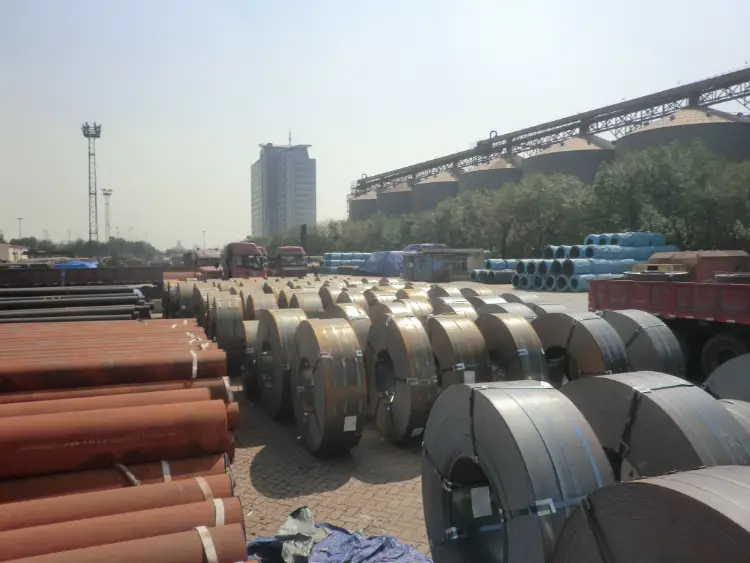
GB/T14164-2013 L320 (X46) PSL1 Pipeline Steel Coil
L320 (X46) Pipeline Steel Coil to GB/T 14164 – PSL1 High Strength Carbon Steel for Oil & Gas Transmission
L320 (X46) pipeline steel coil according to GB/T 14164 PSL1, offering a minimum yield strength of 320 MPa and excellent weldability for gas and oil line pipe applications.
Cold forming, welding (SAW, ERW), cutting, bending
- Phone : +8618037372205
- Email : [email protected]
- WhatsApp: Contact via Whtsapp
- WeChat: +8618037372205
GB/T14164-2013 L320 PSL1 Pipeline Steel Coil Introduction
L320 steel, also designated as X46 under API 5L, is a low-carbon pipeline grade supplied as hot-rolled coil according to GB/T 14164-2013 (Petroleum and natural gas industries – Steel pipe for pipeline transportation systems). It belongs to the PSL1 product specification level, which provides basic but strict chemical and mechanical property requirements. The material exhibits a minimum yield strength of 320 MPa and a tensile strength of 435–655 MPa, combined with good toughness and excellent weldability even under field conditions.
- Designed for longitudinal or spiral submerged-arc welded (SAW) line pipes for onshore and offshore transport of crude oil, natural gas, and refined products.
- Low carbon content (<0.22%) ensures resistance to hydrogen-induced cracking (HIC) in sour service when supplementary requirements are applied.
- Suitable for cold forming of pipes and fittings, provided proper bending radii are maintained.
GB/T14164-2013 L320 PSL1 Pipeline Steel Coil Chemical Composition
The chemical composition is governed by GB/T 14164-2013, Table 4 for PSL1 steel grades. Values represent maximum limits unless a range is specified. The steel is fully killed and fine-grained, with microalloying elements (Nb, V, Ti) used singly or in combination to achieve strength and toughness.
| Element | Mass Fraction (max, %) | Remarks |
|---|---|---|
| C | 0.22 | Carbon equivalent CE(IIW) typical ≤ 0.43 |
| Si | 0.45 | |
| Mn | 1.40 | |
| P | 0.025 | |
| S | 0.015 | |
| V | 0.10 | Sum of V+Nb+Ti ≤ 0.15 |
| Nb | 0.05 | Sum of V+Nb+Ti ≤ 0.15 |
| Ti | 0.04 | Sum of V+Nb+Ti ≤ 0.15 |
| Cu | 0.50 | If specified for HIC resistance |
| Ni | 0.50 | Residual element |
| Cr | 0.50 | Residual element |
| Mo | 0.50 | Residual element |
| N | 0.012 | Total nitrogen, unless sufficient Ti/Al for binding |
GB/T14164-2013 L320 PSL1 Pipeline Steel Coil Thermal and Electrical Physical Properties
Listed properties are typical for low-carbon pipeline steels at ambient temperature, unless otherwise noted. Values are influenced by exact chemical composition and processing path. Data are based on engineering references and ISO/TR 15608 for steel physical constants.
| Property | Typical Value | Unit | Test Conditions |
|---|---|---|---|
| Density (ρ) | 7.85 | g/cm³ | 20°C |
| Modulus of Elasticity (E) | 205 – 210 | GPa | 20°C |
| Shear Modulus (G) | 80 | GPa | 20°C |
| Poisson's Ratio (ν) | 0.30 | 20°C | |
| Coefficient of Thermal Expansion (α) | 11.7 × 10⁻⁶ | K⁻¹ | 20–100°C |
| Coefficient of Thermal Expansion (α) | 12.5 × 10⁻⁶ | K⁻¹ | 20–200°C |
| Coefficient of Thermal Expansion (α) | 13.6 × 10⁻⁶ | K⁻¹ | 20–400°C |
| Thermal Conductivity (λ) | 50 | W/(m·K) | 20°C |
| Thermal Conductivity (λ) | 45 | W/(m·K) | 200°C |
| Specific Heat Capacity (cp) | 460 | J/(kg·K) | 20°C |
| Electrical Resistivity (ρe) | 0.17 | µΩ·m | 20°C |
GB/T14164-2013 L320 PSL1 Pipeline Steel Coil Mechanical Properties
Tensile testing is performed on transverse strip specimens taken from the coil after controlled processing. Standard test conditions: room temperature, strain rate in accordance with ISO 6892-1. Yield strength is reported as Rt0.5 (total extension 0.5% under load) as per the standard.
- The ratio Rt0.5/Rm shall not exceed 0.90 for PSL1.
- Elongation is based on a gauge length of 50 mm (2 in) rectangular test piece; minimum values are calculated by the formula Af = 1950·A00.2/Rm0.9 but practical values are tabulated.
- Bend tests are performed on full-section or strip specimens over a mandrel diameter related to wall thickness.
| Property | Required Value | Unit | Test Conditions |
|---|---|---|---|
| Yield Strength (Rt0.5) | 320 – 525 | MPa | Transverse, room temperature |
| Tensile Strength (Rm) | 435 – 655 | MPa | Transverse, room temperature |
| Elongation after fracture (A) | ≥ 19 (min. typical) | % | Transverse, 50 mm gauge, wall thickness ≤ 20 mm |
| Bend Test (Mandrel Diameter) | 3·t (t = wall thickness) | 180° bend, no cracks, for t ≤ 15 mm; larger diameter for thicker gauges | |
| Impact Energy (KV2) at 0°C | ≥ 27 (average of 3) | J | Transverse, full-size Charpy V-notch, when supplementary requirement is agreed |
| Hardness | ≤ 250 HV10 or equivalent | HV | Not mandatory for PSL1, unless specified for sour service |
GB/T14164-2013 L320 PSL1 Pipeline Steel Coil Fully Equivalent Material Standards & Replaceable Grades
| Country/Region | Standard | Grade | Remarks |
|---|---|---|---|
| China | GB/T 14164-2013 | L320 (X46) | Identical to ISO 3183 L320 PSL1 |
| International | ISO 3183:2012 | L320 | PSL1, technical delivery conditions |
| USA | API Specification 5L (45th Ed.) | X46 (PSL1) | Equivalent strength level; traceable to same L320 category |
| Europe | EN 10208-2:2009 | L320GA | For gas pipelines; chemical requirements slightly different |
| Russia/CIS | GOST R 53383-2009 | K52 (К52) | Approximate equivalent, with Russian steelmaking practice |
GB/T14164-2013 L320 PSL1 Pipeline Steel Coil Application Introduction
L320 (X46) pipeline steel coil is engineered for the construction of high-integrity, long-distance pipeline networks. Its balanced strength, formability, and field weldability make it a cost-effective choice for transmission pipelines operating at moderate pressures. Key application insights:
- Can be fabricated into longitudinal submerged-arc welded (LSAW) or spiral submerged-arc welded (SSAW) pipes with diameters up to 60 inches (1524 mm).
- In sour service environments (H₂S), supplementary requirements for HIC and SSC resistance per NACE MR0175/ISO 15156 can be imposed.
- Typical coating systems include 3-layer polyethylene (3LPE) or fusion-bonded epoxy (FBE) for corrosion protection.
Product Applications: Long-distance onshore oil and gas transmission pipelines, High-pressure natural gas trunk lines, Subsea flowlines and risers (with supplemental requirements), Gas gathering and distribution networks, Structural tubular members for offshore platforms, Conveying pipeline for liquefied natural gas (LNG) terminals
Processed into products: Line pipe (LSAW, SSAW, ERW pipes), Pipe bends and elbows (induction bends), Pipeline tees and reducers, Flanges and connectors (when forged from similar chemical composition), Pup joints and short pipe spools, Pipeline casing for road and river crossings
Application industries: Oil & Gas Exploration and Production, Pipeline Operator Companies, Petrochemical Plant Construction, Energy Infrastructure (natural gas distribution), Water Transmission (large-diameter conduits)
GB/T14164-2013 L320 PSL1 Pipeline Steel Coil Near/Similar Substitute Materials
| Country/Region | Standard | Grade | Remarks |
|---|---|---|---|
| China | GB/T 14164-2013 | L290 (X42) | Lower strength, easily replaceable in non-critical sections |
| China | GB/T 14164-2013 | L360 (X52) | Higher strength; suitable if design allows increased safety margin |
| USA | API 5L PSL2 | X46Q | PSL2 offers tighter chemistry and mandatory toughness; suitable for more demanding service |
| Europe | EN 10208-2 | L360MB | Higher strength but comparable weldability; often used interchangeably in large-diameter pipelines |
Notes:
For PSL1 L320 (X46) steel coil, the standard does not mandate notch toughness testing unless specified on the purchase order. However, when ordering for low-temperature or critical applications, Charpy V-notch impact requirements at 0°C or lower must be agreed. The carbon equivalent CE(IIW) is typically controlled to ≤ 0.43% to guarantee field weldability without preheating. Delamination testing per ASTM A578/A578M or equivalent may be required for offshore or sour service. For coil used in welded pipe production, the coil edge quality and flatness are critical; slab thickness tolerances are per GB/T 709 or as agreed. Supplementary hydrogen-induced cracking (HIC) tests per NACE TM0284 and sulfide stress cracking (SSC) tests per NACE TM0177 can be invoked for sour service.
- Share



