
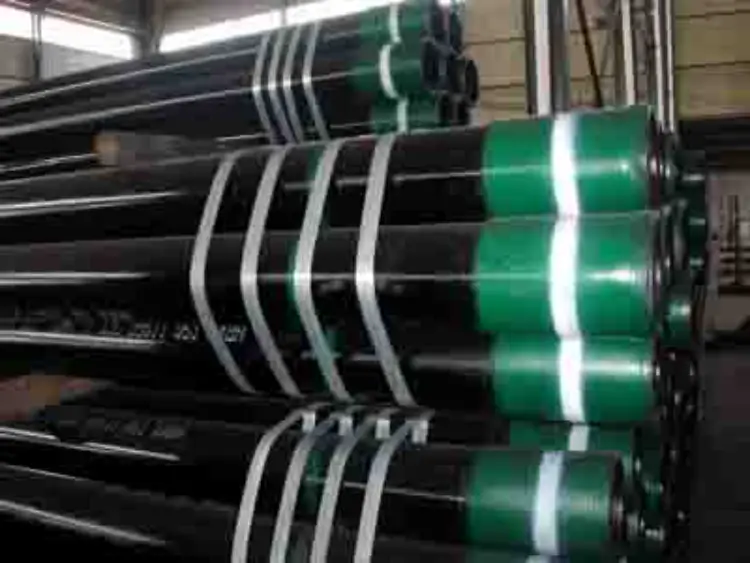
GB/T 9711 L245 Pipeline Steel Reliable Carbon-Manganese Steel
L245 Pipeline Steel (GB/T 9711) - Reliable Carbon-Manganese Steel for Oil & Gas Transmission
Comprehensive material data for L245 pipeline steel according to GB/T 9711 standard, including chemical composition, mechanical and physical properties, international equivalents, and application guide.
Cold forming, hot forming, welding (ERW, SAW, SMAW), bending, machining
- Phone : +8618037372205
- Email : [email protected]
- WhatsApp: Contact via Whtsapp
- WeChat: +8618037372205
GB/T 9711 L245 Pipeline Steel Reliable Carbon-Manganese Steel Introduction
L245 is a carbon-manganese pipeline steel grade specified in the Chinese standard GB/T 9711 (the equivalent of ISO 3183 and API 5L). It is primarily used for oil and natural gas transportation pipes. With a minimum yield strength of 245 MPa, L245 offers an excellent balance of strength, weldability, and toughness, making it suitable for buried and above-ground pipelines. The steel is typically supplied as welded or seamless pipes in both PSL1 and PSL2 quality levels. Its chemistry is controlled to ensure good field weldability and resistance to hydrogen-induced cracking in sour service when specified. L245 is widely adopted in China and international projects as a basic line pipe grade for moderate pressure systems.
The material can be delivered in as-rolled, normalized, or thermomechanically rolled conditions depending on the required mechanical properties and the pipe manufacturing process.
GB/T 9711 L245 Pipeline Steel Reliable Carbon-Manganese Steel Chemical Composition
The chemical composition of L245 pipeline steel is strictly controlled to ensure good weldability, toughness, and resistance to hydrogen-induced cracking. The following table provides the maximum limits for common elements according to GB/T 9711-2017 for PSL1. For PSL2, more restrictive limits on carbon equivalent (CEV) and additional elements may apply. Note that micro-alloying elements like Nb, V, and Ti may be added under agreement.
| Element | Standard Value (Max) | Remarks |
|---|---|---|
| C | 0.26 | |
| Si | 0.35 | |
| Mn | 1.20 | |
| P | 0.030 | For PSL2: ≤ 0.025 |
| S | 0.030 | For PSL2: ≤ 0.015 |
| V | 0.10 | |
| Nb | 0.10 | Sum of Nb+V+Ti ≤ 0.15% unless otherwise agreed |
| Ti | 0.06 | |
| Cu | 0.50 | |
| Ni | 0.50 | |
| Cr | 0.50 | |
| Mo | 0.50 | |
| Al | 0.060 | When added as a grain-refining element, Al/N ratio shall be adequate |
GB/T 9711 L245 Pipeline Steel Reliable Carbon-Manganese Steel Thermal and Electrical Physical Properties
The following physical properties are typical for L245 carbon-manganese steel. These values are not specified in the delivery standard but are widely accepted for engineering calculations. They may vary slightly with actual chemical composition, temperature, and manufacturing process.
| Property | Typical Value | Unit | Test Condition |
|---|---|---|---|
| Density (ρ) | 7.85 | g/cm³ | At 20°C |
| Modulus of Elasticity (E) | 210 | GPa | At 20°C, tension |
| Shear Modulus (G) | 81 | GPa | At 20°C |
| Poisson's Ratio (ν) | 0.3 | - | At 20°C, elastic range |
| Thermal Expansion Coefficient (α) | 12.0 x 10⁻⁶ | 1/K | 20°C – 100°C |
| Thermal Expansion Coefficient (α) | 13.0 x 10⁻⁶ | 1/K | 20°C – 300°C |
| Thermal Conductivity (λ) | 50 | W/(m·K) | At 20°C |
| Thermal Conductivity (λ) | 45 | W/(m·K) | At 100°C |
| Specific Heat Capacity | 460 | J/(kg·K) | At 20°C |
| Electrical Resistivity (ρ_e) | 0.18 | μΩ·m | At 20°C |
GB/T 9711 L245 Pipeline Steel Reliable Carbon-Manganese Steel Mechanical Properties
Mechanical properties are determined on pipe body test specimens. The minimum values for PSL1 and PSL2 are presented. For PSL2, impact testing (Charpy V-notch) is normally mandatory at a specified temperature. Actual values may vary slightly depending on pipe diameter, wall thickness, and heat treatment condition.
| Property | Standard Requirement | Unit | Test Condition |
|---|---|---|---|
| Yield Strength (ReH) | 245 – 450 | MPa | Transverse or longitudinal, pipe body |
| Tensile Strength (Rm) | 415 – 760 | MPa | Transverse or longitudinal, pipe body |
| Elongation (A50) | ≥ 24 (longitudinal) / ≥ 21 (transverse) | % | Gauge length 50 mm, for wall thickness ≤ 25.4 mm |
| Elongation (A50) | ≥ 22 (longitudinal) / ≥ 19 (transverse) | % | Gauge length 50 mm, for wall thickness 25.4–50.8 mm |
| Charpy Impact (KV) | ≥ 27 (single min. 20) at 0°C | J | PSL2, full-size specimen (10x10 mm), transverse, base metal, weld impacted tested separately |
| Charpy Impact (KV) | ≥ 40 (single min. 30) at -10°C | J | Optional higher toughness PSL2 agreement |
| Bend Test (bend angle 180°) | No cracks or ruptures | - | Mandrel diameter per standard, weld and base metal |
GB/T 9711 L245 Pipeline Steel Reliable Carbon-Manganese Steel Completely Equivalent Material Standards and Replaceable Grades
| Country/Region | Standard | Grade | Remarks |
|---|---|---|---|
| International | ISO 3183 | L245 | Equivalent to PSL1 or PSL2 of L245 |
| USA | API 5L | Grade B | Equivalent to L245 PSL1; for PSL2 equivalent is Grade B with supplementary requirements |
| European Union | EN 10208-1 | L245GA / L245NB | L245GA for welded pipes, L245NB for seamless, similar strength level |
| Russia | GOST 20295 | K52 | Strength level close to 245 MPa, used for welded pipes |
| Canada | CSA Z245.1 | Grade 241 | Slightly lower yield, often used interchangeably with L245 |
GB/T 9711 L245 Pipeline Steel Reliable Carbon-Manganese Steel Application Introduction
L245 is a versatile line pipe steel used extensively in energy infrastructure. Its moderate strength and good weldability make it suitable for onshore and offshore pipelines, as well as for flowlines and gathering systems. The material can be formed into bends, reducers, and tees without preheating in most conditions. When anti-corrosion coating is applied, service life exceeds 30 years. PSL2 variants with low sulfur and controlled CEV are recommended for sour environments (NACE MR0175/ISO 15156).
Product Applications: SMLS (seamless) pipes, ERW/LSAW/SSAW welded pipes, Pipe fittings: elbows, tees, reducers, caps, Flanges and gaskets for pipeline connections, Pig launchers and receivers fabricated from L245 plate, Pipeline repair clamps and sleeves
Processed into products: Line pipe segments for gas trunklines, Flowlines from wellhead to gathering station, Underground water transmission mains, Slurry pipeline for mining industry, Riser pipes on offshore platforms, Fabricated pipe spools and modules for plant piping
Application industries: Oil and gas upstream and midstream (transmission pipelines), Petrochemical and refining, Water and slurry transport infrastructure, Marine and offshore platforms, Structural supports for pipeline corridors
GB/T 9711 L245 Pipeline Steel Reliable Carbon-Manganese Steel Similar / Alternative Materials with Comparable Performance
| Country/Region | Standard | Grade | Remarks |
|---|---|---|---|
| International | ISO 3183 | L290 (X42) | Next higher strength grade, still weldable and widely available |
| USA | API 5L | X42 | Yield strength 290 MPa, similar applications, may allow thinner wall |
| China | GB/T 9711 | L245NB / L245NE | PSL2 grades of same strength but with higher toughness and stricter chemistry |
| European Union | EN 10208-2 | L245NB | For offshore or more demanding sour service |
| Japan | JIS G3454 | STPG 370 | Carbon steel pipe for pressure service, but not dedicated to pipeline; similar tensile properties |
Notes:
L245 steel is usually supplied with a 3.1 or 3.2 inspection certificate according to EN 10204. For sour service applications, the steel must meet supplementary requirements such as HIC (Hydrogen-Induced Cracking) and SSC (Sulfide Stress Cracking) testing per NACE TM0284/TM0177. The user should specify the desired PSL level and any additional testing. Preheating before welding is generally not required for thicknesses below 20 mm, but for higher thicknesses a preheat of 100–150°C may be advisable. Post-weld heat treatment is not mandatory for most applications.
- Share



