
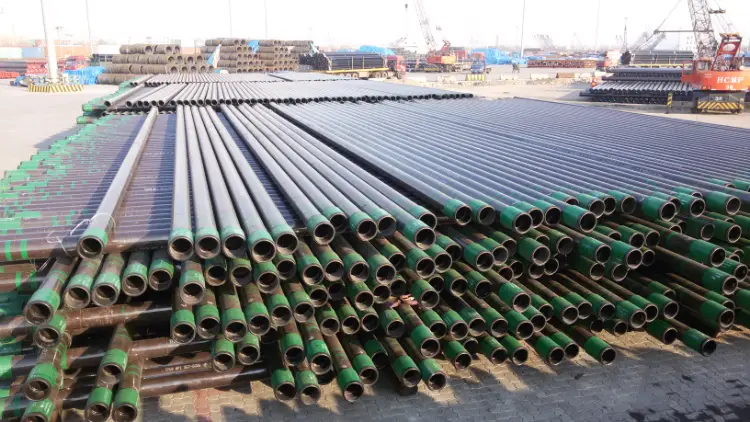
GB/T 9711-2011 PSL2 L485 LSAW Pipe
GB/T 9711-2011 PSL2 L485 LSAW Pipe: High-Strength Steel Grade for Line Pipe
Detailed material data for L485 (X70) PSL2 steel according to GB/T 9711-2011, including chemical composition, mechanical properties, physical characteristics, and equivalent grades for longitudinal submerged arc welded (LSAW) pipe.
Plate forming and welding (SAW), cold forming, tack welding, ID/OD welding, mechanical expansion, hydrostatic testing; available processes for further fabrication include beveling, bending, cutting, and coating.
- Phone : +8618037372205
- Email : [email protected]
- WhatsApp: Contact via Whtsapp
- WeChat: +8618037372205
GB/T 9711-2011 PSL2 L485 LSAW Pipe Introduction
L485 (equivalent to API 5L X70) is a high-strength low-alloy steel grade used primarily for longitudinal submerged arc welded (LSAW) line pipe in oil and gas transmission pipelines. Under the Chinese standard GB/T 9711-2011 (based on ISO 3183 and API 5L), the PSL2 designation ensures stricter requirements for chemical composition, toughness, and non-destructive testing. The material exhibits excellent strength, good weldability, and adequate low-temperature toughness, making it suitable for high-pressure, large-diameter pipeline projects. The LSAW process uses controlled-rolled (TMCP) plate, which after forming and welding results in a pipe with uniform mechanical properties along the body. Typical yield strength is 485–635 MPa, with tensile strength 570–760 MPa, and a maximum yield-to-tensile ratio of 0.93.
GB/T 9711-2011 PSL2 L485 LSAW Pipe Chemical Composition
Typical values as required by GB/T 9711-2011 Table 5 for PSL2 L485 (X70) pipe, wall thickness ≤ 25 mm. Elements are shown as maximum unless a range is given. Total micro-alloying (V+Nb+Ti) ≤ 0.15%. Carbon equivalent limits for weldability: CEIIW ≤ 0.43, CEPcm ≤ 0.25.
| Chemical Element | Standard Value (Wt%) | Remarks |
|---|---|---|
| Carbon (C) | 0.22 max | For wall thickness ≤ 25 mm; 0.24 max for >25 mm |
| Silicon (Si) | 0.45 max | Typical 0.15–0.35 |
| Manganese (Mn) | 1.70 max | Often controlled 1.40–1.65 for strength and toughness |
| Phosphorus (P) | 0.025 max | PSL2 requirement |
| Sulfur (S) | 0.015 max | PSL2 requirement |
| Vanadium (V) | 0.06 max | Microalloying element |
| Niobium (Nb) | 0.06 max | Microalloying element |
| Titanium (Ti) | 0.06 max | Microalloying element; grain refinement and toughness |
| Copper (Cu) | 0.50 max | Residual (Cu+Ni+Cr) ≤ 0.50 often, check standard |
| Nickel (Ni) | 0.50 max | Residual |
| Chromium (Cr) | 0.50 max | Residual |
| Molybdenum (Mo) | 0.50 max | Residual |
| Boron (B) | 0.0005 max | Residual |
| Aluminium (Al) | 0.060 max | Total aluminium |
GB/T 9711-2011 PSL2 L485 LSAW Pipe Thermal and Electrical Physical Properties
Typical values for high-strength low-alloy line pipe steel of L485/X70 grade. These data apply to the base material in the final TMCP condition. Properties may vary slightly with specific chemical composition and pipe diameter.
| Property | Typical Value | Unit | Test Condition / Remarks |
|---|---|---|---|
| Density (ρ) | 7.85 | g/cm³ | At 20°C |
| Elastic Modulus (E) | 207 | GPa | Tension, room temperature |
| Shear Modulus (G) | 80 | GPa | Calculated from E and Poisson ratio |
| Poisson's Ratio (ν) | 0.30 | — | Elastic, room temperature |
| Thermal Expansion (α) | 12.0 | 10⁻⁶/K | Average 20–100°C |
| Thermal Conductivity (λ) | 52 | W/(m·K) | At 20°C |
| Specific Heat Capacity (cp) | 470 | J/(kg·K) | At 20°C |
| Electrical Resistivity (ρe) | 0.13 | μΩ·m | At 20°C |
GB/T 9711-2011 PSL2 L485 LSAW Pipe Mechanical Properties – Pipe Body
Values according to GB/T 9711-2011 Tables 7 and 8 for L485 PSL2 LSAW pipe body. Yield strength and tensile strength are specified as 0.5% total extension under load. Bending test applies to base metal and requires no cracks > 3 mm. Impact test temperature is 0°C, with full-size Charpy V-notch specimens (10×10 mm). Weld and heat-affected zone (HAZ) must meet separate requirements of ≥ 40 J average.
| Property | Required Value | Unit | Test Condition |
|---|---|---|---|
| Yield Strength (ReH) | 485–635 | MPa | Transverse strip specimen, room temperature |
| Tensile Strength (Rm) | 570–760 | MPa | Transverse strip specimen, room temperature |
| Yield-to-Tensile Ratio | ≤ 0.93 | — | PSL2 requirement |
| Elongation after Fracture (A50) | ≥ 22 | % | Gauge length 50 mm, wall thickness ≤ 25 mm; value formula-based |
| Bend Test – Base Metal | 180° bend, no initiation of cracks | — | Mandrel diameter: 3T (T≤12.7 mm), 5T (T>12.7 mm) |
| Charpy Impact (KV), pipe body | ≥ 40 (average) / ≥ 30 (single) | J | Full-size specimen, test at 0°C |
| Charpy Impact (KV), weld & HAZ | ≥ 40 (average) / ≥ 30 (single) | J | Full-size specimen, test at 0°C (PSL2) |
GB/T 9711-2011 PSL2 L485 LSAW Pipe Exact Equivalent Material Standards and Grade Replacements
| Country / Region | Standard | Grade | Remarks |
|---|---|---|---|
| USA | API 5L (46th Ed.) | X70 PSL2 | Direct equivalent for L485 PSL2 line pipe |
| International | ISO 3183:2012 | L485M or L485Q | M – thermomechanical rolled; Q – quenched and tempered (for heavy wall) |
| Europe | EN 10208-2:2009 | L485MB | Steel for pipelines for combustible fluids |
| Russia / CIS | GOST R 52079 | K60 | Similar strength class; check specific conditions |
GB/T 9711-2011 PSL2 L485 LSAW Pipe Application Introduction
L485 PSL2 LSAW pipe is widely specified for large-diameter, high-pressure oil and gas transmission pipelines. The high strength reduces wall thickness and weight without compromising safety, while the PSL2 requirements ensure reliable fracture arrest and long service life. The LSAW process allows manufacturing of pipe up to 56 inch (1422 mm) OD and wall thickness up to 60 mm, making it suitable for both onshore trunk lines and offshore risers.
Product Applications: Long-distance cross-country pipelines (e.g., West-East Gas Pipeline in China), High-pressure subsea flowlines, Station piping and manifold sections, Tie-in and replacement spools, Steam and water injection piping
Processed into products: Straight pipe sections (LSAW joint lengths up to 12 m), Pipe bends (cold or induction bends), Tees and reducers, Flanges (weld neck, slip-on), Pipeline fittings (API 5L/ASME B16.9 matching material)
Application industries: Oil and gas upstream transmission, Gas gathering and distribution networks, Offshore oil and gas export lines, Water and slurry transportation, Structural piling and foundation works
GB/T 9711-2011 PSL2 L485 LSAW Pipe Similar or Alternative Materials with Close Properties
| Country / Region | Standard | Grade | Remarks |
|---|---|---|---|
| China | GB/T 9711-2011 | L450 PSL2 | X65 equivalent; slightly lower strength, often used where toughness is prioritized |
| China | GB/T 9711-2011 | L555 PSL2 | X80 equivalent; higher strength, requires more stringent welding control |
| International | API 5L | X70 PSL1 | Lower requirements on toughness and inspection, for non-critical applications |
Notes:
Weld and HAZ properties: In LSAW pipe, the weld metal typically has a slightly overmatched strength to ensure ductile failure away from the joint. Weld chemistry is controlled to maintain Charpy impact values ≥ 40 J at 0°C. NDT requirements per GB/T 9711-2011 PSL2 include full-length ultrasonic testing of the pipe body and radiographic/ultrasonic inspection of the weld seam. Differences between thermomechanical (M) and quenched-and-tempered (Q) delivery conditions are critical for subsequent hot bending or post-weld heat treatment; L485M (TMCP) should not be heated above 300°C unless allowed by the steelmaker. For sour service, additional testing per NACE MR0175/ISO 15156 is mandatory, and a lower hardness limit (e.g., ≤ 248 HV10) is often specified.
- Share



