
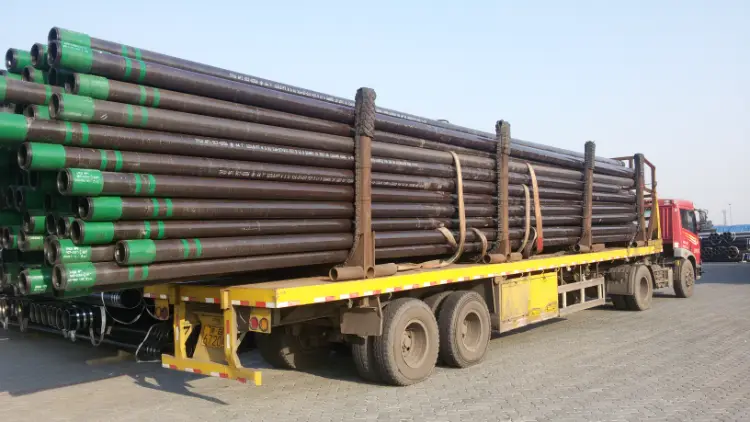
GB/T 9711-2011 PSL2 L555 LSAW Pipe Steel
GB/T 9711-2011 PSL2 L555 LSAW Pipe Steel - High-Strength Line Pipe Material
Complete material data for L555 PSL2 LSAW pipe per GB/T 9711-2011, including chemical composition, mechanical properties, and international equivalents.
Steelmaking (BOF/EAF) + secondary metallurgy, continuous casting, TMCP or quenching & tempering, pipe forming by UOE/JCOE/three-roll bending, double submerged arc welding (inside & outside), post-weld seam normalizing, hydraulic testing, non-destructive inspection (RT, UT)
- Phone : +8618037372205
- Email : [email protected]
- WhatsApp: Contact via Whtsapp
- WeChat: +8618037372205
GB/T 9711-2011 PSL2 L555 LSAW Pipe Steel Introduction
GB/T 9711-2011 PSL2 steel grade L555 is a high-strength low-alloy (HSLA) line pipe steel primarily used for longitudinal submerged arc welded (LSAW) pipes in oil and gas transmission pipelines. It combines a minimum yield strength of 555 MPa with excellent toughness and weldability, achieved through advanced thermo-mechanical controlled processing (TMCP) or quenching and tempering (Q&T). PSL2 imposes stricter chemical limits and mandatory fracture toughness (Charpy V-notch) requirements compared to PSL1, ensuring reliable performance under high pressure and low-temperature conditions. Typical applications include transcontinental gas trunklines, offshore export lines, and high-pressure onshore networks. The material is often supplied with post-weld normalizing of the seam area to guarantee homogeneity. International equivalents include API 5L X80 PSL2 and ISO 3183 L555M.
GB/T 9711-2011 PSL2 L555 LSAW Pipe Steel Chemical Composition
PSL2 L555 chemical composition limits according to GB/T 9711-2011 Table C.2. The grade relies on low carbon content and microalloying elements like Nb, V, and Ti for grain refinement and precipitation strengthening. Carbon equivalent (Ceq) and Pcm values are tightly controlled to ensure weldability and resistance to cold cracking. Values are maximum unless otherwise noted.
| Element | Specified Value (wt%) | Remarks |
|---|---|---|
| C | ≤0.12 | Also limited by Ceq and Pcm |
| Si | ≤0.45 | |
| Mn | ≤1.85 | For product thickness ≤25.4 mm |
| P | ≤0.025 | |
| S | ≤0.015 | |
| V | ≤0.05 | Microalloying element |
| Nb | ≤0.05 | Microalloying element |
| Ti | ≤0.04 | Used for grain refinement and inclusion shape control |
| Cu | ≤0.25 | Residual element; limit for sour service may be lower |
| Ni | ≤0.30 | Residual element |
| Cr | ≤0.30 | Residual element |
| Mo | ≤0.15 | Residual element |
| N | ≤0.012 | |
| Al (total) | ≤0.06 | Usually acid-soluble Al is controlled for deoxidation |
| Ceq (IIW) | ≤0.43 (M) / ≤0.45 (Q) | Ceq = C + Mn/6 + (Cr+Mo+V)/5 + (Ni+Cu)/15 |
| Pcm | ≤0.21 (M) / ≤0.22 (Q) | Pcm = C + Si/30 + Mn/20 + Cu/20 + Ni/60 + Cr/20 + Mo/15 + V/10 + 5B |
GB/T 9711-2011 PSL2 L555 LSAW Pipe Steel Thermal and Electrical Physical Properties
GB/T 9711-2011 does not specify physical properties such as density, modulus, or thermal conductivity. The values listed below are typical for a TMCP low-carbon microalloyed steel like L555 (X80) and are provided for engineering reference. Actual values may vary depending on exact composition and final microstructure.
| Property | Typical Value | Unit | Condition / Remark |
|---|---|---|---|
| Density (ρ) | 7.85 | g/cm³ | Room temperature |
| Young's modulus (E) | 205 – 210 | GPa | Ambient temperature; slightly decreases at elevated temperatures |
| Shear modulus (G) | 80 – 82 | GPa | |
| Poisson's ratio (ν) | 0.28 – 0.30 | — | |
| Thermal expansion coefficient (α) | ~11.7 × 10⁻⁶ | 1/K | 20–100°C; increases with temperature |
| Thermal conductivity (λ) | ~45 | W/(m·K) | At 20°C; decreases with increasing temperature |
| Specific heat capacity | ~460 | J/(kg·K) | At 20°C |
| Electrical resistivity (ρₑ) | ~0.22 | µΩ·m | At 20°C |
GB/T 9711-2011 PSL2 L555 LSAW Pipe Steel Mechanical Properties
Mechanical test requirements for L555 PSL2 LSAW pipe per GB/T 9711-2011. Tensile and bend tests are performed on the pipe body (base metal). Charpy V-notch impact tests are carried out at 0°C or lower as per specification. The elongation after fracture is calculated using a standard formula that depends on the specimen cross-sectional area and the specified minimum tensile strength, ensuring a consistent measurement for different pipe dimensions. All values apply to wall thickness ≤25.4 mm unless otherwise noted.
| Property | Required Value | Unit | Test Condition / Remark |
|---|---|---|---|
| Yield strength (Rt0.5) | 555 – 825 | MPa | Transverse rectangular specimen, tested at room temperature per GB/T 228.1 |
| Tensile strength (Rm) | 625 – 825 | MPa | Transverse specimen; ratio Rt0.5/Rm typically between 0.85 and 0.98 |
| Elongation after fracture (A) | Calculated per formula; typical ≥22% for a 12.5 mm thick strip specimen | % | A = 1940 × (Axc^¹⁵⁻¹) / U^⁰¹⁹; Axc = cross-sectional area (mm²), U = 625 MPa (min. tensile). Gauge length 50 mm. Transverse test |
| Bend test (mandrel diameter) | 3.0 × specimen thickness | — | 180° bend for plate/weld; no cracks or defects permitted in base metal or weld zone |
| Charpy impact (KV₂) | Average ≥40; Single ≥28 (or as agreed) | J | V-notch, 10×10×55 mm, transverse specimen, 0°C (lower test temperature possible per customer spec) |
| Shear area (DWTT) | ≥85% at 0°C (if specified) | % | Drop-weight tear test on full-thickness specimen for fracture toughness in longitudinal direction |
GB/T 9711-2011 PSL2 L555 LSAW Pipe Steel Identical / Direct Equivalent Material Standards and Grades
| Country/Region | Standard | Grade | Remarks |
|---|---|---|---|
| International | ISO 3183:2012 | L555M or L555Q | Same PSL2 requirements, interchangeable with GB/T 9711 |
| USA/Global | API Spec 5L (46th Edition) | X80 PSL2 | Most widely recognized equivalent; identical mechanical and chemical requirements |
| Europe | EN 10208-2:2009 | L555MB (TM) / L555QB (Q&T) | Direct equivalent for pipeline steel; PSL2 conditions matched |
| Brazil | ABNT NBR 14048 | 80K | Grade 80, equivalent to X80, used for high-pressure pipelines |
| Russia | GOST R 52079-2003 | K65 | Covers steel for welded pipes, mechanical properties aligned with X80 |
GB/T 9711-2011 PSL2 L555 LSAW Pipe Steel Application Introduction
L555 PSL2 LSAW pipe is the backbone of modern high-pressure gas transmission networks. Its high yield-to-tensile ratio, good low-temperature toughness, and large diameters (up to 64 inches) make it ideal for long-distance transmission where internal pressures range from 10 to 25 MPa. The material can be tailored for sour service (e.g., H₂S-containing environments) by restricting chemistry and performing HIC/SSC tests. Typical applications include subsea pipelines, Arctic cross-country pipelines, and high-pressure export lines from gas processing plants.
Product Applications: Cross-country natural gas trunklines (e.g., West-East gas pipeline in China), Submarine natural gas export lines, High-pressure flare and blow-down lines in refineries, Sour service gas gathering lines (with HIC-resistant steel), Large-diameter water injection and disposal pipelines
Processed into products: Straight LSAW pipe sections (main component), Induction hot-bent bends (made from LSAW pipe) for directional changes, Tees and wyes fabricated from plate of equivalent grade, Flanges (weld-neck, blind) machined from forged or plate material of compatible strength, Reducers, reducing elbows, and laterals for pipe networks
Application industries: Oil and gas upstream (gathering and transport), Natural gas long-distance transmission, Petrochemical process piping (high-pressure steam, hydrocarbons), Offshore and subsea pipeline projects, Water and slurry transport (when high strength is required)
GB/T 9711-2011 PSL2 L555 LSAW Pipe Steel Near-Equivalent / Similar Performance Substitute Materials
| Country/Region | Standard | Grade | Remarks |
|---|---|---|---|
| International | API 5L / ISO 3183 | X70 (L485) | Lower strength, higher ductility; used where lower pressure reduces cost without sacrificing toughness |
| International | API 5L / ISO 3183 | X90 (L625) | Higher strength, reduced ductility and weldability margins; suitable for ultra-high-pressure lines |
| International | API 5L / ISO 3183 | X100 (L690) | Advanced high-strength grade, still under limited application due to field welding and strain-based design issues |
| Europe | EN 10208-2 | L485MB (X70) | Similar base metal toughness and welding behavior, but lower strength requires thicker wall for the same pressure rating |
Notes:
Additional considerations: LSAW pipes under GB/T 9711 L555 PSL2 are often delivered with either internal and external anti-corrosion coatings (FBE, 3LPE, 3LPP) depending on service conditions. For sour service applications, supplementary requirements such as HIC (Hydrogen Induced Cracking) test per NACE TM0284 and SSC (Sulfide Stress Cracking) test per NACE TM0177 must be specified. The weld seam is typically subjected to full-length ultrasonic and radiographic inspection. The material is compatible with all conventional welding procedures (SMAW, GMAW, SAW) using matching or undermatching filler metals designed for X80 steel. For strain-based design situations, careful control of the stress-strain curve (e.g., uniform elongation and yield-to-tensile ratio) is required beyond the basic standard.
- Share



