
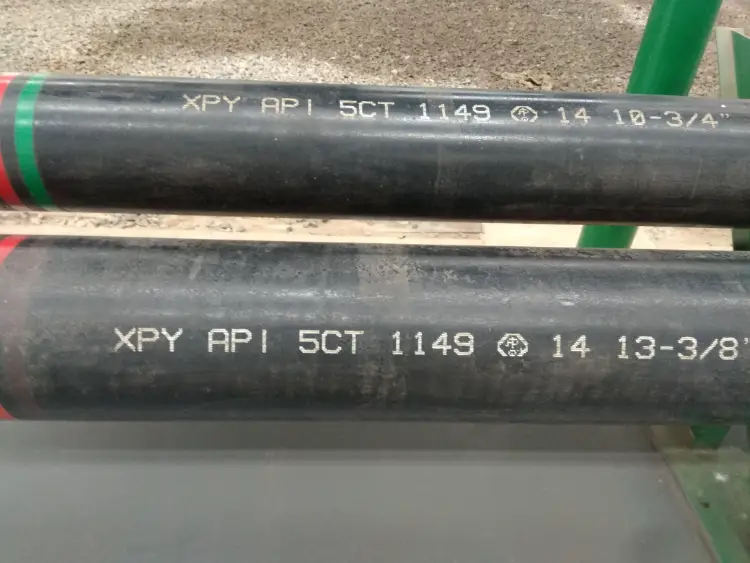
GB/T 9711-2011 PSL2 L450 LSAW Pipe
GB/T 9711-2011 PSL2 L450 LSAW Pipe - Chemical, Mechanical & Physical Data
Full technical profile of L450 grade longitudinal submerged arc welded pipe according to GB/T 9711-2011 PSL2, including composition, tensile, impact and physical properties for oil and gas transportation.
Hot rolled plate/skelp, cold or hot forming, submerged arc welding (inside and outside), post-weld heat treatment if required; pipe ends may be beveled; standard surface protection is temporary coating or bare.
- Phone : +8618037372205
- Email : [email protected]
- WhatsApp: Contact via Whtsapp
- WeChat: +8618037372205
GB/T 9711-2011 PSL2 L450 LSAW Pipe Introduction
GB/T 9711-2011 PSL2 L450 is a high-strength low-alloy (HSLA) steel grade for longitudinal submerged arc welded (LSAW) pipe used in petroleum and natural gas pipeline transmission systems. It complies with the Chinese standard equivalent to ISO 3183:2007 and API 5L (45th Edition). The grade designation 'L450' indicates a minimum yield strength of 450 MPa, placing it in the same strength category as API 5L X65.
PSL2 (Product Specification Level 2) imposes mandatory Charpy V-notch toughness, stricter chemical composition limits, non-destructive testing, and certified manufacturing procedures. Typical delivery condition is as-rolled or normalised, depending on thickness and required notch toughness.
- Excellent weldability with controlled carbon equivalent (CE) for girth welding and field joining.
- High resistance to brittle fracture at low temperatures and good ductility for strain-based design.
- Suitable for sour service with additional HIC/SSC testing when specified by supplementary requirements.
GB/T 9711-2011 PSL2 L450 LSAW Pipe Chemical Composition
The composition limits are in accordance with GB/T 9711-2011 Table A.1 for PSL2 pipe. Additional alloying elements such as Cu, Ni, Cr, Mo may be present as residuals. The carbon equivalent (CEIIW and CEPcm) shall meet agreement limits to ensure weldability. For wall thickness ≤25 mm the typical constraints apply; for greater thicknesses tighter limits may be agreed.
| Element | Standard Value (max, %) | Remarks |
|---|---|---|
| Carbon (C) | 0.22 | Heat analysis; product analysis max 0.24 |
| Silicon (Si) | 0.45 | Max unless otherwise agreed |
| Manganese (Mn) | 1.40 | Max; lower values may be used for enhanced toughness |
| Phosphorus (P) | 0.025 | Max for PSL2 |
| Sulfur (S) | 0.015 | Max for PSL2 |
| Vanadium (V) | 0.10 | Sum of V+Nb+Ti ≤ 0.15% |
| Niobium (Nb) | 0.05 | |
| Titanium (Ti) | 0.06 | |
| Aluminium (Al) total | 0.060 | Typically added for grain refinement; soluble Al ≥0.015% |
| Copper (Cu) | 0.50 | Residual; maximum unless agreed |
| Nickel (Ni) | 0.50 | Residual; maximum |
| Chromium (Cr) | 0.50 | Residual; maximum |
| Molybdenum (Mo) | 0.50 | Residual; maximum |
| Nitrogen (N) | 0.012 | Max if not controlled |
| Carbon equivalent CEIIW | 0.43 | Typical agreed limit for thickness ≤25 mm |
| Carbon equivalent CEPcm | 0.25 | Typical agreed limit for sour service or low temperature toughness |
GB/T 9711-2011 PSL2 L450 LSAW Pipe Thermal & Electrical Physical Properties
Physical properties are representative for 0.22% C manganese steel in the as‑rolled or normalised condition. These values are not part of the mandatory certification but are useful for design calculations. Actual properties may vary slightly with manufacturing process and composition.
| Property | Standard Value | Unit | Test Condition |
|---|---|---|---|
| Density (ρ) | 7850 | kg/m³ | at 20°C |
| Elastic modulus (E) | 205 | GPa | at 20°C, dynamic method |
| Shear modulus (G) | 80 | GPa | at 20°C |
| Poisson's ratio (ν) | 0.29 – 0.30 | – | at 20°C |
| Thermal expansion coefficient (α) | 11.7 / 12.5 / 13.0 | 10⁻⁶ / K | 20–100°C / 20–200°C / 20–300°C |
| Thermal conductivity (λ) | 52 / 50 / 46 | W/(m·K) | at 20°C / 200°C / 400°C |
| Specific heat capacity (cp) | 460 / 520 | J/(kg·K) | at 20°C / 300°C |
| Electrical resistivity (ρe) | 0.21 – 0.25 | µΩ·m | at 20°C |
GB/T 9711-2011 PSL2 L450 LSAW Pipe Mechanical Properties
Test results are based on pipe body (base material) and weld metal. Transverse or longitudinal specimens as specified. All tests shall be carried out in accordance with GB/T 9711-2011 Clause 10, Tables 7, 8 and 9. Impact test temperature is normally 0°C unless otherwise specified.
| Property | Standard Required Value | Unit | Test Condition |
|---|---|---|---|
| Yield strength (Rt0.5 or ReH) | 450 – 600 | MPa | Transverse strip test, 0.2% offset or 0.5% total extension under load |
| Tensile strength (Rm) | 535 – 760 | MPa | Transverse strip test |
| Yield to tensile ratio (Rt0.5/Rm) | ≤ 0.93 * | * Ratio may be specified for deformation-critical applications, not mandatory for all PSL2 | |
| Elongation (A) | ≥ calculated per formula, typical ≥ 24% for longitudinal and ≥ 22% for transverse | % | 50 mm gauge length; elongation formula: A = 1940·Axc0.2 / U0.9 with U=535 MPa min.; e.g., for a 200 mm² cross-section A ≈ 23% |
| Charpy V‑notch impact energy (KV) | ≥ 27 (average of 3) / ≥ 20 (single) | J | Transverse, full‑size (10×10 mm), 0°C; for smaller specimens values are proportional |
| Weld metal Charpy impact | ≥ 27 (average) / ≥ 20 (single) | J | Transverse, full‑size, 0°C, notch located in weld metal |
| Heat‑affected zone Charpy impact | ≥ 27 (average) / ≥ 20 (single) | J | Transverse, full‑size, 0°C, notch located in HAZ |
| Bend test (weld) | 180° bend, no cracks > 3 mm | – | Guided bend, mandrel diameter 90 mm for t≤12.7 mm; otherwise see standard |
| Hardness (HV10) | ≤ 270 HV (pipe body) / ≤ 300 HV (weld) | HV | For sour service or when specified; otherwise not mandatory |
GB/T 9711-2011 PSL2 L450 LSAW Pipe Fully Equivalent Standards and Substitute Grades
| Country / Region | Standard | Grade | Remarks |
|---|---|---|---|
| International | API Spec 5L (45th Ed.) | X65 PSL2 | API monogram allowed; identical strength and chemistry philosophy |
| International | ISO 3183:2007 | L450 PSL2 | Direct adoption of GB/T 9711; identical requirements |
| European Union | EN 10208-2:2009 | L450MB | For onshore pipes; minor differences in CE limits; B suffix indicates normalised |
| Russia / CIS | GOST R 52079-2003 | К56 (K56) | Strength level comparable to L450/X65, but own manufacturing regime |
| Canada | CSA Z245.1-18 | 450 or Cat II 450 | Comparable pipe grade for oil and gas; additional toughness zones |
GB/T 9711-2011 PSL2 L450 LSAW Pipe Application Introduction
L450 (X65) PSL2 LSAW pipes are the backbone of modern long‑distance oil and gas transportation systems. The combination of moderate yield strength, excellent fracture toughness and good field weldability enables safe operation under high internal pressure and in harsh environments.
- Used for mainline sections, river crossings and offshore risers where strength and reliability are critical.
- PSL2 guarantees Charpy impact values at temperatures as low as −20°C (if agreed), giving confidence against brittle fracture.
- Sour service variants (with HIC/SSC testing) are employed in pipelines carrying H₂S‑containing fluids.
Product Applications: Onshore long‑distance pipeline systems, Subsea pipelines and flowlines, Gas gathering and injection lines, Pipe strings for directional drilling, Station piping and manifold systems, Storage tank shell rings (when approved), Piles and structural columns
Processed into products: LSAW pipe spools with welded end connections, Pipe bends (induction or cold bending to 5D radius), Equal and reducing tees, wyes and laterals, Concentric and eccentric reducers, Flanges and weld‑neck flanges, Pipeline fittings and forged components, Pup pieces and transition pieces
Application industries: Oil & Gas Exploration and Production, Gas Transmission and Distribution, Petrochemical and Refinery Plants, Power Generation (cooling water lines), Marine and Offshore Engineering (platform risers, J‑tubes), Water and Wastewater Trunk Mains, Construction and Piling (structural grade)
GB/T 9711-2011 PSL2 L450 LSAW Pipe Similar or Alternative Grades
| Country / Region | Standard | Grade | Remarks |
|---|---|---|---|
| International | API Spec 5L | X60 (L415) | Lower yield strength (415 MPa); lower pressure rating but higher toughness; often used for distribution |
| International | API Spec 5L | X70 (L485) | Higher strength (485 MPa); used for high‑pressure transmission; needs careful welding |
| European Union | EN 10208-2 | L415MB | Equivalent to X60; may replace L450 if reduced wall thickness is acceptable |
| European Union | EN 10208-2 | L485MB | Equivalent to X70; requires higher welding preheat for carbon equivalent control |
| China | GB/T 9711-2011 | L415 (X60) | Lower strength; may be used where pressure or external load are reduced |
| China | GB/T 21237 | Q450N (e.g., L450Q) | Similar strength in structural pipe (hollow section), but different toughness requirements |
Notes:
PSL2 additional requirements: Charpy V‑notch impact test mandatory for all pipe bodies and welds. Non‑destructive inspection (UT or X‑ray) of the full weld seam for the entire length. Hydrostatic test at mill with holding time per standard. Traceability to heat and plate number. Sour service option: When specified, hardness testing, HIC (Hydrogen Induced Cracking) and SSC (Sulphide Stress Cracking) tests shall be performed in accordance with NACE MR0175/ISO 15156. Max hardness typically limited to 250 HV. Post‑weld heat treatment (PWHT) may be required for some service conditions. Dimensional tolerance: OD tolerance ±0.75% for pipe ends; wall thickness tolerance −0.5 mm / + no limit for Di type (as per standard).
- Share



