
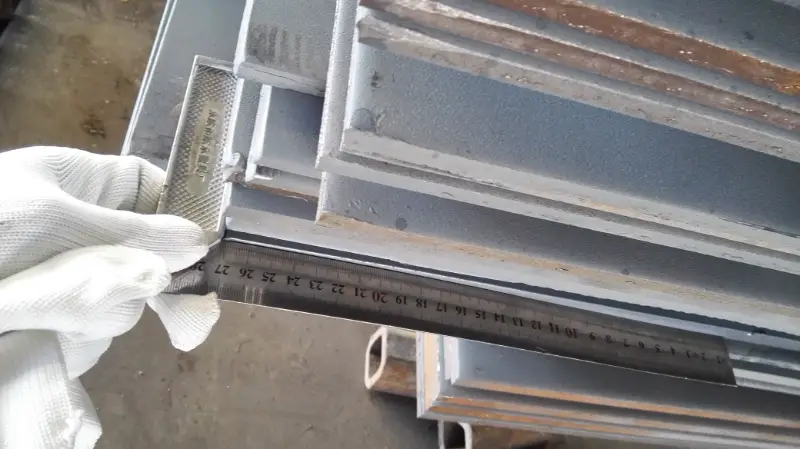
20CrMoH Alloy Steel (GB/T 5216) Structural Steel
20CrMoH Alloy Steel (GB/T 5216) - Hardenability Guaranteed Structural Steel for Automotive Parts
Comprehensive technical data for 20CrMoH according to GB/T 5216, including chemical composition, mechanical properties, thermal and electrical properties, international equivalents, and application guidance.
Hot forging, carburizing, quenching, tempering, machining
- Phone : +8618037372205
- Email : [email protected]
- WhatsApp: Contact via Whtsapp
- WeChat: +8618037372205
20CrMoH Alloy Steel Structural Steel Introduction
20CrMoH is a chromium-molybdenum alloy structural steel with guaranteed hardenability, specified in Chinese standard GB/T 5216. It is primarily used in the manufacture of carburized and hardened automotive and mechanical engineering components such as gears, shafts, pins, and splined parts. The 'H' designation indicates controlled hardenability bands, ensuring consistent core properties after heat treatment.
Key features include:
- Good balance of strength, toughness, and wear resistance after case hardening.
- Controlled hardenability (Jominy hardenability limits) for reliable heat treatment results.
- Excellent machinability in normalized or annealed condition.
- Widely applied in transmission and powertrain systems.
The steel is typically supplied as hot-rolled, forged, or cold-drawn bars, and is suitable for carburizing, quenching and tempering processes.
20CrMoH Alloy Steel Structural Steel Chemical Composition
Chemical composition as specified in GB/T 5216-2014 for grade 20CrMoH. The steel is a low-carbon Cr-Mo alloy, microalloyed for consistent hardenability. Residual elements limits: Ni ≤ 0.30%, Cu ≤ 0.25%.
| Element | Standard Value (%) | Remarks |
|---|---|---|
| Carbon (C) | 0.17 – 0.23 | Core hardenability control |
| Silicon (Si) | 0.17 – 0.37 | Deoxidizer and strength enhancer |
| Manganese (Mn) | 0.60 – 0.95 | Hardenability and desulfurization |
| Phosphorus (P) | ≤ 0.030 | Impurity – toughness reduction |
| Sulfur (S) | ≤ 0.030 | Impurity – machinability and toughness |
| Chromium (Cr) | 0.80 – 1.15 | Carbide former, hardenability |
| Molybdenum (Mo) | 0.15 – 0.25 | Grain refinement, temper resistance |
| Nickel (Ni) | ≤ 0.30 | Residual |
| Copper (Cu) | ≤ 0.25 | Residual |
20CrMoH Alloy Steel Structural Steel Thermal and Electrical Physical Properties
Representative physical properties for 20CrMoH steel at room temperature and elevated temperatures. These values are approximate and intended for engineering design; slight variations may occur due to processing. Thermal conductivity and expansion data are for the annealed condition.
| Property | Typical Value | Unit | Testing Condition |
|---|---|---|---|
| Density (ρ) | 7.84 | g/cm³ | 20 °C |
| Modulus of Elasticity (E) | 206 | GPa | 20 °C |
| Shear Modulus (G) | 80 | GPa | 20 °C |
| Poisson's Ratio (ν) | 0.29 | – | 20 °C |
| Thermal Expansion Coefficient (α) | 11.5 | 10⁻⁶/K | 20 – 100 °C |
| Thermal Expansion Coefficient (α) | 12.5 | 10⁻⁶/K | 20 – 300 °C |
| Thermal Expansion Coefficient (α) | 13.0 | 10⁻⁶/K | 20 – 500 °C |
| Thermal Conductivity (λ) | 44.0 | W/(m·K) | 20 °C |
| Thermal Conductivity (λ) | 42.0 | W/(m·K) | 200 °C |
| Specific Heat Capacity (cp) | 460 | J/(kg·K) | 20 °C |
| Electrical Resistivity (ρe) | 0.15 | Ω·mm²/m | 20 °C |
20CrMoH Alloy Steel Structural Steel Mechanical Properties
The mechanical properties given below are reference values after the recommended heat treatment procedure according to GB/T 5216. These values are not mandatory for acceptance; the main requirement is conformance to specified hardenability bands.
Recommended heat treatment: first quenching at 880°C (oil/water), second quenching at 780°C (oil/water), tempering at 200°C (air cooling). Values are for longitudinal test specimens.
| Property | Specification Value | Unit | Testing Condition |
|---|---|---|---|
| Tensile Strength (Rm) | ≥ 885 | MPa | Quenched & tempered, room temperature |
| Yield Strength (ReH) | ≥ 685 | MPa | 0.2% offset, room temperature |
| Elongation (A) | ≥ 12 | % | Gauge length 5d |
| Reduction of Area (Z) | ≥ 50 | % | Room temperature |
| Impact Energy (KV2) | ≥ 78 | J | Charpy V-notch, room temperature |
| Hardness after Normalizing | ≤ 217 | HBW | Normalized condition |
| Hardness after Annealing | ≤ 179 | HBW | Spheroidized annealed |
| Core Hardness (Carburized) | 30 – 45 | HRC | After carburizing, quenching & tempering |
| Surface Hardness (Carburized) | 58 – 63 | HRC | Carburized case after hardening |
20CrMoH Alloy Steel Structural Steel International Equivalent Grades
| Country/Region | Standard | Grade | Remarks |
|---|---|---|---|
| China | GB/T 5216 | 20CrMoH | Original standard, guaranteed hardenability |
| Japan | JIS G4052 | SCM420H | Same application, slightly narrower Mn range (0.60-0.85) |
| USA | SAE J1268 (former SAE 4120H) | SAE 4120H | C, Mn, Cr, Mo ranges match closely |
| Europe | EN 10084 | 20MoCrS4 (1.7323) | Cr lower (0.70-1.00), Mn (0.60-0.90), suitable substitute |
| International | ISO 683-3 | 20MoCr4H | Identical intention, hardenability bands defined |
20CrMoH Alloy Steel Structural Steel Application Introduction
20CrMoH is designed for use in carburized and hardened components where a tough core and a hard, wear-resistant case are required. The guaranteed hardenability ensures uniformity in production, making it a preferred choice for critical power-transmission parts. Below are typical applications.
Product Applications: Automotive transmissions, Differentials, Axle assemblies, Engine timing gears, Hydraulic pumps and motors, Industrial robots
Processed into products: Transmission gears (helical, spur, bevel), Input/output shafts, Pinion shafts, Synchromesh hubs and sliders, Constant velocity joint inner/outer races, Splined shafts, Camshafts, Crankshaft gears, Heavy-duty studs and bolts, Sprockets
Application industries: Automotive manufacturing (passenger cars, commercial vehicles), Mechanical engineering (general machinery, power tools), Agricultural machinery, Construction equipment, Wind energy (gear box components), Railway and locomotive, Aerospace (secondary structural parts)
20CrMoH Alloy Steel Structural Steel Similar Alternative Steel Grades
| Country/Region | Standard | Grade | Remarks |
|---|---|---|---|
| China | GB/T 3077 | 20CrMo | Non-H grade, wider hardenability scatter, similar base composition |
| China | GB/T 5216 | 20CrMnTiH | Titanium microalloyed, better grain refinement, widely used for heavy-duty gears |
| Japan | JIS G4052 | SCM418H | Lower carbon (0.16-0.21), slightly lower hardenability |
| USA | SAE J1268 | SAE 4118H | Lower carbon and chromium, substitution requires adjusting heat treatment |
| Europe | EN 10084 | 20MnCr5 (1.7147) | Mn-Cr type, no Mo, lower hardenability but suitable for some applications |
Notes:
Hardenability Requirements: The grade 20CrMoH is subject to Jominy end-quench hardenability testing. The hardness band (HRC) at various distances from the quenched end is specified in GB/T 5216 for acceptance. Typical Jominy positions J5, J9, J15, J25 are monitored.
Non-metallic inclusion: High-quality steel practice limits oxide and sulfide inclusions; vacuum degassing can be requested.
Grain size: Fine austenitic grain size (ASTM 5 or finer) is normally required.
Surface quality: Supplied bars are subject to surface defect limits as per GB/T 5216. Ultrasonic testing may be imposed by agreement.
Heat treatment compatibility: The steel is compatible with gas carburizing, carbonitriding, and induction hardening. Care should be taken to avoid overheating during forging (max. 1250°C).
- Share



