
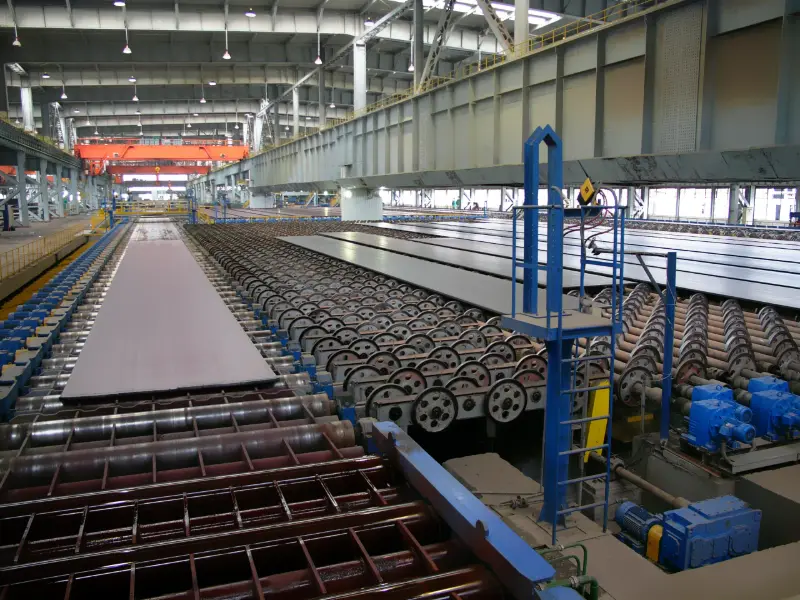
20CrMnTiH
20CrMnTiH: Hardenability-Guaranteed Alloy Steel for Automotive & Mechanical Structure Pipes
20CrMnTiH is a Chinese standard guarantee-hardenability alloy structural steel governed by GB/T 5216. Designed for case-carburized parts requiring high core strength and surface wear resistance, it is ideal for automotive gears and mechanical structure pipes.
Hot rolling, hot forging, annealing, machining, carburizing, quenching, tempering
- Phone : +8618037372205
- Email : [email protected]
- WhatsApp: Contact via Whtsapp
- WeChat: +8618037372205
20CrMnTiH Introduction
20CrMnTiH is a chromium-manganese-titanium alloy structural steel with guaranteed hardenability specified in GB/T 5216. It is primarily designed for carburizing and subsequent quenching/tempering. The steel exhibits an excellent balance of core toughness, surface fatigue resistance, and controlled hardenability bands, making it especially suitable for automotive transmission gears, shafts, and mechanical structural tubes demanding high reliability. The titanium addition effectively refines austenite grains during high-temperature carburizing, preventing abnormal grain growth and ensuring consistent mechanical properties. Typical delivery conditions include hot-rolled, forged, or annealed bars and tubes, enabling efficient subsequent machining and case-hardening processes.
20CrMnTiH Chemical Composition
Chemical composition according to GB/T 5216-2014 for 20CrMnTiH. Residual elements like Ni and Cu are controlled to avoid adverse effects on hardenability and mechanical properties.
| Element | Standard Value | Remarks |
|---|---|---|
| C | 0.17 - 0.23 | Core carbon for strength and hardenability |
| Si | 0.17 - 0.37 | Deoxidizer, solid solution strengthener |
| Mn | 0.80 - 1.15 | Improves hardenability and strength |
| Cr | 1.00 - 1.35 | Major carbide former, enhances hardenability |
| Ti | 0.04 - 0.10 | Grain refiner during high-temperature carburizing |
| P | ≤ 0.035 | Impurity, limits embrittlement |
| S | ≤ 0.035 | Impurity, controls hot shortness |
| Ni | ≤ 0.30 | Residual element, enhances toughness |
| Cu | ≤ 0.25 | Residual element, maintained low |
20CrMnTiH Thermal, Electrical and Physical Properties
These physical properties are typical for 20CrMnTi steel and are not explicitly mandated by GB/T 5216. Values are averaged from engineering handbooks and alloy databases; variations may occur with exact heat treatment and microstructure.
| Property | Typical Value | Unit | Test Condition / Temperature |
|---|---|---|---|
| Density (ρ) | 7.80 | g/cm³ | At 20 °C |
| Young's Modulus (E) | 206 | GPa | At 20 °C |
| Shear Modulus (G) | 79 | GPa | At 20 °C (approximate) |
| Poisson's Ratio (ν) | 0.30 | - | At 20 °C |
| Linear Thermal Expansion Coefficient (α) | 11.5 | 10⁻⁶ /K | 20 - 100 °C |
| Linear Thermal Expansion Coefficient (α) | 12.5 | 10⁻⁶ /K | 20 - 200 °C |
| Linear Thermal Expansion Coefficient (α) | 13.1 | 10⁻⁶ /K | 20 - 300 °C |
| Thermal conductivity (λ) | 44.0 | W/(m·K) | At 100 °C |
| Specific heat capacity (cp) | 460 | J/(kg·K) | Room temperature (approx.) |
| Electrical resistivity (ρₑ) | 0.2 | 10⁻⁶ Ω·m | At 20 °C |
20CrMnTiH Mechanical Properties
Mechanical properties specified in GB/T 5216-2014 for test pieces heat-treated as follows: quenching from 880 °C in oil, tempering at 200 °C (air or water cooling). Hardness is for annealed or high-temperature tempered condition.
| Property | Minimum/Required Value | Unit | Test Condition |
|---|---|---|---|
| Yield Strength (ReH) | ≥ 835 | MPa | Quenched 880 °C (oil), tempered 200 °C |
| Tensile Strength (Rm) | ≥ 1080 | MPa | Quenched 880 °C (oil), tempered 200 °C |
| Elongation after fracture (A) | ≥ 10 | % | Gauge length 5 times diameter |
| Reduction of area (Z) | ≥ 45 | % | At ambient temperature |
| Impact energy (KU2) | ≥ 55 | J | U-notch specimen, room temperature |
| Brinell Hardness (HBW) | ≤ 217 | - | Annealed or high-temperature tempered condition |
20CrMnTiH Completely Equivalent Standards & Substitutable Grades
| Country/Region | Standard | Designation | Remarks |
|---|---|---|---|
| China | GB/T 5216 | 20CrMnTiH | Original specification, guaranteed hardenability |
| Germany | DIN EN 10084 | 20MnCr5 (1.7147) | Similar Mn-Cr case-hardening steel, but without Ti grain refinement. Can be considered a close substitute with adjustment of heat treatment. |
| Japan | JIS G4052 | SCr420H | Hardenability-guaranteed Cr steel. Lower Mn and no Ti. Approximate substitutability with process modifications. |
| USA | ASTM A304 / SAE J1268 | SAE 5120H | Cr case-hardening steel with Mn range, lacks Ti. Equivalent in many mechanical engineering applications. |
20CrMnTiH Application Introduction
20CrMnTiH provides an optimum combination of core hardenability and surface wear resistance after carburizing. Typical applications include:
Product Applications: Transmission gears and shafts, Axle gears and pinions, Planetary gear sets, Mechanical structural pipes (hollow shafts, bushings), Piston pins, Synchronizer hubs, CVJ components
Processed into products: Automotive transmission: 1st, 2nd, 3rd speed gears; reverse idler gears, Differential: side gears, spider gears, ring gears, Engine: camshafts, tappets, wrist pins, Steering system: sector shafts, worm gears, Drivetrain: universal joint crosses, sliding sleeves, Industrial gear units: pinion shafts, gear rims
Application industries: Automotive (passenger cars, trucks, commercial vehicles), Agricultural machinery, Construction machinery, Wind energy (gearboxes, yaw drives), Off-highway vehicles, Industrial gearbox manufacturing
20CrMnTiH Similar or Alternative Material Recommendations
| Country/Region | Standard | Designation | Remarks |
|---|---|---|---|
| China | GB/T 3077 | 20CrMnTi | Same chemical composition without specified hardenability limits. Equivalent for non-hardenability-critical components. |
| ISO | ISO 683-11 | 20MnCr5 | International standard variant, similar carburizing characteristics. |
| USA | SAE J404 | SAE 5120 | General Cr steel for carburizing; lacks Ti. Used for similar gearing but requires careful grain size control. |
| Japan | JIS G4051 | SCr420 | Basic Cr case-hardening steel, commonly used in automotive parts. Suitable after verifying hardenability requirements. |
| Germany | DIN 17210 | 18CrNi8 | Alternative alloy carburizing steel with Ni, offering better toughness for heavy-duty gears. |
Notes:
- Hardenability Requirement: End-quench hardenability bands (Jominy values) are specified in GB/T 5216. Purchasing must include the desired H-band limits.
- Non-metallic inclusions: Controlled according to GB/T 5216; clean steel practices ensure fatigue performance.
- Surface quality: Bars supplied with guaranteed surface quality for direct forging or machining.
- Heat treatment compatibility: Optimal carburizing temperature 930-960 °C; direct quenching or slow cooling followed by re-heating to 830-860 °C, then oil quench and low-temperature temper (180-220 °C).
- Weldability: Not recommended for welding in hardened condition; can be welded in annealed state with pre-heating and post-weld heat treatment.
- Share



