
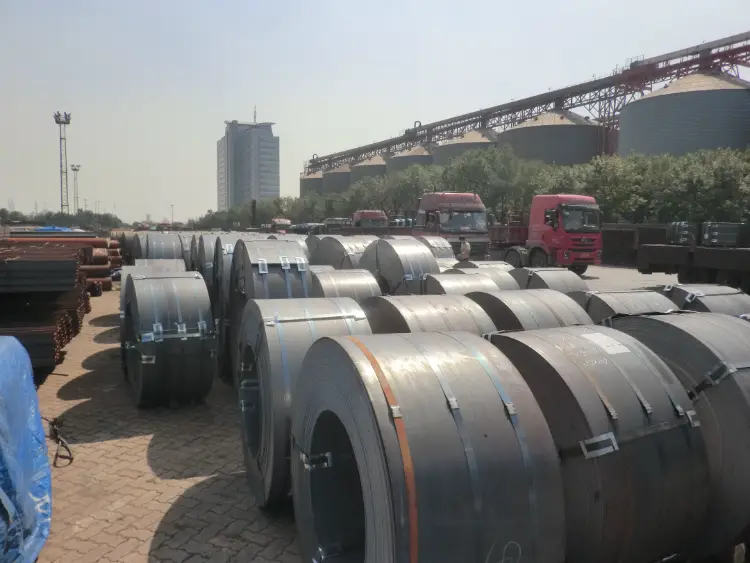
EN10025-3 S275NL Normalized Low-Temperature Fine-Grain Structural Steel Coil
EN10025-3 S275NL Normalized Low-Temperature Fine-Grain Structural Steel Coil - Properties & Applications
Complete technical data for S275NL carbon and low-alloy high-strength steel coil according to EN 10025-3, including chemical composition, mechanical and thermal properties, international equivalents, and applications.
Welding, bending, cold forming, machining, cutting, normalizing (if required)
- Phone : +8618037372205
- Email : [email protected]
- WhatsApp: Contact via Whtsapp
- WeChat: +8618037372205
EN10025-3 S275NL Normalized Low-Temperature Fine-Grain Structural Steel Coil Introduction
S275NL is a weldable fine-grain structural steel delivered in the normalized or normalized rolled condition, defined by European standard EN 10025-3. Designed for low-temperature service down to -50°C, it offers a minimum yield strength of 275 MPa for thicknesses up to 16 mm. Key features: excellent notch toughness, good weldability with controlled carbon equivalent (CEV typically ≤0.40%), and uniform mechanical properties across the thickness due to normalizing. The 'L' designation ensures guaranteed impact energy (≥27 J longitudinal) at -50°C, making it suitable for arctic and offshore environments. Its fine-grain microstructure results from balanced additions of aluminum, niobium, and vanadium, preventing grain coarsening during welding or hot forming. Common delivery forms include hot-rolled coils, plates, and sections, used extensively in welded steel structures subjected to dynamic loads and low temperatures.
EN10025-3 S275NL Normalized Low-Temperature Fine-Grain Structural Steel Coil Chemical Composition
Ladle analysis according to EN 10025-3:2019, Table 3 (for S275NL, thickness ≤ 250 mm). Maximum values unless a range is shown. Microalloying elements (Nb, V, Ti) may be added singly or in combination. Fine-grain practice requires total aluminum (Altot) ≥ 0.015% or alternative grain-refining elements. Carbon Equivalent Value (CEV) max.: 0.40% (for thickness ≤ 100 mm), 0.42% (100–250 mm).
| Element | Standard Value (max, %) | Remarks |
|---|---|---|
| C | ≤0.17 | For thickness ≤ 16 mm; ≤0.18 for 16–40 mm; ≤0.20 for >40 mm |
| Si | ≤0.50 | |
| Mn | 0.50 – 1.50 | Depending on thickness |
| P | ≤0.025 | |
| S | ≤0.020 | |
| Nb | ≤0.05 | May be present as grain refiner |
| V | ≤0.06 | |
| Altot | ≥0.015 | Minimum for fine-grain treatment |
| Ti | ≤0.05 | |
| Cr | ≤0.30 | |
| Ni | ≤0.30 | |
| Mo | ≤0.10 | |
| Cu | ≤0.35 | |
| N | ≤0.015 | |
| CEV | ≤0.40 – 0.42 | Based on product thickness (see description) |
EN10025-3 S275NL Normalized Low-Temperature Fine-Grain Structural Steel Coil Thermal & Electrical Physical Properties
These values are typical for carbon-manganese structural steels and are not part of EN 10025-3 mandatory requirements. They are provided as engineering guidelines. Density is calculated at 20°C. Thermal expansion coefficient is an average for 20–100°C. Properties may vary slightly with composition and temperature.
| Property | Typical Value | Unit | Test Condition / Remarks |
|---|---|---|---|
| Density (ρ) | 7.85 | g/cm³ | At 20°C |
| Elastic modulus (E) | 210 | GPa | At 20°C, static |
| Shear modulus (G) | 81 | GPa | At 20°C |
| Poisson's ratio (ν) | 0.3 | — | Room temperature |
| Thermal expansion coefficient (α) | 12 × 10⁻⁶ | K⁻¹ | 20–100°C range |
| Thermal conductivity (λ) | 50 – 55 | W/(m·K) | At 20°C |
| Specific heat capacity (c) | 460 – 480 | J/(kg·K) | At 20°C |
| Electrical resistivity (ρe) | 0.15 – 0.25 | µΩ·m | At 20°C |
EN10025-3 S275NL Normalized Low-Temperature Fine-Grain Structural Steel Coil Mechanical Properties
Minimum values at room temperature for normalized/normalized rolled condition, per EN 10025-3. Tensile test is transverse (width direction) for flat products and longitudinal for sections. Impact test (Charpy V-notch) is performed at -50°C (L-quality) with minimum average energy values. For thicknesses ≤6 mm, impact tests are not mandatory. Bend test uses a mandrel diameter relative to thickness (t) with a 180° bending angle.
| Property | Requirement | Unit | Test Condition / Thickness Range |
|---|---|---|---|
| Yield strength (ReH) | ≥275 | MPa | Thickness ≤ 16 mm |
| Yield strength (ReH) | ≥265 | MPa | 16 < t ≤ 40 mm |
| Yield strength (ReH) | ≥255 | MPa | 40 < t ≤ 63 mm |
| Yield strength (ReH) | ≥245 | MPa | 63 < t ≤ 80 mm |
| Yield strength (ReH) | ≥235 | MPa | 80 < t ≤ 100 mm |
| Yield strength (ReH) | ≥225 | MPa | 100 < t ≤ 150 mm |
| Tensile strength (Rm) | 370 – 510 | MPa | Thickness ≤ 100 mm |
| Tensile strength (Rm) | 350 – 470 | MPa | 100 < t ≤ 150 mm |
| Elongation (A) | ≥24 | % | Thickness ≤ 40 mm (gauge L0 = 5.65√S0) |
| Elongation (A) | ≥23 | % | 40 < t ≤ 63 mm |
| Elongation (A) | ≥22 | % | 63 < t ≤ 100 mm |
| Elongation (A) | ≥21 | % | 100 < t ≤ 150 mm |
| Impact energy (KV2, longitudinal) | ≥27 | J | At -50°C, for thickness ≥6 mm |
| Impact energy (KV2, transverse) | ≥20 | J | At -50°C, for thickness ≥6 mm |
| Bend test (mandrel diameter) | 2t | — | t ≤ 16 mm, 180° bend |
| Bend test (mandrel diameter) | 3t | — | 16 < t ≤ 100 mm, 180° bend |
EN10025-3 S275NL Normalized Low-Temperature Fine-Grain Structural Steel Coil Completely Equivalent Material Standards & Replaceable Grades
| Country/Region | Standard | Grade | Remarks |
|---|---|---|---|
| European Union | EN 10025-3:2019 | S275NL | Original standard, normalized fine-grain steel for low temperature |
| Germany | DIN EN 10025-3 | S275NL | National adoption of EN 10025-3 |
| United Kingdom | BS EN 10025-3 | S275NL | Identical to EN 10025-3 |
| France | NF EN 10025-3 | S275NL | Identical to EN 10025-3 |
| Italy | UNI EN 10025-3 | S275NL | Identical to EN 10025-3 |
| Spain | UNE EN 10025-3 | S275NL | Identical to EN 10025-3 |
| International | ISO 630-3 (draft) | S275NL | Similar; may have slight differences in impact temperature or CEV |
EN10025-3 S275NL Normalized Low-Temperature Fine-Grain Structural Steel Coil Application Introduction
S275NL is selected for welded structures requiring guaranteed low-temperature toughness combined with moderate strength. Its fine-grain structure ensures resistance to brittle fracture in cold climates and under dynamic loads. Typical applications include:
Product Applications: Welded steel bridges and flyovers, Offshore modules and flare booms, Arctic storage tanks and pressure vessels, Wind turbine tower sections, Structural frames for industrial buildings, Crane girders and gantry structures
Processed into products: Flange and web plates for plate girders, Cold-formed hollow sections (after normalizing), Stiffeners and brackets, Base plates and anchor boxes, Welded tubular joints, Box columns and truss chords
Application industries: Civil engineering and infrastructure (bridges, stadiums, high-rise building frameworks), Offshore and marine (platform substructures, ship hulls, wind turbine foundations), Energy (pressure vessels for low-temperature service, LNG storage tanks), Transportation (railway girders, heavy vehicle chassis, crane booms), Heavy machinery (excavator arms, mining equipment structures)
EN10025-3 S275NL Normalized Low-Temperature Fine-Grain Structural Steel Coil Similar/Alternative Materials with Comparable Performance
| Country/Region | Standard | Grade | Remarks |
|---|---|---|---|
| Europe | EN 10025-3 | S275N | Same strength, impact at -20°C instead of -50°C; suitable for less severe cold |
| Europe | EN 10025-2 | S275J2 | High-toughness structural steel, impact at -20°C; not fine-grain treated |
| Europe | EN 10025-4 | S275ML | TMCP-rolled variant with low-temperature toughness, slightly different chemistry |
| USA | ASTM A572/A572M | Grade 42 | Min yield 290 MPa, similar strength; not specifically treated for -50°C |
| USA | ASTM A36/A36M | — | Lower strength (min 250 MPa), general structural steel; not low-temp rated |
| Japan | JIS G3106 | SM400A/B/C | SM400B/C offer improved toughness, but impact test at 0°C or -10°C |
| China | GB/T 1591 | Q275D | Similar strength, impact at -20°C (D quality); not intentionally killed and normalized |
Notes:
Welding considerations: S275NL has a CEV ≤ 0.40 (for t ≤ 100 mm), which generally allows welding without pre-heating for moderate thicknesses. Hydrogen-controlled processes are recommended. Cold forming: Minimum bend radii should respect EN 10025-3 guidelines; for normalized material, a ratio of 1.5t–2t is typical. Corrosion protection: Same as conventional structural steel; surface preparation and coating essential in aggressive environments. Certification: Inspection documents according to EN 10204 (type 3.1 or 3.2) are common.
- Share



