
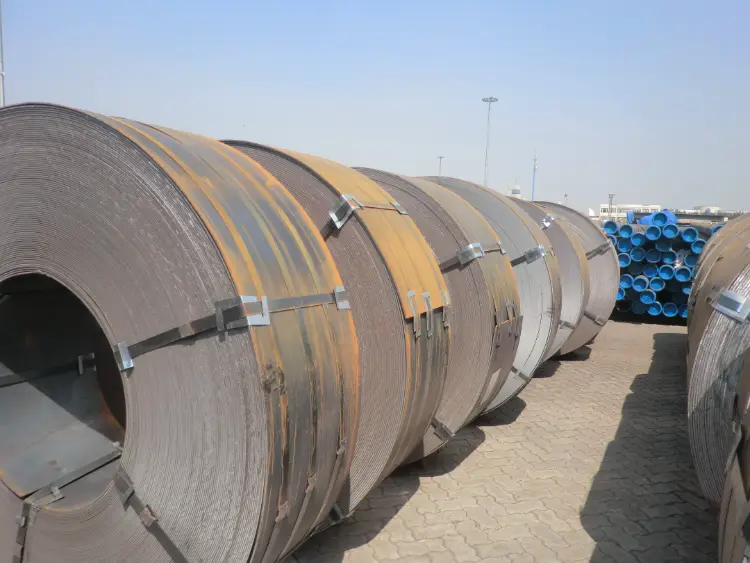
EN10025-3 S355N Carbon and Low-alloy High-strength Steel Coil
EN10025-3 S355N Carbon and Low-alloy High-strength Steel Coil - Full Property Data & Applications
Comprehensive material data for S355N steel coil according to EN 10025-3: chemical composition, mechanical and physical properties, equivalent grades, and industrial application guidance.
Hot rolling, normalized rolling, normalizing heat treatment, welding, cold forming (limited), machining
- Phone : +8618037372205
- Email : [email protected]
- WhatsApp: Contact via Whtsapp
- WeChat: +8618037372205
EN10025-3 S355N Carbon and Low-alloy High-strength Steel Coil Introduction
S355N is a normalized or normalized rolled weldable fine grain structural steel specified in EN 10025-3. As a member of the S355 series with the designation "N", it is intended for use in conditions requiring guaranteed impact toughness at -20 °C. It offers a minimum yield strength of 355 MPa in the as-delivered condition for thicknesses up to 16 mm and is characterized by:
- Excellent weldability due to controlled carbon and alloy content and fine grain practice
- Good combination of high strength and ductility
- Reliable low‑temperature toughness for structural applications
- Uniform properties through the thickness after normalizing
S355N is typically supplied as hot‑rolled coils, plates, and sections and finds widespread use in heavy steel constructions, bridges, pressure vessels, offshore structures, and machinery where safe performance under static and dynamic loads is required.
EN10025-3 S355N Carbon and Low-alloy High-strength Steel Coil Chemical Composition
Ladle analysis according to EN 10025-3. The fine grain treatment is ensured by a minimum total aluminium content or other suitable grain-refining elements. The CEV (carbon equivalent value) is limited to guarantee easy weldability.
| Element | Specified Value (%) | Remarks |
|---|---|---|
| C | ≤ 0.20 | Carbon |
| Si | ≤ 0.50 | Silicon |
| Mn | 0.90 – 1.65 | Manganese |
| P | ≤ 0.030 | Phosphorus |
| S | ≤ 0.025 | Sulphur |
| Al (total) | ≥ 0.020 | Minimum for fine grain practice |
| Nb | ≤ 0.05 | Niobium (optional) |
| V | ≤ 0.12 | Vanadium (optional) |
| Ti | ≤ 0.05 | Titanium (optional) |
| Cr | ≤ 0.30 | Chromium |
| Ni | ≤ 0.50 | Nickel |
| Mo | ≤ 0.10 | Molybdenum |
| Cu | ≤ 0.55 | Copper |
| N | ≤ 0.015 | Nitrogen |
| CEV | ≤ 0.43 | Carbon equivalent: C+Mn/6+(Cr+Mo+V)/5+(Ni+Cu)/15, for t ≤ 63 mm; higher CEV may apply for thicker products |
EN10025-3 S355N Carbon and Low-alloy High-strength Steel Coil Thermal & Electrical Physical Properties
The data below are typical room-temperature values for S355N steel. They are not mandatory in EN 10025-3 but are useful for engineering calculations. Variations may occur with temperature and manufacturing process.
| Property | Typical Value | Unit | Test Condition / Remark |
|---|---|---|---|
| Density (ρ) | 7.85 | g/cm³ | Room temperature |
| Young's modulus (E) | 210 | GPa | Room temperature |
| Shear modulus (G) | ≈ 81 | GPa | Calculated |
| Poisson's ratio (ν) | 0.3 | — | Room temperature, elastic range |
| Thermal expansion coefficient (α) | 12.0 × 10⁻⁶ | K⁻¹ | 20 °C – 100 °C range |
| Thermal conductivity (λ) | ≈ 53 | W/(m·K) | At 20 °C |
| Specific heat capacity | ≈ 460 | J/(kg·K) | At 20 °C |
| Electrical resistivity (ρₑ) | 0.16 – 0.20 | Ω·mm²/m | At 20 °C, typical for carbon‑manganese steel |
EN10025-3 S355N Carbon and Low-alloy High-strength Steel Coil Mechanical Properties
Minimum values for normalized or normalized rolled condition. Mechanical tests are performed on longitudinal specimens, except impact testing may use transverse specimens. The yield strength decreases with increasing product thickness, and the impact energy at −20 °C is the distinguishing characteristic of grade S355N.
| Property | Required Value | Unit | Test Condition |
|---|---|---|---|
| Yield strength (ReH) | 355 | MPa | Thickness t ≤ 16 mm |
| Yield strength (ReH) | 345 | MPa | 16 < t ≤ 40 mm |
| Yield strength (ReH) | 335 | MPa | 40 < t ≤ 63 mm |
| Yield strength (ReH) | 325 | MPa | 63 < t ≤ 80 mm |
| Yield strength (ReH) | 315 | MPa | 80 < t ≤ 100 mm |
| Yield strength (ReH) | 295 | MPa | 100 < t ≤ 150 mm |
| Yield strength (ReH) | 285 | MPa | 150 < t ≤ 200 mm |
| Yield strength (ReH) | 275 | MPa | 200 < t ≤ 250 mm |
| Tensile strength (Rm) | 470 – 630 | MPa | t ≤ 100 mm |
| Tensile strength (Rm) | 450 – 600 | MPa | 100 < t ≤ 250 mm |
| Elongation (A) | ≥ 22 | % | t ≤ 40 mm, longitudinal, gauge 5.65√S₀ |
| Elongation (A) | ≥ 21 | % | 40 < t ≤ 63 mm, longitudinal |
| Elongation (A) | ≥ 20 | % | 63 < t ≤ 100 mm, longitudinal |
| Elongation (A) | ≥ 18 | % | 100 < t ≤ 150 mm, longitudinal |
| Elongation (A) | ≥ 17 | % | 150 < t ≤ 250 mm, longitudinal |
| Charpy impact energy (KV₂) | ≥ 40 (longitudinal) | J | At −20 °C, t ≤ 150 mm, longitudinal specimen |
| Charpy impact energy (KV₂) | ≥ 27 (transverse) | J | At −20 °C, t ≤ 150 mm, transverse specimen |
| Charpy impact energy (KV₂) | ≥ 35 (longitudinal) | J | At −20 °C, 150 < t ≤ 250 mm, longitudinal |
| Charpy impact energy (KV₂) | ≥ 23 (transverse) | J | At −20 °C, 150 < t ≤ 250 mm, transverse |
EN10025-3 S355N Carbon and Low-alloy High-strength Steel Coil Fully Equivalent Grades under Different Standards
| Country / Region | Standard | Grade | Remarks |
|---|---|---|---|
| European Union | EN 10025-3:2019 | S355N | Original specification |
| International (ISO) | ISO 630-3 | S355N | Technically identical |
| Germany | DIN EN 10025-3 | S355N | German adoption of EN standard |
| United Kingdom | BS EN 10025-3 | S355N | British adoption |
| France | NF EN 10025-3 | S355N | French adoption |
| Italy | UNI EN 10025-3 | S355N | Italian adoption |
| Spain | UNE EN 10025-3 | S355N | Spanish adoption |
EN10025-3 S355N Carbon and Low-alloy High-strength Steel Coil Application Introduction
S355N combines high strength with excellent weldability and guaranteed toughness, making it a preferred choice for statically and dynamically loaded structures. Its normalized delivery condition ensures uniform mechanical properties and good ductility throughout heavy sections. Typical applications include:
Product Applications: Welded beams and columns for high‑rise buildings, Bridge girders and arch segments, Offshore platform legs and braces, Pressure vessel shells (within appropriate design codes), Crane booms and chassis, Wind turbine tower flanges and door frames, Heavy‑duty vehicle frames and dump truck bodies
Processed into products: Flanges and webs of fabricated beams, Stiffeners, gussets, and splice plates, Thick‑walled hollow sections and nodes, Heavy‑duty bolted or welded connections, Bearing plates and load‑distribution elements, Pile‑driving templates and temporary works
Application industries: Civil engineering and building construction, Bridge and highway engineering, Offshore and marine structures (non‑corrosive service), Pressure vessel and storage tank manufacturing, Heavy machinery and mining equipment, Wind energy (tower structures, foundations), Shipbuilding (hull structures where approved), Transport and lifting equipment (cranes, trailers)
EN10025-3 S355N Carbon and Low-alloy High-strength Steel Coil Similar / Comparable Material Alternatives
| Country / Region | Standard | Grade | Characteristics & Differences |
|---|---|---|---|
| European Union | EN 10025-2 | S355J2 | Structural steel with −20 °C impact, but not fine‑grain treated; lower notch toughness reliability in thick sections. |
| European Union | EN 10025-3 | S355NL | Same strength, but improved low‑temperature impact down to −50 °C; suitable for colder environments. |
| China | GB/T 1591-2018 | Q355ND | Normalized fine‑grain steel with −20 °C impact; chemical composition differs slightly; CEV ≤ 0.43. |
| USA | ASTM A572/A572M | Grade 50 [345] | High‑strength low‑alloy structural steel; minimum yield 345 MPa (50 ksi); impact toughness not guaranteed unless specified. |
| Japan | JIS G 3106 | SM490B | Weldable structural steel; similar strength (≥ 325–365 MPa yield), but fine‑grain practice not mandatory; impact at 0 °C. |
Notes:
- Weldability: Suitable for all common welding processes thanks to fine grain structure and controlled CEV. Preheating may be required for thick sections or high restraint.
- Cold forming: Permissible within limits; the normalized condition provides good formability, but post‑forming stress relief may be needed for severe deformations.
- Surface condition: Supplied as‑rolled or descaled; no specific surface quality class is mandated by EN 10025-3 unless agreed.
- Testing: Inspection documents per EN 10204 type 3.1 or 3.2 are common; additional ultrasounic testing (EN 10160) or through‑thickness testing (Z‑quality per EN 10164) can be ordered.
- CEV limits: The guaranteed CEV reduces the risk of cold cracking; maximum values increase with thickness according to the standard but remain within good weldability limits.
- Share



