
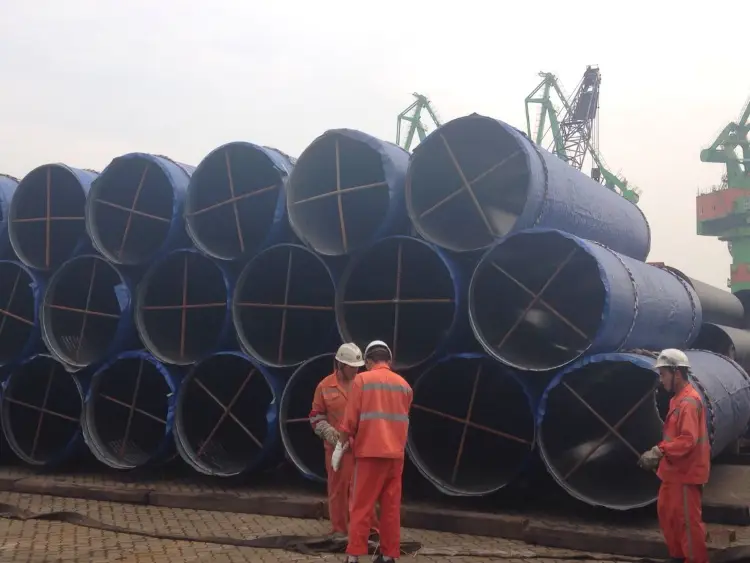
34Mn2V Air Bottle Pipe Steel
34Mn2V Air Bottle Pipe Steel - GB/T 18248 Data, Properties & Equivalents
Complete material profile for 34Mn2V seamless steel pipes used in high-pressure air bottles, including chemical composition, mechanical and physical properties, international equivalents, and application guidance per GB/T 18248.
Hot rolling, cold drawing, quenching and tempering, hot spinning, necking
- Phone : +8618037372205
- Email : [email protected]
- WhatsApp: Contact via Whtsapp
- WeChat: +8618037372205
34Mn2V Air Bottle Pipe Steel Introduction
34Mn2V is a low-alloy high-strength steel specifically designed for seamless steel pipes used in the manufacture of high-pressure gas cylinders (air bottles). Governed by the Chinese standard GB/T 18248, it offers an excellent combination of high tensile and yield strength, good low-temperature impact toughness, and reliable weldability. The addition of vanadium refines grain size and enhances hardenability, making it suitable for quenched and tempered condition. This steel is widely applied in compressed natural gas (CNG) cylinders, industrial gas bottles, and firefighting equipment, where safety and durability under cyclic pressure are critical.
34Mn2V Air Bottle Pipe Steel Chemical Composition
The chemical composition of 34Mn2V according to GB/T 18248 is strictly controlled to ensure deep hardenability, high strength, and excellent low-temperature toughness. The vanadium content is precisely added for grain refinement, while phosphorus and sulfur are kept at very low levels to enhance cleanliness and impact properties. Residual elements like Cr, Ni, and Cu are restricted to avoid adverse effects on weldability and toughness.
| Chemical Element | Standard Value (%) | Remarks |
|---|---|---|
| Carbon (C) | 0.30 - 0.37 | Key strengthening element |
| Silicon (Si) | 0.17 - 0.37 | Deoxidizer |
| Manganese (Mn) | 1.40 - 1.80 | Enhances hardenability and strength |
| Phosphorus (P) | ≤ 0.020 | Maximum, detrimental to toughness |
| Sulfur (S) | ≤ 0.015 | Maximum, improves machinability but limited |
| Chromium (Cr) | ≤ 0.30 | Residual element |
| Nickel (Ni) | ≤ 0.30 | Residual element |
| Copper (Cu) | ≤ 0.20 | Residual element |
| Vanadium (V) | 0.07 - 0.12 | Grain refiner and hardenability agent |
| Molybdenum (Mo) | ≤ 0.10 | Residual element, optional addition |
34Mn2V Air Bottle Pipe Steel Thermal, Electrical & Physical Properties
The physical properties provided are typical values for 34Mn2V in the quenched and tempered condition. These depend on heat treatment history and can vary within normal production tolerances. They are useful for design calculations involving thermal stress, heat transfer, and electromagnetic applications.
| Property | Typical Value | Unit | Test Condition |
|---|---|---|---|
| Density (ρ) | 7.85 | g/cm³ | At 20 °C |
| Modulus of elasticity (E) | 210 | GPa | At 20 °C |
| Shear modulus (G) | 81 | GPa | At 20 °C |
| Poisson's ratio (ν) | 0.3 | — | At 20 °C |
| Thermal expansion coefficient (α) | 11.5 | 10⁻⁶/K | 20-100 °C |
| Thermal expansion coefficient (α) | 12.0 | 10⁻⁶/K | 20-200 °C |
| Thermal expansion coefficient (α) | 12.6 | 10⁻⁶/K | 20-300 °C |
| Thermal expansion coefficient (α) | 13.0 | 10⁻⁶/K | 20-400 °C |
| Thermal conductivity (λ) | 42 | W/(m·K) | At 20 °C |
| Specific heat capacity (cₚ) | 460 | J/(kg·K) | At 20 °C |
| Electrical resistivity (ρ_e) | 0.22 | Ω·mm²/m | At 20 °C |
34Mn2V Air Bottle Pipe Steel Mechanical Properties
The mechanical properties listed below are the minimum requirements for 34Mn2V steel pipes in the quenched and tempered condition as per GB/T 18248. These values are obtained from specimens taken from the pipe wall. The material exhibits excellent combination of strength and ductility, with a guaranteed low-temperature impact toughness necessary for pressure vessel applications.
| Property | Required Value | Unit | Test Condition |
|---|---|---|---|
| Tensile Strength (Rm) | 765 - 930 | MPa | Room temperature, longitudinal specimen |
| Yield Strength (ReL) | ≥ 635 | MPa | Room temperature, 0.2% offset if ReL not pronounced |
| Elongation after fracture (A) | ≥ 16 | % | Longitudinal, proportional specimen, 5.65√S₀ |
| Impact absorbed energy (KV₂) | ≥ 35 | J | Longitudinal, -50 °C, 10×7.5×55 mm specimen |
| Impact absorbed energy (KV₂) | ≥ 27 | J | Transverse, -50 °C, 10×7.5×55 mm specimen |
| Bend test (optional) | No cracks | — | Bend angle 180°, former diameter as agreed; not mandatory for all orders |
34Mn2V Air Bottle Pipe Steel Completely Equivalent Material Standards and Substitute Grades
| Country / Region | Standard | Grade | Remarks |
|---|---|---|---|
| China | GB/T 18248 | 34Mn2V | Original standard for high-pressure gas cylinder seamless pipes |
| — | — | — | No direct complete equivalent identified in other national standards |
34Mn2V Air Bottle Pipe Steel Application Introduction
34Mn2V pipes are primarily designed for the fabrication of refillable high-pressure gas cylinders. The material can be formed by hot spinning, drawing, and necking. It is then heat treated to achieve the required mechanical properties.
- Excellent low-temperature toughness ensures safety at sub-zero service conditions.
- Good weldability when appropriate preheating and post-weld heat treatment are applied.
- High fatigue strength suitable for cyclic pressure loading.
Product Applications: Seamless steel gas cylinders (water capacity 0.4 L to 80 L and above), CNG Type I cylinders for vehicles, Fire extinguisher bodies, Accumulator shells for hydraulic systems, High-pressure tube trailers
Processed into products: Cylinder body (shell), Neck ring and boss (integral or welded), End closures (hot formed ends), Tube trailer container pipes, Stationary high-pressure storage vessels (cylinder assemblies)
Application industries: Compressed gas transportation and storage, Automotive (CNG and hydrogen fuel cell vehicle cylinders), Firefighting and breathing apparatus, Medical oxygen cylinders, Industrial gas (oxygen, nitrogen, argon) supply, Offshore and marine accumulator bottles
34Mn2V Air Bottle Pipe Steel Similar and Alternative Materials
| Country / Region | Standard | Grade | Remarks |
|---|---|---|---|
| China | GB/T 3077 | 35Mn2V | Similar alloy concept; may require additional testing for gas cylinder applications |
| Europe | EN 10297-1 | 34CrMo4 (1.7220) | Cr-Mo steel with comparable strength; used for gas cylinders in some cases |
| USA | ASTM A519 | 4140 | Versatile Cr-Mo grade; can be used as an alternative with heat treatment adjustment |
| Japan | JIS G3441 | SCM435 | Equivalent to 34CrMo4; suitable substitute after verifying low-temperature toughness |
| International | ISO 9809-1 | TC 34Mn2V | ISO cylinder standard permits similar chemistry grades; refer to manufacturer |
Notes:
Additional Information:
- Delivery condition is normally quenched and tempered; hardness is typically 220-260 HBW but not specified in the standard.
- Ultrasonic testing or other NDT for internal and surface defects is mandatory per GB/T 18248.
- Hydrostatic test and burst test are performed on sample cylinders by the manufacturer.
- This grade is not recommended for service temperatures below -50 °C without additional qualification.
- When welding, low-hydrogen electrodes and matching filler metal are required to avoid cold cracking.
- Share



