
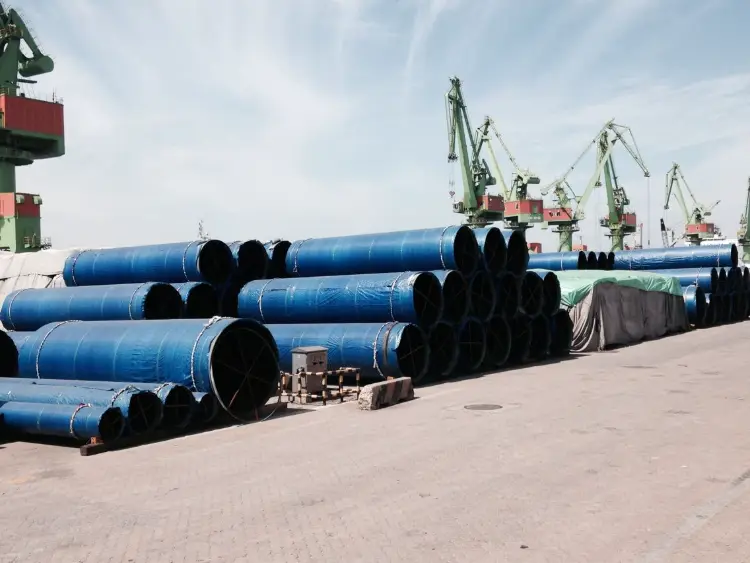
30CrMo Seamless Steel Tube for Gas Cylinders
30CrMo Seamless Steel Tube for Gas Cylinders: GB/T 18248 Specification & International Equivalents
Comprehensive technical data for 30CrMo seamless steel pipe according to GB/T 18248 for air bottle and high-pressure gas cylinder applications. Includes chemical composition, mechanical properties, physical properties, and international cross-reference equivalents.
Hot rolling, cold drawing, quenching and tempering, normalizing and tempering, machining, welding (preheat and post-weld heat treatment required)
- Phone : +8618037372205
- Email : [email protected]
- WhatsApp: Contact via Whtsapp
- WeChat: +8618037372205
30CrMo Seamless Steel Tube for Gas Cylinders Introduction
30CrMo is a medium-carbon chromium-molybdenum alloy steel primarily supplied as seamless tubes under GB/T 18248 for the manufacture of high-pressure gas cylinders. This grade offers an excellent combination of high strength, good toughness, and reliable weldability after appropriate heat treatment, typically quenching and tempering. The addition of chromium and molybdenum enhances hardenability and elevated-temperature strength while maintaining sufficient ductility for cold forming and resistance to brittle fracture at low temperatures.
- Key features: high tensile strength (Rm ≥930 MPa), minimum yield strength of 785 MPa, and guaranteed Charpy impact energy ≥40 J at -50 °C.
- Typical delivery condition: quenched and tempered (hardness ≤22 HRC after tempering recommended for machining), ensuring a fine tempered martensite/bainite microstructure suitable for cyclic pressure service.
30CrMo Seamless Steel Tube for Gas Cylinders Chemical Composition as per GB/T 18248 for 30CrMo
The chemical composition limits below apply to heat analysis of 30CrMo seamless steel tubes for gas cylinder applications. All values are percent by mass. Phosphorus and sulfur are strictly controlled to ensure cleanliness and improve toughness, especially for low-temperature impact properties. The sum of Cu+Ni is limited to avoid hot shortness and temper embrittlement. Residual elements like arsenic, tin, and lead may be further restricted by agreement.
| Chemical Element | Standard Value (wt%) | Remarks |
|---|---|---|
| Carbon (C) | 0.26 – 0.34 | Medium carbon range for strength and hardenability |
| Silicon (Si) | 0.17 – 0.37 | Deoxidizer and solid-solution strengthener |
| Manganese (Mn) | 0.40 – 0.70 | Improves hardenability and deoxidizes |
| Chromium (Cr) | 0.80 – 1.10 | Primary carbide former, enhances hardenability and corrosion resistance |
| Molybdenum (Mo) | 0.15 – 0.25 | Increases high-temperature strength and reduces temper embrittlement |
| Phosphorus (P) | ≤ 0.020 | Stringent limit for toughness and weldability |
| Sulfur (S) | ≤ 0.010 | Stringent limit to avoid hot cracking |
| Nickel (Ni) | ≤ 0.30 | Residual element, total with Cu ≤0.50% |
| Copper (Cu) | ≤ 0.20 | Residual element; higher levels can cause hot shortness |
30CrMo Seamless Steel Tube for Gas Cylinders Thermal and Electrical Physical Properties
The following physical properties are typical for 30CrMo steel in the quenched and tempered condition at ambient temperature unless otherwise indicated. These values are not specified in GB/T 18248 but are commonly used for engineering calculations. Data are sourced from reputable materials handbooks and may vary slightly with heat treatment and specific product form. Thermal expansion coefficient is given for a common temperature range relevant to gas cylinder service.
| Property | Typical Value | Unit | Test Condition |
|---|---|---|---|
| Density (ρ) | 7.85 | g/cm³ | At 20°C |
| Modulus of Elasticity (E) | 206 | GPa | Tensile modulus, room temperature |
| Shear Modulus (G) | 79.3 | GPa | Calculated from E and Poisson ratio |
| Poisson's Ratio (ν) | 0.30 | - | Within elastic range |
| Thermal Expansion Coefficient (α) | 11.2 | 10⁻⁶/K | Between 20°C and 100°C |
| Thermal Conductivity (λ) | 44 | W/(m·K) | At 100°C |
| Specific Heat Capacity | 460 | J/(kg·K) | At 20°C |
| Electrical Resistivity (ρₑ) | 0.23 | 10⁻⁶ Ω·m | At 20°C |
30CrMo Seamless Steel Tube for Gas Cylinders Mechanical Properties per GB/T 18248
Mechanical properties are verified on longitudinal test pieces taken from the tube body after the final heat treatment (quenching and tempering). 30CrMo tubes are typically tempered at a temperature not lower than 540°C. Values represent minimum requirements except where a range is given. The bending test ensures ductility sufficient for cold expansion finishing operations used in cylinder manufacturing. Charpy impact test is conducted at -50°C on longitudinal specimens, which is critical for cryogenic service cylinders.
| Property | Required Value | Unit | Test Condition / Remarks |
|---|---|---|---|
| Tensile Strength (Rm) | 930 – 1130 | MPa | Room temperature, longitudinal |
| Yield Strength (ReL) | ≥ 785 | MPa | Room temperature, 0.2% offset method if no distinct yield |
| Elongation after Fracture (A) | ≥ 12 | % | Gauge length 5.65√S₀ (proportional) on longitudinal test piece |
| Charpy Impact Energy (KV₂) | ≥ 40 | J | At -50 °C, longitudinal, average of three tests (min. single value 28 J) |
| Bend Test | No cracks or openings | - | Bend angle 180°, mandrel diameter = 4 × wall thickness (for tubes with wall ≤30 mm) |
30CrMo Seamless Steel Tube for Gas Cylinders Fully Equivalent International Standards and Substitute Grades for 30CrMo Gas Cylinder Tube
| Country/Region | Standard | Grade Designation | Remarks |
|---|---|---|---|
| China | GB/T 18248 | 30CrMo | Base specification; seamless tubes for high-pressure gas cylinders |
| USA | ASTM A519 | 4130 | Seamless carbon and alloy steel mechanical tubing; similar chemical and mechanical properties when supplied in Q&T condition for cylinder applications |
| Europe | EN 10297-1 | 25CrMo4 (1.7218) | Seamless circular steel tubes for mechanical and general engineering purposes; comparable strength and chemistry for tempered tubes |
| Japan | JIS G3441 | SCM430TK | Alloy steel tubes for machine structural purposes, TK (special quality) for cylinder applications; similar Cr-Mo grade |
| International | ISO 9809-1 | 34CrMo4 | Quenched and tempered steel tubes for refillable seamless steel gas cylinders; slightly higher carbon variant with equivalent mechanical properties |
30CrMo Seamless Steel Tube for Gas Cylinders Application Introduction
30CrMo seamless tubes under GB/T 18248 are specifically designed for manufacturing refillable high-pressure gas cylinders. The material's balance of strength, ductility, and low-temperature toughness makes it suitable for both stationary and automotive applications. Key applications and machinable components are listed below.
Product Applications: Seamless steel gas cylinders (water capacity up to 150 L), High-pressure storage vessels for compressed natural gas (CNG), Hydrogen refueling station buffer tanks, Seamless liner for composite overwrapped pressure vessels (COPV), Hydraulic accumulator shells
Processed into products: Cylinder body (main liner tube), Neck ring / end closure (machined from the same steel or compatible forging), Boss and valve connector, End plug and adapter, Pipe spool for high-pressure manifold
Application industries: Gas cylinder manufacturing (industrial, medical, beverage CO₂), Natural gas vehicles (CNG cylinders), Hydrogen energy (Type I steel cylinders for hydrogen storage), Fire protection (breathing apparatus cylinders), Offshore and marine (accumulator bottles), Aerospace (emergency oxygen bottles)
30CrMo Seamless Steel Tube for Gas Cylinders Similar/Alternative Materials with Comparable Performance
| Country/Region | Standard | Grade | Remarks |
|---|---|---|---|
| China | GB/T 3077 | 42CrMo (4140 equivalent) | Higher carbon and chromium content, providing higher hardenability and strength but lower toughness and ductility. Can be used for cylinders requiring higher working pressures if impact properties are re-qualified. |
| China | GB/T 3077 | 30CrMnSiA | High-strength structural steel with slightly lower Mo-free alloy system. Similar yield strength but lower fracture toughness at low temperatures; not standard for gas cylinder tubes unless specially agreed. |
| USA | ASTM A519 | 4140 | AISI 4140 offers greater depth of hardening and higher strength after tempering, but requires careful tempering to avoid brittleness. Suitable for heavy-wall cylinders. |
| Europe | EN 10297-1 | 34CrMo4 (1.7220) | Similar Cr-Mo grade with slightly higher carbon (0.30-0.37%), often used for gas cylinders under EN 10297; can be considered but may need re-certification per GB/T 18248. |
Notes:
- Heat treatment: Typical quenching temperature 860-880°C (oil or water quench), followed by tempering at 540-680°C to achieve the required mechanical properties. Tempering above 600°C may reduce tensile strength below the minimum if not controlled.
- Non-destructive testing: Seamless tubes are normally subjected to ultrasonic or eddy current inspection per the standard to guarantee freedom from defects.
- Marking: Tubes shall be marked with manufacturer's name, standard, grade, heat number, and inspection stamp as per GB/T 18248 requirements.
- For cylinders in hydrogen service, special low-temperature impact requirements (-50°C) are mandatory, already covered by the specification.
- Share



