
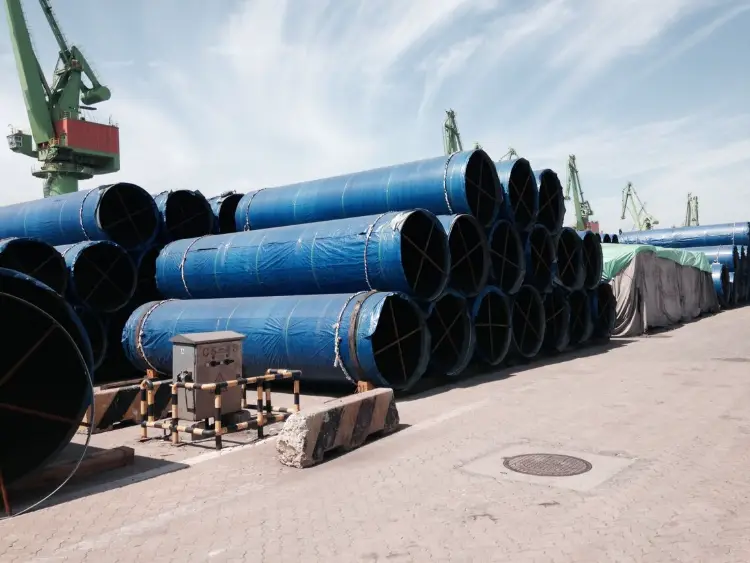
35CrMo Air Bottle Pipes GB/T 18248
35CrMo Air Bottle Pipes GB/T 18248 - High-Strength Seamless Tubes for Gas Cylinders
Comprehensive material data of 35CrMo alloy steel seamless tubes for high-pressure gas cylinders (air bottles) according to GB/T 18248, covering chemical composition, mechanical properties at various test conditions, thermal and electrical physical properties, international equivalents, and application guidance.
Hot rolling, cold drawing, heat treatment (quenching & tempering), machining, non-destructive testing
- Phone : +8618037372205
- Email : [email protected]
- WhatsApp: Contact via Whtsapp
- WeChat: +8618037372205
35CrMo Air Bottle Pipes GB/T 18248 Introduction
35CrMo is a chromium-molybdenum alloy structural steel specifically designed for seamless tubes used in high-pressure gas cylinders as per GB/T 18248. It exhibits high strength, excellent toughness, and good hardenability, making it suitable for repeated pressure cycling and low-temperature gas storage.
Key characteristics:
- High tensile strength (Rm ≥ 980 MPa) and yield strength (ReL ≥ 835 MPa) after quenching and tempering.
- Sufficient ductility (elongation ≥ 12%) and high reduction of area (Z ≥ 45%) to allow hot forming of cylinder ends.
- Low-temperature impact toughness (KV₂ ≥ 27 J at -50°C) for safe operation in cold climates.
- Strict control of sulfur and phosphorus to ensure cleanliness and resistance to hydrogen embrittlement.
- Used primarily for CNG, industrial gas, and medical oxygen cylinders.
35CrMo Air Bottle Pipes GB/T 18248 Chemical Composition
The chemical composition is tightly controlled to guarantee uniform hardenability, high toughness, and safe gas containment. Sulfur and phosphorus are kept at very low levels to minimize embrittlement and inclusion risks.
| Element | Standard Value | Remarks |
|---|---|---|
| C | 0.32–0.40 | Carbon for strength and hardenability |
| Si | 0.17–0.37 | Deoxidizer, contributes to strength |
| Mn | 0.40–0.70 | Improves hardenability and toughness |
| P | ≤0.020 | Max. impurity for ductility |
| S | ≤0.010 | Max. impurity for toughness and cleanliness |
| Cr | 0.80–1.10 | Principal hardenability and corrosion resistance element |
| Mo | 0.15–0.25 | Enhances hardenability, creep strength, and tempering resistance |
| Ni | ≤0.30 | Residual, may slightly improve toughness |
| Cu | ≤0.20 | Residual, normally kept low |
| Al (total) | ≤0.015* | Optional grain refiner; if added, controlled for fine grain |
35CrMo Air Bottle Pipes GB/T 18248 Thermal and Electrical Physical Properties
Physical properties of 35CrMo steel are similar to those of medium-carbon low-alloy Cr-Mo steels. Values are representative for a density of 7.82 g/cm³ at room temperature. Thermal expansion and conductivity are given for common temperature ranges.
| Property | Value | Unit | Test Conditions |
|---|---|---|---|
| Density (ρ) | 7.82 | g/cm³ | 20 °C |
| Elastic Modulus (E) | 210 | GPa | 20 °C |
| Shear Modulus (G) | 81 | GPa | 20 °C (calculated from E and ν) |
| Poisson's Ratio (ν) | 0.3 | – | 20 °C |
| Thermal Expansion Coefficient (α) | 12.2 | 10⁻⁶ / °C | 20 – 100 °C |
| Thermal Expansion Coefficient (α) | 13.5 | 10⁻⁶ / °C | 20 – 300 °C |
| Thermal Conductivity (λ) | 42.7 | W/(m·K) | 100 °C |
| Specific Heat Capacity (c) | 460 | J/(kg·K) | 20 °C |
| Electrical Resistivity (ρₑ) | 0.23 | µΩ·m | 20 °C |
35CrMo Air Bottle Pipes GB/T 18248 Mechanical Properties
Mechanical properties are tested after final heat treatment. Standard specifies minimum values for tubes with wall thickness up to 30 mm. Impact test at -50°C is mandatory to ensure safety at low service temperatures. Hardness values are typical for quenched and tempered condition.
| Property | Value | Unit | Test Conditions / Notes |
|---|---|---|---|
| Yield Strength (ReL, lower) | ≥ 835 | MPa | Quenched at 850°C (oil) / Tempered at 550°C (water or oil) |
| Tensile Strength (Rm) | 980 – 1180 | MPa | Quenched and tempered, gauge length 5.65√S₀ |
| Elongation (A) | ≥ 12 | % | 5.65√S₀ gauge; fracture outside middle third requires re-test |
| Reduction of Area (Z) | ≥ 45 | % | Measured at fracture |
| Impact Absorbed Energy (KV₂) | ≥ 27 | J | Charpy V-notch, -50 °C, transverse specimen |
| Brinell Hardness (HBW) | 250 – 330 (typical) | HBW | After Q&T, 10 mm ball, 3000 kg |
35CrMo Air Bottle Pipes GB/T 18248 Completely Equivalent Material Standards and Replaceable Designations
| Country/Region | Standard | Grade | Remarks |
|---|---|---|---|
| China | GB/T 18248 | 35CrMo | Intended for high-pressure gas cylinder tubes |
| International | ISO 9809-1 | 34CrMo4 | For seamless steel gas cylinders; similar chemical and mechanical requirements |
| European Union | EN 10297-1 | 34CrMo4 | Mechanical tubes; appropriate when ordered for cylinder applications |
| USA | ASTM A519 | 4135 | Seamless carbon and alloy steel mechanical tubing; nearest match in Cr-Mo series |
| Japan | JIS G3441 / JIS G4105 | SCM435TK / SCM435 | SCM435TK for mechanical tubing; SCM435 for alloy steel bars |
35CrMo Air Bottle Pipes GB/T 18248 Application Introduction
35CrMo tubes are the backbone of high-pressure seamless gas cylinder manufacturing. Their balanced mechanical properties allow reliable service under repeated filling cycles and harsh environments.
Typical production route:
- Tubes are received in quenched and tempered condition.
- They are hot-spun or cold-drawn to form cylinder necks and ends.
- After forming, cylinders undergo final stress-relief annealing and hydraulic pressure tests.
- Strict non-destructive testing (ultrasonic, magnetic particle) ensures zero critical defects.
Product Applications: Seamless high-pressure CNG cylinders for vehicles, Industrial gas storage bottles (ISO standard cylinders), Medical oxygen cylinders (portable and hospital backup), Fire extinguisher bodies (CO₂, dry powder), High-pressure hydrogen storage tanks (type I all-steel cylinders), Air receiver tanks (pressure accumulators)
Processed into products: Cylinder shell (main body, closed-end tube), Neck ring (hot-formed from tube end), Base cup (welded or shrunk-fit onto cylinder bottom), Threaded boss (for valve attachment, machined from neck area), Tube billet (for subsequent hot forming - delivered as full-length pipe)
Application industries: Automotive (Compressed Natural Gas - CNG and Hydrogen fuel storage), Industrial gas (O₂, N₂, Ar, CO₂ cylinders), Medical & healthcare (oxygen therapy, emergency portable cylinders), Firefighting (portable extinguishers and breathing apparatus), Aerospace & defence (lightweight high-pressure vessels for aircraft systems), Energy (hydrogen refuelling station storage)
35CrMo Air Bottle Pipes GB/T 18248 Similar / Alternative Material Recommendations
| Country/Region | Standard | Grade | Remarks |
|---|---|---|---|
| China | GB/T 18248 | 30CrMo | Lower carbon (0.26–0.34%) provides better toughness and weldability but slightly lower strength (Rm ≥ 880 MPa). Often used for thicker-walled cylinders. |
| China | GB/T 18248 | 42CrMo | Higher carbon (0.38–0.45%) gives higher strength (Rm ≥ 1080 MPa) but reduced ductility and impact toughness. Suitable when maximum strength is required. |
| USA/International | ASTM A519 / AISI | 4130 | Lower carbon (~0.30%) Cr-Mo steel. Offers good combination of strength and toughness; widely used for aircraft and automotive cylinders, but may need thicker walls to meet same pressure ratings. |
| Germany/EU | DIN EN 10297-1 | 34CrMo4 | Almost identical composition to 35CrMo; can directly substitute in many cylinder designs subject to certification. |
| Japan | JIS G3441 | SCM435TK | Cr-Mo steel tube grade with similar hardenability; check specific mechanical property requirements for cylinder use. |
Notes:
Additional requirements as per GB/T 18248:
- Non-destructive testing: Each tube shall be ultrasonically inspected over the entire length and circumference; eddy current or magnetic particle testing may supplement for surface defects.
- Hydrostatic pressure test: Final cylinders are tested at 1.5× design service pressure.
- Burst test: Prototype cylinders must pass burst test with a minimum burst ratio.
- Flattening test: Samples shall withstand flattening without cracks to demonstrate hot forming capability.
- Grain size: Fine austenitic grain (typically ASTM No. 5 or finer) is ensured by aluminium control.
- Hydrogen embrittlement resistance: Low sulphur and phosphorus, plus careful heat treatment reduce susceptibility.
- Share



