
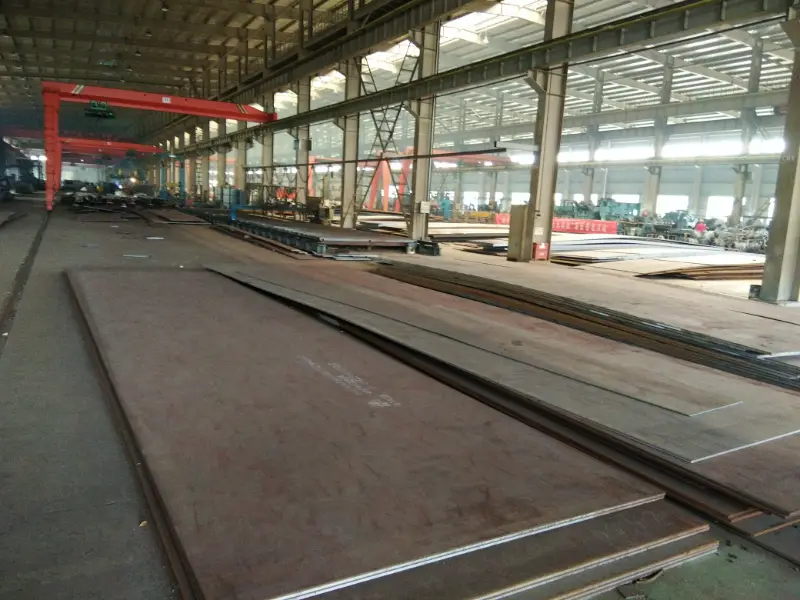
EN10025-3 S275N Steel
EN10025-3 S275N Steel: Normalized Fine Grain Structural Steel for Welded Construction
Comprehensive material data for S275N steel grade under EN10025-3. Includes chemical composition, mechanical properties, thermal and electrical properties, international equivalents, and application guide.
Hot rolling, normalized rolling, normalization, cold forming, machining, welding, and hot-dip galvanizing
- Phone : +8618037372205
- Email : [email protected]
- WhatsApp: Contact via Whtsapp
- WeChat: +8618037372205
EN10025-3 S275N Steel Introduction
S275N is a weldable fine-grain structural steel grade defined in the European standard EN 10025-3, designated by its minimum yield strength of 275 MPa and delivery condition 'N' (normalized or normalized rolled). This low-alloy carbon steel is engineered for superior toughness and weldability, making it suitable for heavily loaded and dynamically stressed welded structures. Key characteristics include:
- High resistance to brittle fracture at low temperatures, with guaranteed impact energy values down to -20°C.
- Fine-grain microstructure achieved through normalization, which refines the grain size using nitrogen-binding elements like aluminium.
- Excellent process reliability for cold forming, welding, and hot-dip galvanizing.
- Balanced combination of strength, ductility, and through-thickness deformation properties.
EN10025-3 S275N Steel Chemical Composition
The chemical composition of S275N steel is strictly controlled to ensure its fine-grain structure and superior mechanical properties. Key alloying principles include:
- Carbon (C) is limited to ensure good weldability and toughness.
- Manganese (Mn) contributes to strength and toughness.
- Aluminium (Al) or other nitrogen-binding elements are added to achieve the fine-grain microstructure.
- Residual elements such as phosphorus and sulfur are kept very low to enhance ductility and resistance to cracking.
Values are based on heat analysis according to EN 10025-1:2004 for product thickness ≤ 100mm.
| Element | Standard Value (Max %) | Remarks |
|---|---|---|
| Carbon (C) | 0.18 | Max. for thickness ≤ 100mm |
| Silicon (Si) | 0.50 | Max. |
| Manganese (Mn) | 0.50 – 1.50 | Range |
| Phosphorus (P) | 0.025 | Max. |
| Sulfur (S) | 0.015 | Max. |
| Aluminium (Al, total) | ≥ 0.020 | Minimum for fine grain practice |
| Nitrogen (N) | 0.012 | Max. |
| Chromium (Cr) | 0.30 | Max., allowable residual |
| Copper (Cu) | 0.55 | Max., allowable residual |
| Molybdenum (Mo) | 0.10 | Max., allowable residual |
| Nickel (Ni) | 0.30 | Max., allowable residual |
| Titanium (Ti) | 0.05 | Max. |
| Vanadium (V) | 0.05 | Max. |
| Niobium (Nb) | 0.05 | Max. |
| C.E.V. (CEV) | 0.40 | Max. typical, based on formula CEV= C+Mn/6+(Cr+Mo+V)/5+(Ni+Cu)/15 |
EN10025-3 S275N Steel Thermal and Electrical Physical Properties
Physical properties for S275N steel are provided for engineering calculation purposes, evaluated at room temperature unless specified. These values are typical for low-alloy fine-grain structural steels:
- Density is fundamental for dead-weight calculations.
- Moduli of elasticity, Poisson's ratio, and thermal expansion are critical for structural analysis and design.
- Thermal conductivity and specific heat capacity are essential for simulating welding processes and fire resistance.
- Properties are moderately temperature-dependent and may vary slightly based on the exact microstructural condition.
| Property Item | Standard Required Value | Unit | Test Condition |
|---|---|---|---|
| Density (ρ) | 7.85 | kg/dm³ | At 20°C |
| Modulus of Elasticity (E) | 210 | GPa | At 20°C |
| Shear Modulus (G) | ~81 | GPa | At 20°C, calculated from E and ν |
| Poisson's Ratio (ν) | 0.3 | No Unit | At 20°C |
| Thermal Expansion Coefficient (α) | 12.0 x 10⁻⁶ | K⁻¹ | Range 20-100°C |
| Thermal Expansion Coefficient (α) | 12.5 x 10⁻⁶ | K⁻¹ | Range 20-200°C |
| Thermal Expansion Coefficient (α) | 13.0 x 10⁻⁶ | K⁻¹ | Range 20-300°C |
| Thermal Conductivity (λ) | 52 | W/(m·K) | At 20°C |
| Specific Heat Capacity (c) | 460 | J/(kg·K) | At 20°C |
| Electrical Resistivity (ρ_e) | 0.15 – 0.25 | Ω·mm²/m | At 20°C |
EN10025-3 S275N Steel Mechanical Properties
The following mechanical properties are guaranteed for normalized S275N steel under the EN10025-3 standard. Performance criteria include:
- Tensile testing at ambient temperature according to EN 10002-1.
- Charpy V-notch impact testing to guarantee low-temperature toughness.
- Bend testing capability to demonstrate sufficient ductility for forming.
- Properties are verified on test pieces taken transverse to the rolling direction, based on nominal thickness ranges.
| Property Item | Standard Required Value | Unit | Test Condition |
|---|---|---|---|
| Minimum Yield Strength (ReH) | 275 | MPa | Nominal thickness ≤ 16mm |
| Minimum Yield Strength (ReH) | 265 | MPa | Nominal thickness > 16mm ≤ 40mm |
| Minimum Yield Strength (ReH) | 255 | MPa | Nominal thickness > 40mm ≤ 100mm |
| Tensile Strength (Rm) | 370 – 510 | MPa | Nominal thickness ≤ 100mm |
| Minimum Elongation (A, Lo=5.65√So) | 24 | % | Nominal thickness ≤ 16mm |
| Minimum Elongation (A, Lo=5.65√So) | 23 | % | Nominal thickness > 16mm ≤ 40mm |
| Minimum Elongation (A, Lo=5.65√So) | 22 | % | Nominal thickness > 40mm ≤ 100mm |
| Minimum Impact Energy (KV, Longitudinal) | 40 | J | At -20°C |
| Minimum Impact Energy (KV, Transverse) | 27 | J | At -20°C |
| Bend Test (Minimum Bend Radius) | 1-2 x t | No Unit | 180° bend test as per EN 10025-1 |
EN10025-3 S275N Steel Completely Equivalent Material Standards and Replaceable Designations
| Country/Region | Standard | Designation | Remarks |
|---|---|---|---|
| European Union | EN 10025-3:2019 | S275N | Original standard and designation |
| Germany | DIN EN 10025-3 | S275N | Adopted European standard |
| France | NF EN 10025-3 | S275N | Adopted European standard |
| United Kingdom | BS EN 10025-3 | S275N | Adopted European standard |
| Italy | UNI EN 10025-3 | S275N | Adopted European standard |
| Spain | UNE EN 10025-3 | S275N | Adopted European standard |
| International | ISO 630-3 | E275N | Technically equivalent fine-grain steel |
EN10025-3 S275N Steel Application Introduction
S275N is optimized for demanding structural applications where resistance to brittle fracture and high reliability during welding are crucial. Its fine-grain structure and guaranteed toughness at sub-zero temperatures make it the preferred choice over standard steels for heavy dynamic and impact loads. Common application sectors and examples include:
Product Applications: Welded I-beams and box columns for high-load bearing members., Structural hollow sections for dynamically loaded lattice frame constructions., Hot-rolled plates cut and welded into complex joint nodes for bridges., Normalized strips slitted into high-precision blanks for automotive structural parts (e.g., truck chassis components).
Processed into products: Bridge bearing stiffeners and main girder webs., Reinforced joints and base plates for heavy machinery., Lattice members in tower cranes and crawler cranes., Stiffened panels for ship superstructures and inland waterway vessel hulls., Tunnel lining segments and structural ribs in mining support systems.
Application industries: Bridge Building: Steel girders, arch bridges, roadway expansion joints., Industrial and Commercial Construction: High-rise building columns, trusses, stadium roof support structures., Heavy Machinery Manufacturing: Excavator booms, truck frames, press frames., Offshore Technology: Jack-up rig legs, ship hull stiffeners, deck modules (where not in highly corrosive splash zone without protection)., Crane and Conveying Technology: Mobile crane telescopic booms, gantry crane beams, heavy-duty roller conveyors., Energy Sector: Penstocks, spiral casings for hydroelectric power plants, wind turbine tower internal platforms.
EN10025-3 S275N Steel Recommendation for Similar/Near Equivalent Materials
| Country/Region | Standard | Designation | Remarks |
|---|---|---|---|
| China | GB/T 1591-2018 | Q275ND | Similar normalized delivery condition; verification of full compliance with EN10025-3 needed |
| European Union | EN 10025-2:2019 | S275J2 | Equivalent strength level, J2 guarantees -20°C impact, but not fine-grain treated against EN10025-3 |
| European Union | EN 10025-4:2019 | S275M | Thermomechanically rolled equivalent to S275N with similar mechanical properties and weldability |
| USA | ASTM A572 / A572M | Grade 42 [290] | Similar strength grade; chemical and impact requirements differ and must be compared |
| Japan | JIS G 3136 | SN400B | Steel for building structure with similar yield and impact, but different carbon equivalent approach |
Notes:
Supplemental Important Information:
- Weldability: S275N exhibits excellent arc welding properties using all standard processes (SMAW, GMAW, SAW). The low carbon equivalent (CEV ≤ 0.40) typically eliminates the need for pre-heating on thin to medium sections, though a welding engineer should establish procedures per EN 1011-2 based on actual thickness, heat input, and hydrogen scaling.
- Cold Forming: The material is well-suited for cold flanging, bending, and pressing of radii consistent with the minimum recommended bend radii. Stress-relief annealing after severe cold deformation is recommended to restore toughness properties.
- Corrosion Resistance: As an unprotected carbon steel, S275N is not intrinsically corrosion resistant and requires surface protection (coating, galvanizing, painting) for outdoor or wet exposure. It has good suitability for hot-dip galvanizing due to controlled silicon content.
- Product of Analysis and Inspection: Inspection documents per EN 10204, Type 3.1 or 3.2, are standard for this grade to verify compliance with all required specifications.
- Share



