
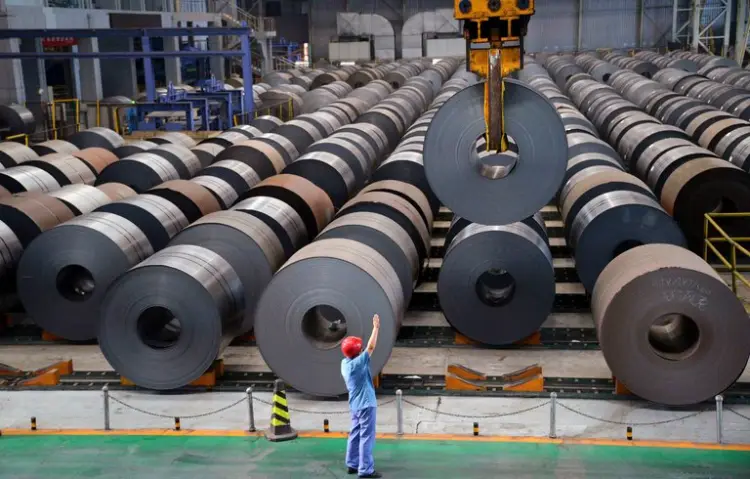
GB/T 14164-2013 X56N (L390N) PSL2 Pipeline Steel Coil
GB/T 14164-2013 X56N (L390N) PSL2 Pipeline Steel Coil - Premium Structural Steel for Oil & Gas Transmission
Explore the properties, equivalents, and applications of X56N (L390N) PSL2 pipeline steel coil according to GB/T 14164-2013.
Hot rolling, thermomechanical rolling, normalizing rolling, normalizing heat treatment
- Phone : +8618037372205
- Email : [email protected]
- WhatsApp: Contact via Whtsapp
- WeChat: +8618037372205
GB/T 14164-2013 X56N PSL2 Pipeline Steel Coil Introduction
GB/T 14164-2013 X56N (L390N) PSL2 is a high-strength low-alloy pipeline steel coil specifically designed for longitudinal or helical welded pipes used in oil and gas transmission. As a PSL2 grade, it offers enhanced notch toughness, stricter chemical composition controls, and mandatory impact testing compared to PSL1, ensuring reliable performance in demanding environments including onshore and offshore sour service conditions. The material is delivered in the normalized or normalizing-rolled condition (indicated by the suffix N), providing a uniform fine-grained microstructure that optimizes strength (minimum yield strength 390 MPa) and excellent weldability. Typical applications include high-pressure natural gas and crude oil pipelines, where high toughness at low temperatures and resistance to ductile fracture propagation are critical. It fully complies with the technical delivery conditions for steel strips used in welded pipes, covering thicknesses up to approximately 25 mm, and is widely accepted in international markets due to its equivalence to API 5L X56N PSL2 and ISO 3183 L390N.
GB/T 14164-2013 X56N PSL2 Pipeline Steel Coil Chemical Composition
The chemical composition of X56N (L390N) PSL2 pipeline steel is strictly controlled to achieve the required strength, weldability, and toughness. The limits below are based on GB/T 14164-2013 for PSL2 grades and apply to the heat analysis. The carbon equivalent (CEV) is limited to prevent cold cracking during welding. Microalloying elements like V, Nb, and Ti are used for grain refinement and precipitation strengthening.
| Element | Standard Value (≤) | Remarks |
|---|---|---|
| C | 0.22 | Max; heat analysis |
| Si | 0.45 | Max; heat analysis |
| Mn | 1.40 | Max; heat analysis |
| P | 0.025 | Max; PSL2 limit |
| S | 0.015 | Max; PSL2 limit |
| V | 0.05 | Max; per element |
| Nb | 0.05 | Max; per element |
| Ti | 0.04 | Max; per element |
| V+Nb+Ti | 0.15 | Max; sum of microalloying |
| Cu | 0.35 | Max; if agreed |
| Ni | 0.30 | Max; if agreed |
| Cr | 0.30 | Max; if agreed |
| Mo | 0.15 | Max; if agreed |
| CEV | 0.43 | Max for thickness ≤25 mm; PSL2 |
| Fe | Balance | Remainder |
GB/T 14164-2013 X56N PSL2 Pipeline Steel Coil Physical and Thermal Properties
The following physical properties are typical for carbon-manganese pipeline steel in the normalized or normalizing-rolled condition at room temperature unless otherwise specified. These values are suitable for design calculations and are not mandatory per the product standard, but represent commonly accepted engineering data for X56N (L390N) type steel. Thermal conductivity and expansion coefficient are provided for a range of temperatures to assist in welding and thermal stress analysis.
| Property | Typical Value | Unit | Test Condition / Temperature |
|---|---|---|---|
| Density (ρ) | 7.85 | g/cm³ | 20°C |
| Elastic Modulus (E) | 210 | GPa | Room temperature |
| Shear Modulus (G) | 81 | GPa | Room temperature |
| Poisson's Ratio (ν) | 0.3 | - | Room temperature |
| Thermal Expansion Coefficient (α) | 12.5 × 10⁻⁶ | K⁻¹ | 20–100°C |
| Thermal Expansion Coefficient (α) | 13.5 × 10⁻⁶ | K⁻¹ | 20–300°C |
| Thermal Conductivity (λ) | 45.0 | W/(m·K) | 20°C |
| Thermal Conductivity (λ) | 41.0 | W/(m·K) | 200°C |
| Specific Heat Capacity (cp) | 460 | J/(kg·K) | 20°C |
| Electrical Resistivity (ρe) | 0.15 | μΩ·m | 20°C |
GB/T 14164-2013 X56N PSL2 Pipeline Steel Coil Mechanical Properties
Mechanical properties are determined on test pieces taken transverse to the rolling direction and are mandatory for PSL2 compliance. The specified yield strength (Rt0.5) and tensile strength (Rm) are applicable to the as-delivered condition. Charpy V-notch impact tests are performed at the temperature designated by the grade suffix (N indicates -10°C, while M would be at -20°C). Elongation depends on wall thickness and is calculated using the formula A = 1950000 / Rm^0.9 (for metric units) or can be taken from tables.
| Property | Standard Requirement | Unit | Test Condition |
|---|---|---|---|
| Yield Strength (Rt0.5) | 390 – 545 | MPa | Transverse direction, room temperature, strip/coil |
| Tensile Strength (Rm) | 490 – 755 | MPa | Transverse direction, room temperature |
| Elongation (A) | ≥ 22 (typical for ≤25 mm) | % | Gauge length 50 mm or L0 = 5.65√S0; transverse |
| Yield-to-Tensile Ratio (Rt0.5/Rm) | ≤ 0.90 | - | PSL2 requirement |
| Charpy Impact Energy (KV) | ≥ 27 (average) / ≥ 20 (single) | J | Temperature -10°C; 10×10×55 mm specimen; transverse |
| Bend Test | No cracks | - | Guided bend; 180°; mandrel diameter 3T (T≤12.7 mm) or 4T |
| Hardness (Optional) | ≤ 250 HV10 or ≤ 22 HRC | - | For sour service specification if required |
GB/T 14164-2013 X56N PSL2 Pipeline Steel Coil Fully Equivalent Material Standards and Substitute Grades
| Country/Region | Standard | Grade | Remarks |
|---|---|---|---|
| United States / International | API Spec 5L (46th Ed.) | X56N PSL2 | Direct equivalent; identical chemical and mechanical requirements |
| International | ISO 3183:2019 | L390N | Same grade designation; technical delivery conditions harmonized with API 5L |
| Europe | EN 10208-2:2009 | L390NB | Equivalent for gas pipelines; N indicates normalized; analogous toughness |
| Russia | GOST R 52079-2003 (approximate) | K56-2 | Strength class K56 corresponds to yield ~390 MPa, with N‑type normalizing option |
| Brazil | ABNT NBR 14730 | X56N | Harmonized with API 5L |
| China | GB/T 14164-2013 | X56N (L390N) PSL2 | The base standard covered here |
GB/T 14164-2013 X56N PSL2 Pipeline Steel Coil Application Introduction
X56N (L390N) PSL2 pipeline steel coil is engineered for high-pressure oil and gas transmission systems where reliability and safety are paramount. Its good low-temperature toughness makes it ideal for arctic and subsea pipelines. The material is suitable for spiral and longitudinal submerged arc welding (SAW) as well as electric resistance welding (ERW). It is also cost-effective for large-diameter pipelines due to its combination of strength and formability. Engineering applications focus on components that demand a balance of high strength, ductility, and fracture arrest properties.
Product Applications: High-pressure natural gas pipelines, Crude oil trunk lines, Refined product pipelines, Offshore riser pipes, Subsea flowlines (with appropriate anti-corrosion coating), Gas storage well casings
Processed into products: Pipeline joint segments (straight pipes), Induction bends and elbows, Tees and reducers, Flanges and weld-neck flanges, Closures and pressure vessel shells fabricated from coil plate, Longitudinally welded tubular poles for utility structures
Application industries: Oil and Gas Transmission, Petrochemical Processing, Offshore Engineering, Power Generation (Gas transport), Water Supply (large-diameter water mains where high strength is desired)
GB/T 14164-2013 X56N PSL2 Pipeline Steel Coil Similar or Closely Related Materials
| Country/Region | Standard | Grade | Remarks |
|---|---|---|---|
| China/International | GB/T 14164 / API 5L | X52N (L360N) | Lower strength (360 MPa yield), but similar normalized condition and PSL2 toughness; suitable if lower pressure rating acceptable |
| China/International | GB/T 14164 / API 5L | X60N (L415N) | Higher strength (415 MPa yield) with similar chemistry; may require adjustment in welding procedures |
| China/International | GB/T 14164 / API 5L | X56M (L390M) | Same strength level but delivered in thermomechanical rolled condition; may have different toughness temperature requirements (M typically -20°C) |
| China | GB/T 700 | Q390D | Structural steel with comparable yield strength, but not specifically for pipeline; may lack hydrogen-induced cracking (HIC) resistance |
| Europe | EN 10028-3 | P355N | Pressure vessel steel with similar normalized condition; used for steel plates but not in coil form |
Notes:
Additional Requirements for PSL2: In addition to mandatory notch toughness, PSL2 grades under GB/T 14164-2013 have a maximum carbon equivalent (CEV) limit, restricted non-metallic inclusion levels, and often require through-thickness tensile or fracture toughness testing when specified for sour service (HIC/SSC resistant). The suffix N indicates a normalized or normalizing-rolled delivery condition; for sour gas applications, further chemistry restrictions (e.g., S ≤ 0.003%, Ca treatment) and special test reports are necessary. Always consult the final product specification for exact dimensional tolerances and supplementary requirements.
- Share



