
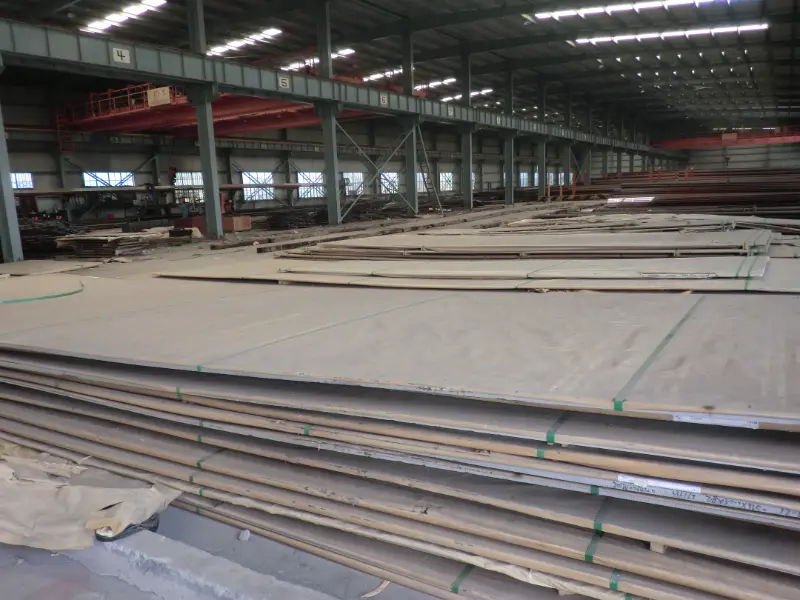
022Cr19Ni5Mo3Si2N (S21953) Duplex Stainless Steel
022Cr19Ni5Mo3Si2N (S21953) Duplex Stainless Steel Plate/Coil – Chemical, Mechanical & Physical Data
Complete material data for 022Cr19Ni5Mo3Si2N (former 00Cr18Ni5Mo3Si2) according to GB/T 4237. Covers chemical composition, mechanical properties, thermal and electrical physical performance, international equivalents, and application guidelines.
Welding, cutting, forming, machining (solution annealing required after hot working)
- Phone : +8618037372205
- Email : [email protected]
- WhatsApp: Contact via Whtsapp
- WeChat: +8618037372205
022Cr19Ni5Mo3Si2N Duplex Stainless Steel Introduction
022Cr19Ni5Mo3Si2N, also designated as S21953 and formerly known as 00Cr18Ni5Mo3Si2, is a nitrogen-enhanced, low-carbon austenitic-ferritic (duplex) stainless steel specified in GB/T 4237 for hot-rolled plates and coils. Its balanced two-phase microstructure (approximately 50% austenite and 50% ferrite) provides an excellent combination of high strength, good ductility, and outstanding resistance to stress corrosion cracking, especially in chloride-containing environments. The controlled additions of chromium, molybdenum, and nitrogen significantly improve pitting and crevice corrosion resistance compared to standard austenitic grades. This grade offers roughly twice the yield strength of common 304L/316L stainless steels while maintaining good weldability and formability. Typical delivery condition is solution annealed, ensuring optimum corrosion resistance and mechanical properties. It is widely used in chemical processing, marine engineering, desalination, and pulp & paper industries where high mechanical loads and aggressive media are encountered.
022Cr19Ni5Mo3Si2N Duplex Stainless Steel Chemical Composition
Chemical composition according to GB/T 4237-2015 for grade 022Cr19Ni5Mo3Si2N (S21953). All values are in weight percent. The alloy relies on chromium, molybdenum, and nitrogen for pitting resistance, while nickel stabilizes the austenite phase. Low carbon content minimizes intergranular carbide precipitation during welding.
- Si improves fluidity and oxidation resistance.
- N significantly enhances strength and corrosion resistance.
| Element | Standard Value (wt%) | Remarks |
|---|---|---|
| Carbon (C) | ≤ 0.030 | Low carbon to prevent sensitization |
| Silicon (Si) | 1.30 – 2.00 | Deoxidizer, aids phase balance |
| Manganese (Mn) | ≤ 2.00 | Austenite stabilizer |
| Phosphorus (P) | ≤ 0.035 | Impurity control |
| Sulfur (S) | ≤ 0.030 | Impurity, machinability improvement limited |
| Chromium (Cr) | 18.0 – 19.5 | Key element for corrosion resistance |
| Nickel (Ni) | 4.50 – 5.50 | Controls austenite/ferrite ratio |
| Molybdenum (Mo) | 2.50 – 3.00 | Enhances pitting resistance |
| Nitrogen (N) | 0.05 – 0.12 | Strength and corrosion improvement |
022Cr19Ni5Mo3Si2N Duplex Stainless Steel Thermal and Electrical Physical Properties
Typical physical properties at room temperature unless otherwise indicated. These values are not mandatory standard requirements but represent commonly accepted data for this duplex stainless steel grade. Density is slightly lower than austenitic grades, and thermal expansion is between carbon steel and austenitic stainless steel, reducing thermal stress in composite structures.
| Property | Typical Value | Unit | Test Condition / Remarks |
|---|---|---|---|
| Density (ρ) | 7.8 | g/cm³ | 20 °C |
| Elastic Modulus (E) | 200 | GPa | 20 °C; average tension |
| Shear Modulus (G) | 77 | GPa | 20 °C; calculated |
| Poisson's Ratio (ν) | 0.30 | — | 20 °C |
| Thermal Expansion Coefficient (α) | 13.5 | 10⁻⁶/K | 20–100 °C |
| Thermal Conductivity (λ) | 15 | W/(m·K) | 20 °C |
| Specific Heat Capacity | 460–500 | J/(kg·K) | 20 °C |
| Electrical Resistivity (ρₑ) | 0.8 | µΩ·m | 20 °C |
022Cr19Ni5Mo3Si2N Duplex Stainless Steel Mechanical Properties
Mechanical properties as per GB/T 4237-2015 for 022Cr19Ni5Mo3Si2N in solution-annealed condition. The duplex structure provides nearly double the yield strength of conventional austenitic stainless steels. Values vary with thickness; typical ranges are given.
- Elongation requirement decreases for thicker sections.
- Hardness values apply to any thickness (solution annealed).
| Property | Required Value | Unit | Test Condition |
|---|---|---|---|
| Yield Strength (Rp0.2) | ≥ 390 | MPa | Room temperature, thickness ≤ 75 mm |
| Tensile Strength (Rm) | ≥ 590 | MPa | Room temperature, thickness ≤ 75 mm |
| Elongation (A) | ≥ 20 | % | Gauge length 50 mm, thickness ≤ 30 mm |
| Elongation (A) | ≥ 18 | % | Gauge length 50 mm, thickness > 30–75 mm |
| Brinell Hardness (HBW) | ≤ 290 | — | Solution annealed |
| Rockwell Hardness (HRB) | ≤ 96 | — | Solution annealed |
| Rockwell Hardness (HRC) | ≤ 30 | — | Solution annealed, for reference |
022Cr19Ni5Mo3Si2N Duplex Stainless Steel Fully Equivalent Material Standards and Replaceable Grades
| Country/Region | Standard | Grade / Designation | Remarks |
|---|---|---|---|
| China | GB/T 4237 | 022Cr19Ni5Mo3Si2N (S21953) | Base standard |
| China | GB/T 20878 | S21953 | Unified digital designation |
| EU | EN 10088-2 | 1.4424 (X2CrNiMoSi18-5-3) | Identical composition and application |
| USA | ASTM A240 / A240M | UNS S31500 | Slight variations in Ni and Cr but within overlap; fully interchangeable |
| International | ISO 4955 | X2CrNiMoSi18-5-3 | Equivalent heat-resistant stainless steel |
022Cr19Ni5Mo3Si2N Duplex Stainless Steel Application Introduction
022Cr19Ni5Mo3Si2N duplex stainless steel is specifically designed for aggressive environments requiring high strength and stress corrosion cracking resistance. Its superior corrosion resistance in chloride-bearing media makes it an ideal candidate for many capital-intensive industries. The material can be formed, machined, and welded using standard practices, but should be re-solution annealed after heavy hot working. Common delivery forms include hot-rolled plates and coils from which a wide array of components are fabricated.
Product Applications: Hot-rolled plates for pressure vessels and tanks, Coils for welded pipes and tubes, Structural sections for marine applications, Clad plates for corrosion-resistant linings, Shell and tube heat exchangers
Processed into products: Centrifuge bodies and parts, Impellers and pump shafts, Valve bodies and trim, Chemical storage tanks, Seawater cooling system pipes, FGD absorber tower internals, Brackets and supports in offshore platforms
Application industries: Chemical and Petrochemical Processing, Marine Engineering and Offshore Structures, Desalination Plants, Pulp and Paper Production, Flue Gas Desulfurization (FGD) Systems, Heat Exchangers and Pressure Vessels, Oil and Gas Extraction Equipment
022Cr19Ni5Mo3Si2N Duplex Stainless Steel Similar / Substitute Material Recommendations
| Country/Region | Standard | Grade | Remarks |
|---|---|---|---|
| USA / Europe | ASTM A240 / EN 10088-2 | UNS S32205 / 1.4462 (2205) | Higher Mo and N; higher strength and better corrosion resistance, widely used duplex |
| USA / Europe | ASTM A240 / EN 10088-2 | UNS S32304 / 1.4362 (2304) | Lower Mo; economical duplex for less severe chlorides; lower strength |
| USA / Europe | ASTM A240 / EN 10088-2 | UNS S31803 / 1.4462 | Older 2205 composition; similar to S32205, suitable substitution with care |
| Europe | EN 10088-2 | 1.4162 (X2CrMnNiN21-5-2-2) | Low-Ni duplex; cost-effective with reduced corrosion resistance |
Notes:
- Welding: Use matching filler metal (e.g., ER2209 or similar) with low heat input (0.5–2.5 kJ/mm) to maintain phase balance. Interpass temperature should not exceed 150 °C. Post-weld solution annealing is recommended for critical corrosion applications.
- Forming: Due to higher strength, bending requires more force than austenitic grades. Hot forming should be performed at 1100–950 °C followed by solution annealing.
- Heat treatment: Solution annealing at 980–1040 °C with rapid cooling. Do not hold in the 475 °C embrittlement range or sigma-phase formation range (600–900 °C).
- Corrosion: Pre-qualification according to ASTM G48 Method A (critical pitting temperature typically >20 °C in 6% FeCl₃) is recommended for highly acidic or oxidizing environments.
- Share



