
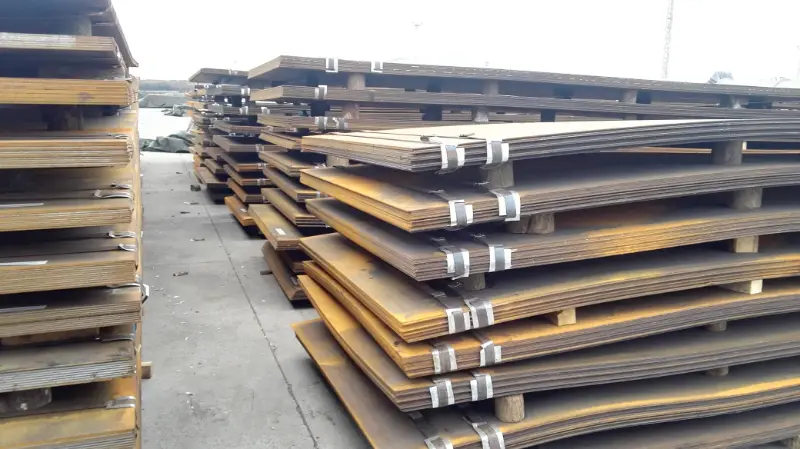
GB/T 11251 40Cr Hot Rolled Structural Steel Plate Material
40Cr Alloy Structural Steel Plate per GB/T 11251: Hot-Rolled High-Strength Quenched & Tempered Steel
40Cr is a chromium-alloyed structural steel supplied as hot-rolled plates under GB/T 11251, designed for quenching and tempering to achieve high strength and good toughness for machinery components.
Hot rolling, annealing, normalizing, quenching and tempering, surface hardening (induction hardening), machining
- Phone : +8618037372205
- Email : [email protected]
- WhatsApp: Contact via Whtsapp
- WeChat: +8618037372205
GB/T 11251 40Cr Hot Rolled Structural Steel Plate Introduction
40Cr is a Chinese standard alloy structural steel widely used in the manufacture of medium-sized, moderately loaded mechanical parts. Under GB/T 11251 (Hot-rolled alloy structural steel plates), it is typically supplied in hot-rolled, annealed, or high-temperature tempered condition. After final heat treatment (quenching and tempering), 40Cr exhibits excellent comprehensive mechanical properties, including high tensile strength (≥980 MPa), good yield strength (≥785 MPa), and moderate toughness. Its hardenability is adequate for parts with section sizes up to 50 mm in oil quenching. Common applications include gears, shafts, connecting rods, and bolts where good wear resistance and fatigue strength are required. The steel offers a good balance of strength and cost-effectiveness, making it one of the most popular alloy steels in the Chinese machinery industry.
GB/T 11251 40Cr Hot Rolled Structural Steel Plate Chemical Composition of 40Cr per GB/T 3077
Chemical composition according to GB/T 3077-2015, the basis standard for alloy structural steels in China. The values represent ladle analysis.
- Carbon provides hardenability and strength.
- Chromium improves hardenability, strength, and wear resistance.
- Manganese and Silicon deoxidize and enhance strength.
- Phosphorus and Sulfur are strictly limited as residuals.
| Element | Specified Value (wt%) | Remarks |
|---|---|---|
| Carbon (C) | 0.37 – 0.44 | Key hardening element |
| Silicon (Si) | 0.17 – 0.37 | Deoxidizer, strength contributor |
| Manganese (Mn) | 0.50 – 0.80 | Hardenability and strength |
| Chromium (Cr) | 0.80 – 1.10 | Major alloying element for hardenability |
| Phosphorus (P) | ≤ 0.030 | Maximum residual |
| Sulfur (S) | ≤ 0.030 | Maximum residual |
| Nickel (Ni) | ≤ 0.30 | Residual element |
| Copper (Cu) | ≤ 0.25 | Residual element |
GB/T 11251 40Cr Hot Rolled Structural Steel Plate Thermal, Electrical and Physical Properties of 40Cr
These values are typical for 40Cr alloy steel in the quenched and tempered condition, collected from reliable engineering material databases. They may vary slightly with heat treatment and temperature.
- Density is standard for low-alloy steel.
- Elastic moduli decrease at elevated temperatures.
- Thermal expansion coefficient is given for the range 20-100°C.
- Thermal conductivity and electrical resistivity are representative for alloy steel.
| Property | Typical Value | Unit | Condition / Temperature |
|---|---|---|---|
| Density (ρ) | 7.85 | g/cm³ | 20°C |
| Elastic modulus (E) | 206 | GPa | 20°C |
| Shear modulus (G) | 79.4 | GPa | 20°C (estimated from E and ν) |
| Poisson's ratio (ν) | 0.30 | – | 20°C |
| Thermal expansion coefficient (α) | 11.5 | 10⁻⁶ /K | 20 to 100°C |
| Thermal conductivity (λ) | 32.6 | W/(m·K) | 100°C |
| Specific heat capacity | 460 | J/(kg·K) | 20°C |
| Electrical resistivity (ρₑ) | 0.23 | 10⁻⁶ Ω·m (Ω·mm²/m) | 20°C |
GB/T 11251 40Cr Hot Rolled Structural Steel Plate Mechanical Properties of 40Cr Steel Plate per GB/T 11251-2020
Mechanical properties are specified for samples heat treated according to standard recommendations (quenching at 850°C in oil, tempering at 520°C in water or oil).
- Yield strength and tensile strength represent minimum values for plates up to 250 mm thickness.
- Elongation and reduction of area indicate good ductility after tempering.
- Impact energy (KV2) is measured on Charpy V-notch specimens at room temperature.
- Values apply to longitudinal samples. Hardness after delivery in annealed condition is typically ≤ 207 HB.
| Property | Required Value | Unit | Test Condition / Notes |
|---|---|---|---|
| Yield Strength (ReL - lower yield) | ≥ 785 | MPa | Quenched & tempered, room temperature |
| Tensile Strength (Rm) | ≥ 980 | MPa | Quenched & tempered, room temperature |
| Elongation after fracture (A) | ≥ 9 | % | Gauge length 5.65√S₀ (proportional), quenched & tempered |
| Reduction of area (Z) | ≥ 45 | % | Quenched & tempered |
| Impact absorbed energy (KV₂) | ≥ 47 | J | Charpy V-notch, 20°C, quenched & tempered |
| Hardness (annealed delivery) | ≤ 207 | HB | Brinell hardness for plates supplied in softened condition |
GB/T 11251 40Cr Hot Rolled Structural Steel Plate Completely Equivalent Standards and Designations for Substitution
| Country/Region | Standard | Designation | Remarks |
|---|---|---|---|
| International (ISO) | ISO 683-2 | 41Cr4 | Same chemical composition and hardenability band |
| Germany | DIN EN ISO 683-2 / DIN 17200 | 41Cr4 (1.7035) | Identical alloy content; properties aligned |
| Japan | JIS G4053 | SCr440 | Equivalent Cr-Mo level; interchangeable for most uses |
| USA | ASTM A29 / SAE J404 | 5140 (UNS G51400) | Very similar composition; slight Mn difference may require review |
| European Union | EN 10083-3 | 41Cr4 (1.7035) | Harmonized with ISO, direct substitute |
GB/T 11251 40Cr Hot Rolled Structural Steel Plate Application Introduction
40Cr is ideally suited for medium-strength, wear-resistant components after quenching and tempering. It can be further surface hardened by induction or flame hardening to improve fatigue life and wear resistance. Common processing includes: hot forging, machining in annealed condition, then final heat treatment. It is not recommended for welded structures due to high carbon equivalent. Typical hardness after quenching and low-temperature tempering can reach 48-55 HRC for wear parts.
Product Applications: Transmission gears and gear shafts, Crankshafts and camshafts, Connecting rods, Bolts, studs, and nuts, Spindles and arbors, Pins and bushings, Machine tool components, Cylinder liners (after nitriding)
Processed into products: Gear blanks and finished gears (after hobbing and heat treatment), Stepped shafts, Thrust washers, Spline shafts, Torsion bars, Crankshaft counterweights, Bearing races, Piston pins
Application industries: Automotive, Machinery manufacturing, Agricultural equipment, Engineering machinery, General manufacturing
GB/T 11251 40Cr Hot Rolled Structural Steel Plate Near-Equivalent or Comparable Substitute Materials
| Country/Region | Standard | Designation | Remarks |
|---|---|---|---|
| China | GB/T 3077 | 45Cr | Higher carbon (0.42-0.49%) for slightly higher strength, lower toughness |
| China | GB/T 3077 | 35CrMo | Contains Mo for improved high-temperature strength and hardenability; better for thicker sections |
| Germany | DIN EN 10083-3 | 34Cr4 (1.7033) | Lower carbon, better weldability, lower strength |
| Japan | JIS G4105 | SCM440 | Chromium-molybdenum steel, higher hardenability and heat resistance than SCr440 |
| USA | ASTM A29 / SAE J404 | 5140 | Essentially equivalent (as above), but may be considered similar if exact heat treatment differs |
Notes:
Heat treatment: The standard recommended heat treatment for 40Cr is quenching from 850°C (oil) and tempering at 520°C (water or oil). Tempering temperature can be adjusted to achieve desired strength and hardness. For small parts requiring high surface hardness, nitriding or carburizing can be applied. Weldability: Preheating (200-300°C) and post-weld stress relieving are necessary to avoid cracking; generally not preferred for primary welded structures. Machinability: In the annealed or high-temperature tempered condition, machinability is good, roughly 65% compared to free-cutting steels.
- Share



