
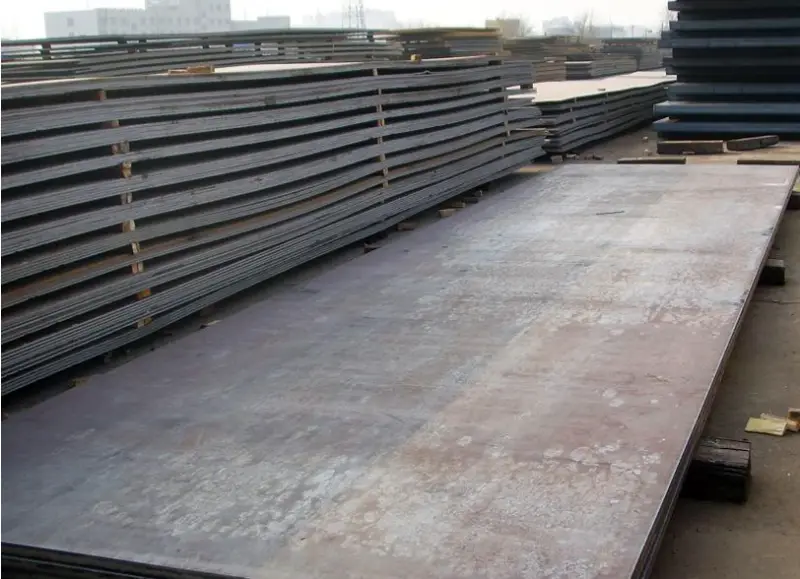
30CrMnSiA Hot Rolled Steel Plate Material
30CrMnSiA Hot Rolled Steel Plate: High-Strength Structural Alloy per GB/T 11251
Comprehensive technical data for 30CrMnSiA hot rolled structure steel plates under GB/T 11251, covering chemical composition, mechanical and physical properties, equivalent grades, and applications.
Hot rolling, annealing, quenching and tempering, normalizing, machining, welding (with preheating)
- Phone : +8618037372205
- Email : [email protected]
- WhatsApp: Contact via Whtsapp
- WeChat: +8618037372205
30CrMnSiA Hot Rolled Steel Plate Introduction
30CrMnSiA is a high-quality, medium-carbon alloy structural steel standardized under GB/T 11251 for hot-rolled plates. This chromium-manganese-silicon steel grade is renowned for its excellent combination of high strength, superior toughness, and good hardenability after quenching and tempering. The material typically exhibits a tempered martensitic or bainitic microstructure, providing a remarkable balance between tensile strength and ductility. Key characteristics include high fatigue resistance and reasonable weldability with appropriate preheating. It is widely utilized in demanding applications requiring robust mechanical performance, such as heavy-duty machinery components, automotive parts, and aerospace structural elements. Delivery condition is usually hot-rolled and annealed, offering a baseline microstructure suitable for subsequent heat treatment to achieve final desired mechanical properties.
30CrMnSiA Hot Rolled Steel Plate Chemical Composition
The chemical composition of 30CrMnSiA steel is strictly controlled to meet GB/T 11251, ensuring its high strength and hardenability. The specified alloying elements like Chromium (Cr) and Manganese (Mn) enhance hardenability and strength, while Silicon (Si) contributes to solid solution strengthening and deoxidation. Tight limits on impurities such as Phosphorus (P) and Sulfur (S) are maintained to guarantee superior mechanical properties and toughness.
| Element | Standard Value (min-max) | Remarks |
|---|---|---|
| Carbon (C) | 0.28 – 0.34 | Primary hardenability element |
| Silicon (Si) | 0.90 – 1.20 | Strengthening and deoxidation |
| Manganese (Mn) | 0.80 – 1.10 | Enhances hardenability and strength |
| Chromium (Cr) | 0.80 – 1.10 | Improves hardenability and corrosion resistance |
| Phosphorus (P) | ≤ 0.035 | Impurity control for toughness |
| Sulfur (S) | ≤ 0.035 | Impurity control for ductility |
| Nickel (Ni) | ≤ 0.40 | Residual element |
| Copper (Cu) | ≤ 0.30 | Residual element |
30CrMnSiA Hot Rolled Steel Plate Thermal and Electrical Physical Properties
The physical properties of 30CrMnSiA steel are critical for design considerations involving thermal stress, heat transfer, and dynamic loading. Values such as thermal expansion coefficient and thermal conductivity are key for predicting material behavior under temperature gradients. These properties are typical for this class of medium-carbon alloy steel and may vary slightly with microstructure and temperature.
| Property | Standard Requirement Value | Unit | Test Condition |
|---|---|---|---|
| Density (ρ) | 7.85 | g/cm³ | At room temperature (~20°C) |
| Modulus of Elasticity (E) | 210 | GPa | At room temperature (~20°C) |
| Shear Modulus (G) | 81 | GPa | At room temperature (~20°C) |
| Poisson's Ratio (ν) | 0.3 | - | At room temperature (~20°C) |
| Thermal Expansion Coefficient (α) | 11.0 | 10⁻⁶/K | Between 20°C and 100°C |
| Thermal Conductivity (λ) | 36.4 | W/(m·K) | At 100°C |
| Specific Heat Capacity (c) | 477 | J/(kg·K) | At room temperature (~20°C) |
| Electrical Resistivity (ρ_e) | 0.23 | Ω·mm²/m | At room temperature (~20°C) |
30CrMnSiA Hot Rolled Steel Plate Mechanical Properties
The mechanical properties below are measured on specimens taken from hot-rolled and annealed plates as per GB/T 11251. These values represent the baseline material condition. The final properties for engineering applications are typically achieved after quenching and tempering heat treatment, which can significantly elevate yield and tensile strength while maintaining adequate ductility and toughness.
| Property | Standard Requirement Value | Unit | Test Condition |
|---|---|---|---|
| Yield Strength (ReH) | ≥ 735 | MPa | Longitudinal, after quenching and tempering |
| Tensile Strength (Rm) | ≥ 1080 | MPa | Longitudinal, after quenching and tempering |
| Elongation after Fracture (A) | ≥ 10 | % | Gauge length L₀ = 5d, after quenching and tempering |
| Reduction of Area (Z) | ≥ 45 | % | After quenching and tempering |
| Impact Absorbed Energy (KV₂) | ≥ 39 | J | At room temperature, after quenching and tempering |
| Brinell Hardness (HBS) | ≤ 241 | N/mm² | Hot rolled and annealed condition |
30CrMnSiA Hot Rolled Steel Plate Equivalent Material Standards and Substitutable Grade Recommendations
| Country/Region | Standard | Grade | Remarks |
|---|---|---|---|
| Russia | GOST 4543-71 | 30KhGSA (30ХГСА) | Closest direct equivalent in chemical composition and mechanical properties. |
| Germany | DIN 17200 | 1.6657 (28CrMnSiA) | Comparable alloy with slightly lower carbon range. |
| United Kingdom | BS 970-3 | X30CrMnSiA | Designated for similar high-strength applications. |
30CrMnSiA Hot Rolled Steel Plate Application Introduction
30CrMnSiA is an engineering alloy specifically suited for components demanding a superior strength-to-weight ratio and high fatigue resistance. Its robust mechanical properties make it a premier choice for critical structural and dynamic parts where failure is not an option. Typical processing involves forging or hot rolling, followed by precision machining and a final heat treatment of quenching and tempering to achieve the service hardness and strength. The steel exhibits good workability in the annealed state but requires careful process control during welding and heat treatment to avoid cracking.
Product Applications: Aircraft landing gear and structural frames, Heavy-duty transmission gears and pinions, High-strength bolts, screws, and fasteners, Axles and drive shafts for trucks and armored vehicles, Mold tools and die holders for high-stress forming, Torsion bars and leaf springs for heavy suspension systems
Processed into products: Crankshafts and connecting rods for high-performance engines, Wear-resistant gear wheels and splined shafts, Coupling flanges and articulating joints, Pneumatic cylinder rods and hydraulic piston rods, Structural brackets and load-bearing plates in construction machinery
Application industries: Aerospace Engineering, Automotive Manufacturing, Heavy Machinery and Equipment, Defense and Armament, Oil and Gas Exploration, Power Generation
30CrMnSiA Hot Rolled Steel Plate Recommendations for Similar/Comparable Alternative Materials
| Country/Region | Standard | Grade | Remarks |
|---|---|---|---|
| China | GB/T 3077 | 35CrMnSiA | Slightly higher carbon content for greater strength but lower ductility. Suitable for heavier sections. |
| China | GB/T 3077 | 40Cr | A classic Cr-rich alloy steel with similar hardenability but lower strength. Widely used for gears and shafts. |
| USA | ASTM A304 | 4130 (UNS G41300) | A Cr-Mo steel with excellent weldability and fatigue resistance. Good alternative for aircraft tubular structures. |
| Germany | DIN EN 10083-3 | 1.7225 (42CrMo4) | Higher carbon Cr-Mo steel for very high strength machine parts. Suitable for large cross-sections. |
Notes:
All data provided conforms to GB/T 11251 for hot-rolled structure steel plates. The mechanical properties are specified in the quenched and tempered condition, which is the primary service condition. For welding, preheating to 250-350°C and post-weld heat treatment is strongly recommended to prevent cold cracking. Annealed hardness is tested per HBW standard, and impact toughness is assured via Charpy V-notch testing at ambient temperature. Magnetic properties are typical for ferromagnetic martensitic steel.
- Share



