
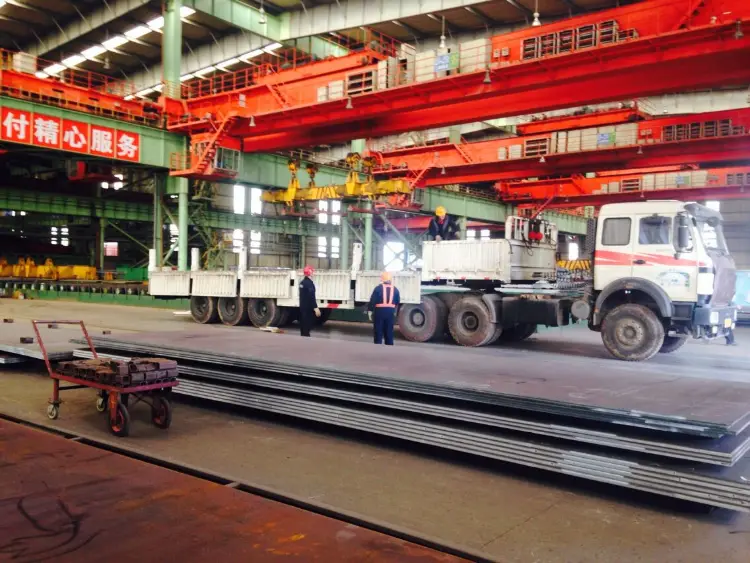
GB/T 11251 35CrMnSiA Hot Rolled Structural Steel Plate Material
35CrMnSiA Hot Rolled Alloy Structural Steel Plate – GB/T 11251 Data Sheet
Comprehensive technical data for 35CrMnSiA steel plate under GB/T 11251, covering chemical composition, mechanical properties, physical and thermal performance, equivalent grades, and recommended applications in aerospace, defense, and heavy machinery.
Hot rolling, forging, quenching + tempering (QT), normalizing, annealing, machining, limited welding (preheat and PWHT required)
- Phone : +8618037372205
- Email : [email protected]
- WhatsApp: Contact via Whtsapp
- WeChat: +8618037372205
GB/T 11251 35CrMnSiA Hot Rolled Structural Steel Plate Introduction
35CrMnSiA is a high-strength, medium-carbon alloy structural steel supplied as hot rolled plates conforming to GB/T 11251. It belongs to the Cr-Mn-Si series and is designed for components requiring very high tensile and yield strength combined with good toughness after quenching and tempering.
- Ultra-high tensile strength up to 1620 MPa after heat treatment
- Excellent hardenability and moderate ductility
- Widely used for critical aircraft and military parts
- Can be delivered in hot rolled, annealed, or quenched & tempered condition
- Suitable for machining in annealed condition and for welding with strict procedures
GB/T 11251 35CrMnSiA Hot Rolled Structural Steel Plate Chemical Composition
Chemical composition according to GB/T 11251-2009, identical to that specified in GB/T 3077 for 35CrMnSiA. Residual elements Ni and Cu must not exceed the indicated maxima. All values are heat analysis applied to the hot rolled product.
| Element | Standard Value (wt%) | Remarks |
|---|---|---|
| C | 0.32 – 0.39 | |
| Si | 1.10 – 1.40 | |
| Mn | 0.80 – 1.10 | |
| P | ≤ 0.035 | |
| S | ≤ 0.035 | |
| Cr | 1.10 – 1.40 | |
| Ni | ≤ 0.30 | Residual element |
| Cu | ≤ 0.30 | Residual element |
GB/T 11251 35CrMnSiA Hot Rolled Structural Steel Plate Thermal & Electrical Physical Properties
The following physical properties are typical for 35CrMnSiA alloy steel in the as‑supplied condition (near room temperature unless otherwise stated). They are not specification‑mandated but are widely used in engineering design and simulation.
| Property | Typical Value | Unit | Test Condition |
|---|---|---|---|
| Density (ρ) | 7.85 | g/cm³ | 20°C |
| Elastic modulus (E) | 207 | GPa | 20°C |
| Shear modulus (G) | 79.3 | GPa | 20°C |
| Poisson's ratio (ν) | 0.30 | – | 20°C |
| Thermal expansion coefficient (α) | 11.1 | 10⁻⁶ /K | 20–100°C |
| Thermal conductivity (λ) | 37.7 | W/(m·K) | 100°C |
| Specific heat capacity | 460 | J/(kg·K) | 20°C |
| Electrical resistivity (ρ_e) | 0.20 | 10⁻⁶ Ω·m | 20°C |
GB/T 11251 35CrMnSiA Hot Rolled Structural Steel Plate Mechanical Properties
Mechanical properties are measured on longitudinal test pieces taken from plates ≤80 mm thickness. The values below apply after the prescribed heat treatment: quenching at 880°C (oil) and tempering at 230°C (water or oil). Hardness is measured on the product in the annealed or high-temperature tempered condition. Impact test uses KV2 (U‑notch) specimens at room temperature.
| Property | Required Value | Unit | Test Condition |
|---|---|---|---|
| Tensile Strength (Rm) | ≥ 1620 | MPa | Quenched + tempered (880°C / oil, 230°C / water-oil), longitudinal |
| Yield Strength (ReH) | ≥ 1280 | MPa | Quenched + tempered, longitudinal |
| Elongation after fracture (A) | ≥ 9 | % | Quenched + tempered, L0=5.65√S0 |
| Reduction of area (Z) | ≥ 40 | % | Quenched + tempered |
| Impact energy (KV2, U-notch) | ≥ 31 | J | Quenched + tempered, 20°C |
| Brinell hardness (HBW) | ≤ 229 | HBW | Annealed or high-temperature tempered |
GB/T 11251 35CrMnSiA Hot Rolled Structural Steel Plate Fully Equivalent Grades from Different Standards
The following standards and grades have identical or near‑identical chemical composition and equivalent mechanical properties, making them direct substitutes for 35CrMnSiA hot rolled plate under GB/T 11251.
| Country / Region | Standard | Grade | Remarks |
|---|---|---|---|
| China | GB/T 11251-2009 | 35CrMnSiA | Hot rolled alloy structural steel plates and strips |
| China | GB/T 3077-2015 | 35CrMnSiA | Alloy structure steel bars |
| Russia | GOST 4543-71 | 35KhGSA | Chemical and mechanical equivalent |
GB/T 11251 35CrMnSiA Hot Rolled Structural Steel Plate Application Introduction
35CrMnSiA steel plates are intended for extremely highly stressed parts where strength‑to‑weight ratio and durability are critical. The material is typically used in the quenched and tempered condition (RC 45–50). It provides excellent resistance to plastic deformation under high static and dynamic loads but requires controlled processing due to its high carbon equivalent and limited weldability.
Product Applications: Aircraft landing gear components, Armor plates for vehicles and shelters, Missile and rocket motor casings, Heavy‑duty transmission shafts, Gears, pinions, and spline shafts, Torsion bars and high‑strength fasteners
Processed into products: Landing gear cylinder bodies and struts, Structural ribs and frames in armored vehicles, Main rotor shafts for helicopters (replaced by maraging steels in newer designs), Crankshafts for high‑performance engines, Wear‑resistant tool holders and dies
Application industries: Aerospace & Aviation, Military & Defense, Heavy Machinery & Equipment, Energy & Power Generation (high‑stress structural parts)
GB/T 11251 35CrMnSiA Hot Rolled Structural Steel Plate Similar / Alternative Material Recommendations
The following grades are close but not identical substitutes. They should be used after re‑evaluating strength, hardenability, and heat treatment requirements. Principal differences in composition are noted.
| Country / Region | Standard | Grade | Remarks |
|---|---|---|---|
| China | GB/T 3077-2015 | 30CrMnSi | Lower C (0.27~0.34%), slightly lower strength, better weldability |
| China | GB/T 3077-2015 | 40Cr | Higher C, lower Si and Mn, lower hardenability; approximate tensile ~980 MPa after QT |
| USA | ASTM A29/A29M | 4140 (UNS G41400) | Cr-Mo steel, tensile ~1080 MPa after QT; similar application range but different alloying |
| Germany | DIN 17200 / EN 10083-3 | 34CrNiMo6 (1.6582) | Higher Ni, higher toughness and deep hardenability; often used as upgrade |
Notes:
- Weldability: Poor due to high carbon equivalent (~0.9–1.0). Welding requires preheating to 250–350°C, low hydrogen electrodes, and immediate post‑weld heat treatment.
- Machinability: Good in annealed condition (HB ≤229). After quenching and tempering, carbide tools and rigid setups are necessary.
- Heat treatment: Parts should be quenched in oil to minimize distortion and cracking. Tempering must be performed immediately after quenching.
- Decarburization: Surface decarburization may occur during rolling; plates can be ordered with machining allowance for removal.
- Standards: The data provided are based on GB/T 11251-2009. Additional supplementary requirements may be agreed upon at the time of order.
- Share



