
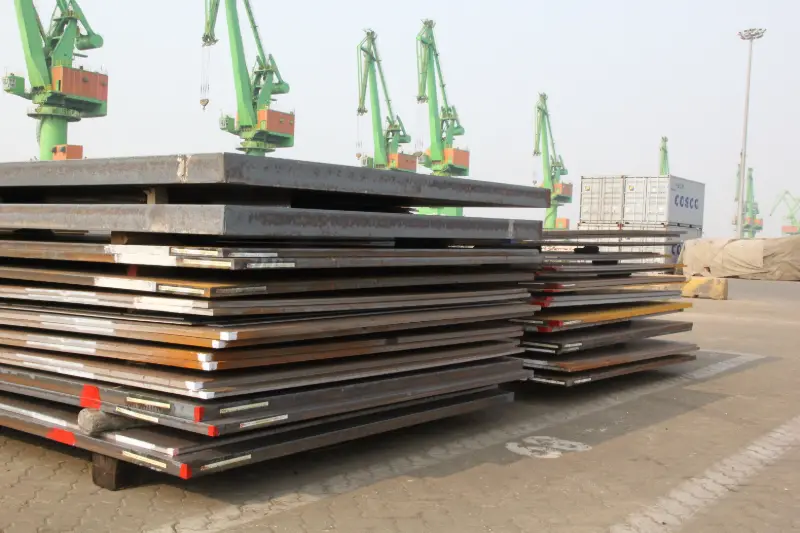
20Cr Hot Rolled Structural Steel Plate Material
20Cr Hot Rolled Alloy Structural Steel Plate - Properties & Equivalent Grades
Complete technical data for 20Cr hot rolled alloy structural steel plates as per GB/T 11251, including chemical composition, mechanical properties, physical properties, equivalent grades and application guidance.
Hot rolling, cutting, carburizing, quenching, tempering, machining
- Phone : +8618037372205
- Email : [email protected]
- WhatsApp: Contact via Whtsapp
- WeChat: +8618037372205
20Cr Hot Rolled Structural Steel Plate Introduction
20Cr is a low-carbon chromium alloy structural steel specified in GB/T 11251 for hot rolled plates. With carbon around 0.20% and chromium about 0.85%, this steel offers a balanced combination of strength, toughness and wear resistance after carburizing and heat treatment.
- Good hardenability and machinability in annealed condition.
- Widely used for medium-duty gears, shafts, pins and other components requiring a hard wear-resistant surface and tough core.
- Supplied in annealed or high-temperature tempered condition with max Brinell hardness 179 HBW for improved formability.
20Cr Hot Rolled Structural Steel Plate Chemical Composition
The chemical composition of 20Cr hot rolled plates shall conform to the requirements in GB/T 3077 as referenced by GB/T 11251. Limits are given for the standard elements; all values are in weight percent.
- Tight control on carbon and chromium ensures consistent hardenability.
- Residual elements Cu, Ni, P, S are restricted to maintain purity and mechanical properties.
| Element | Standard Value | Remarks |
|---|---|---|
| Carbon (C) | 0.18–0.24 | Key for strength and carburizing response |
| Silicon (Si) | 0.17–0.37 | Deoxidizer and strength enhancer |
| Manganese (Mn) | 0.50–0.80 | Improves hardenability and tensile strength |
| Chromium (Cr) | 0.70–1.00 | Primary alloying element for hardenability and carbide formation |
| Phosphorus (P) | ≤ 0.035 | Max limit for ductility |
| Sulfur (S) | ≤ 0.035 | Max limit for toughness |
| Nickel (Ni) | ≤ 0.30 | Residual element, no intentional addition |
| Copper (Cu) | ≤ 0.25 | Residual element, no intentional addition |
20Cr Hot Rolled Structural Steel Plate Thermal and Electrical Physical Properties
Physical property data are typical values for 20Cr steel at room temperature unless otherwise noted. These values are not specified in GB/T 11251 but are representative of the alloy in its normalized or annealed state.
- Thermal conductivity decreases with increasing temperature.
- The coefficient of thermal expansion is important for design of precision components.
| Property | Typical Value | Unit | Test Condition |
|---|---|---|---|
| Density (ρ) | 7.82 | g/cm³ | At 20°C |
| Modulus of Elasticity (E) | 207 | GPa | Room temperature |
| Shear Modulus (G) | 79 | GPa | Room temperature (calculated) |
| Poisson's Ratio (ν) | 0.30 | — | Room temperature |
| Thermal Expansion Coeff. (α) | 11.3 | 10⁻⁶/K | 20–100°C |
| Thermal Conductivity (λ) | 40.2 | W/(m·K) | At 100°C |
| Specific Heat Capacity | 460 | J/(kg·K) | At 20°C |
| Electrical Resistivity (ρ_e) | 0.23 | 10⁻⁶ Ω·m | At 20°C |
20Cr Hot Rolled Structural Steel Plate Mechanical Properties
The following mechanical properties apply to 20Cr hot rolled plates in the heat-treated condition (quenched and tempered) as per GB/T 11251. The test samples are taken from plates of thickness ≤ 80 mm and heat treated according to standard procedures.
- Yield strength and tensile strength are guaranteed minimums.
- Impact energy is measured at room temperature using Charpy V-notch specimens.
| Property | Standard Required Value | Unit | Test Condition |
|---|---|---|---|
| Tensile Strength (Rm) | ≥ 835 | MPa | Longitudinal specimen, after heat treatment |
| Yield Strength (ReH) | ≥ 540 | MPa | After heat treatment, 0.2% offset |
| Elongation (A) | ≥ 10 | % | Gauge length 5.65√So, after heat treatment |
| Reduction of Area (Z) | ≥ 40 | % | After heat treatment |
| Impact Energy (KV) | ≥ 47 | J | Room temperature, Charpy V-notch, heat treated condition |
| Brinell Hardness | ≤ 179 | HBW | Delivery condition (annealed or high-temp tempered) |
20Cr Hot Rolled Structural Steel Plate Directly Equivalent Material Standards and Substitutable Grades
| Country / Region | Standard | Grade | Remarks |
|---|---|---|---|
| China | GB/T 3077 | 20Cr | Basic alloy structural steel standard |
| USA | ASTM A29 / A322 | 5120 (AISI 5120) | Similar Cr alloy steel, slightly different Mn and Si ranges |
| Japan | JIS G4053 | SCr420 | Close equivalent, commonly used in Japanese automotive industry |
| Germany | DIN EN 10084 | 20Cr4 (1.7027) | Chemical composition closely matches 20Cr |
| International | ISO 683-18 | 20Cr4 | ISO grade directly derived from European/DIN system |
20Cr Hot Rolled Structural Steel Plate Application Introduction
20Cr hot rolled plates are primarily employed for manufacturing components that require a combination of a tough core and a hard wear-resistant surface after carburizing, quenching and tempering. The grade is well suited for medium-duty dynamic loads in machinery and automotive applications.
- Typical processing includes cutting plates to blanks, hot or cold forming, machining, carburizing at 900–930°C, direct quench or re-heating quench, and low-temperature tempering.
- Excellent weldability in annealed condition with proper preheating.
Product Applications: Automotive transmission gears and shafts, Clutch plates and camshafts, Pins, bushings and splined shafts, Tractor and earthmoving equipment parts, Small to medium-sized carburized structural parts
Processed into products: Gears (spur, helical, bevel), Shafts (transmission, pump, intermediate), Piston pins, Cams and rollers, Wrist pins, Small crankshafts, Valve tappets, Chain links and sprockets
Application industries: Automotive manufacturing, Agricultural machinery, General mechanical engineering, Gear and transmission production, Power tool components
20Cr Hot Rolled Structural Steel Plate Similar / Alternative Material Recommendations
| Country / Region | Standard | Grade | Remarks |
|---|---|---|---|
| China | GB/T 3077 | 20CrMnTi | Added Mn and Ti for better hardenability and grain refinement; widely used for gears |
| China | GB/T 3077 | 20CrMo | Contains Mo for higher heat resistance and hardenability; suitable for larger cross-sections |
| USA | ASTM A29 | 4120 | Similar carbon level with Cr-Mo addition for improved strength |
| Germany | DIN EN 10084 | 20MnCr5 (1.7147) | Higher Mn and Cr variant, offers better core strength after carburizing |
Notes:
- For plates supplied in annealed or high-temperature tempered condition, the maximum hardness guarantee of 179 HBW is critical for blanking and machining operations.
- Heat treatment parameters for mechanical testing: quenching at 880°C (water or oil) followed by tempering at 200°C (water or air).
- Always consult the full GB/T 11251 standard for sampling location, test frequency, and tolerances.
- Share



