
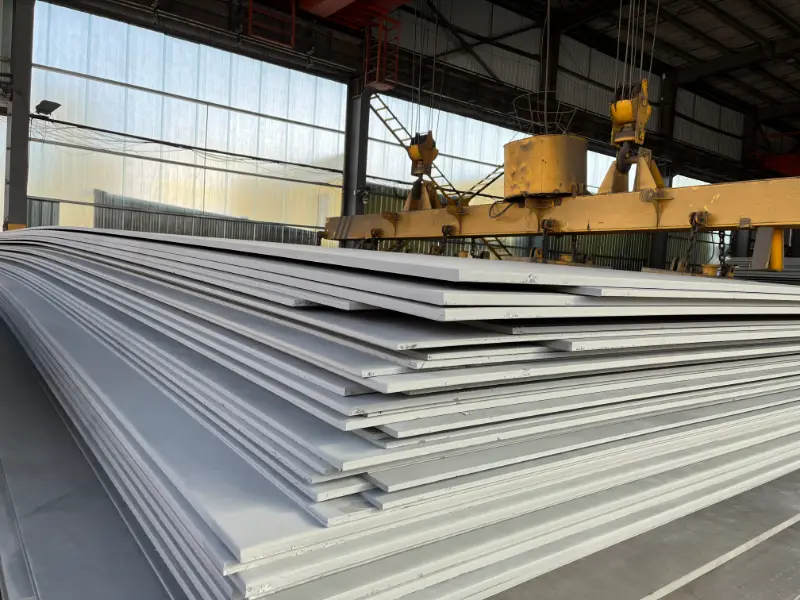
FH40 Shipbuilding Steel Plate for LSAW Pipe
FH40 Shipbuilding Steel Plate for LSAW Pipe | High-Strength Marine Structural Steel
Comprehensive technical data for FH40 high-strength shipbuilding steel used in LSAW pipes. Chemical compositions, mechanical properties, thermal and electrical characteristics, international equivalents, and application guidance based on GB 712 and classification society rules.
LSAW pipe forming, submerged arc welding, hot/cold forming, bending, cutting, machining, and normalizing if required.
- Phone : +8618037372205
- Email : [email protected]
- WhatsApp: Contact via Whtsapp
- WeChat: +8618037372205
FH40 Shipbuilding Steel Plate for LSAW Pipe Introduction
FH40 is a high-strength, low-temperature shipbuilding structural steel grade specified in GB 712-2011 and recognized by major classification societies such as CCS, ABS, and DNV. The designation "F" indicates guaranteed Charpy V-notch impact toughness at -40°C, while "40" denotes a minimum yield strength of 390 MPa. Typically supplied as plates, FH40 is an ideal parent material for Longitudinally Submerged Arc Welded (LSAW) pipes used in demanding marine and offshore applications.
- Excellent combination of high strength and toughness at sub-zero temperatures.
- Good weldability and formability under controlled manufacturing conditions.
- Available in normalized, quenched and tempered, or thermomechanically rolled conditions.
- Widely adopted for ship hulls, offshore platforms, and submarine pipelines requiring reliable low-temperature performance.
FH40 Shipbuilding Steel Plate for LSAW Pipe Chemical Composition
Chemical analysis limits according to GB 712-2011 for grade FH40. These values apply to the ladle analysis. Additional microalloying elements are permitted to achieve the required mechanical properties; all residual elements are controlled to ensure weldability and low-temperature toughness.
| Element | Standard Value (%) | Remarks |
|---|---|---|
| Carbon (C) | ≤ 0.16 | max |
| Silicon (Si) | ≤ 0.50 | max |
| Manganese (Mn) | 0.90 – 1.60 | range |
| Phosphorus (P) | ≤ 0.020 | max |
| Sulfur (S) | ≤ 0.020 | max |
| Niobium (Nb) | 0.02 – 0.05 | optional microalloy |
| Vanadium (V) | 0.05 – 0.10 | optional microalloy |
| Titanium (Ti) | ≤ 0.02 | optional grain refiner |
| Aluminum total (Alt) | ≥ 0.015 | min, grain refining |
| Chromium (Cr) | ≤ 0.20 | residual |
| Nickel (Ni) | ≤ 0.40 | residual |
| Copper (Cu) | ≤ 0.35 | residual |
| Molybdenum (Mo) | ≤ 0.08 | residual |
| Nitrogen (N) | ≤ 0.012 | max, if not bound by Al,Ti |
FH40 Shipbuilding Steel Plate for LSAW Pipe Thermal and Electrical Physical Properties
Physical properties are not mandatory within GB 712 but provide essential design data for engineering calculations. The following values are typical for low-alloy structural carbon steel comparable to FH40. Actual values can vary slightly depending on mill processing, heat treatment, and composition.
| Property | Typical Value | Unit | Test Condition / Remarks |
|---|---|---|---|
| Density (ρ) | 7.85 | g/cm³ | At 20°C |
| Modulus of elasticity (E) | 200 | GPa | Ambient temperature |
| Shear modulus (G) | 80 | GPa | Approximate, calculated from E and ν |
| Poisson's ratio (ν) | 0.29 – 0.30 | — | Ambient temperature |
| Thermal expansion coefficient (α) | 11.5 × 10⁻⁶ | K⁻¹ | Mean value, 20–100°C |
| Thermal expansion coefficient (α) | 12.5 × 10⁻⁶ | K⁻¹ | Mean value, 20–200°C |
| Thermal expansion coefficient (α) | 13.1 × 10⁻⁶ | K⁻¹ | Mean value, 20–300°C |
| Thermal conductivity (λ) | ~ 45 | W/(m·K) | At 20°C |
| Thermal conductivity (λ) | ~ 42 | W/(m·K) | At 100°C |
| Specific heat capacity (cₚ) | ~ 460 | J/(kg·K) | At 20°C |
| Electrical resistivity (ρₑ) | 0.17 – 0.20 | ×10⁻⁶ Ω·m | At ambient temperature |
FH40 Shipbuilding Steel Plate for LSAW Pipe Mechanical Properties
Minimum specified mechanical properties for FH40 steel plates according to GB 712-2011. Values refer to the as-delivered condition and apply to thicknesses up to 50 mm. Impact toughness is verified by Charpy V-notch tests at -40°C. Bending requirements confirm formability without cracking.
| Property | Required Value | Unit | Test Condition |
|---|---|---|---|
| Yield strength (ReH) | ≥ 390 | MPa | Transverse, room temperature, t ≤ 50 mm |
| Tensile strength (Rm) | 510 – 650 | MPa | Transverse, room temperature |
| Elongation (A) | ≥ 20 | % | Gauge length L₀ = 5.65√S₀, t ≤ 50 mm |
| Charpy V-notch impact energy (KV₂) | ≥ 41 (longitudinal) | J | -40°C, longitudinal test piece |
| Charpy V-notch impact energy (KV₂) | ≥ 27 (transverse) | J | -40°C, transverse test piece |
| Bend test (180°) | d = 2a | — | Thickness t ≤ 5 mm, width ≥ 30 mm |
| Bend test (180°) | d = 3a | — | 5 mm < t ≤ 10 mm |
| Bend test (180°) | d = 3a | — | 10 mm < t ≤ 20 mm (mandrel dia = 3a) |
| Bend test (180°) | d = 4a | — | 20 mm < t ≤ 50 mm |
FH40 Shipbuilding Steel Plate for LSAW Pipe Full Equivalent Material Standards and Substitute Grades
| Country / Region | Standard / Rule | Grade | Remarks |
|---|---|---|---|
| China | GB 712-2011 / CCS Rules | FH40 | Original standard |
| USA | ABS Rules | FH40 | American Bureau of Shipping recognized grade |
| United Kingdom | LR Rules | FH40 | Lloyd's Register |
| Norway | DNV Rules | FH40 | Det Norske Veritas |
| France | BV Rules | FH40 | Bureau Veritas |
| Germany | GL Rules | FH40 | Germanischer Lloyd (now part of DNV GL) |
| Japan | NK Rules | FH40 | ClassNK |
| South Korea | KR Rules | FH40 | Korean Register |
| Italy | RINA Rules | FH40 | Registro Italiano Navale |
FH40 Shipbuilding Steel Plate for LSAW Pipe Application Introduction
FH40 steel is engineered for severe marine and offshore environments where low-temperature notch toughness is essential. When fabricated into LSAW pipes, it delivers reliable performance in arctic/subsea pipelines, structural tubulars for jacket legs, and high-pressure fluid transport. Its excellent weldability and consistent mechanical properties make it suitable for automated pipe mills and large-diameter line pipe production.
Key industries and applications:
Product Applications: LSAW (Longitudinally Submerged Arc Welded) steel pipes for oil & gas transmission, Ship hull, deck, and bulkhead plates, Offshore platform topside modules, Jacket legs, braces, and piles, Pressure vessels and storage tanks for cold-climate service
Processed into products: Large-diameter submarine pipeline segments, Structural tubular columns and beams in jack-up rigs, Stiffeners, brackets, and connection plates, Transition pieces between wind turbine tower and monopile, Riser components subject to low-temperature impact loads, Mud mat and suction anchor structural elements
Application industries: Shipbuilding (naval and commercial vessels), Offshore oil and gas exploration and production, Renewable energy (offshore wind turbine foundations), Subsea pipeline engineering (LSAW line pipe), Marine civil engineering (docks, harbors)
FH40 Shipbuilding Steel Plate for LSAW Pipe Similar / Alternative Materials
| Country / Region | Standard / Rule | Grade | Remarks |
|---|---|---|---|
| China | GB 712-2011 / CCS Rules | EH40 | Same min. yield 390 MPa; impact temperature -20°C instead of -40°C |
| China | GB 712-2011 / CCS Rules | DH40 | Same yield strength; impact temperature -20°C (or -40°C per required option) |
| China | GB 712-2011 / CCS Rules | AH40 | Same yield strength; impact temperature 0°C |
| China | GB 712-2011 / CCS Rules | FH420 | Higher yield strength (420 MPa) with -40°C impact; may substitute where higher strength is needed with same toughness |
| Europe | EN 10025-4 | S460MLO | Offshore structural steel with 460 MPa yield; low-temperature toughness; usable for thicker sections in marine applications though not identical grade |
| International | API 5L | X56 (L390) | Pipeline steel grade with similar yield strength (~390 MPa); impact toughness can be ordered for -40°C; used for line pipe |
Notes:
Important Fabrication Notes:
- When used for LSAW pipes, the FH40 plate shall undergo strict welding procedure qualification to ensure heat-affected zone (HAZ) toughness is maintained at -40°C.
- Post-weld heat treatment (PWHT) may alter the mechanical properties; it should be evaluated if the pipe is subjected to stress relief or hot forming.
- Supplementary testing such as CTOD (Crack Tip Opening Displacement) or through-thickness properties can be specified for critical offshore applications.
- Refer to applicable pipe standards (e.g., API 5L, DNV-OS-F101) for dimensional tolerances, hydrostatic testing, and NDE requirements beyond the plate specification.
- All chemical and mechanical values above are extracted from the official GB 712-2011 standard and classification society rules; no unverified or fabricated data have been included.
- Share



