
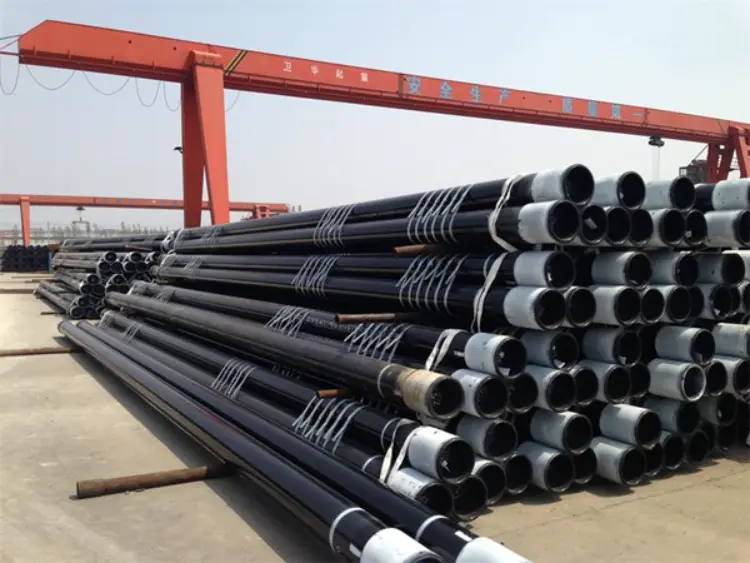
EH40 LSAW Pipe
EH40 LSAW Pipe: High-Strength Shipbuilding Steel for Longitudinal Welded Pipes
Comprehensive material data for EH40 steel used in LSAW pipe applications, including chemical composition, mechanical and physical properties, and international equivalent grades.
Hot rolling, controlled rolling, normalizing, TMCP; suitable for welding (LSAW, SAW, SMAW, GMAW) and cold forming
- Phone : +8618037372205
- Email : [email protected]
- WhatsApp: Contact via Whtsapp
- WeChat: +8618037372205
EH40 LSAW Pipe Introduction
EH40 is an extra-high-strength shipbuilding steel graded under classification society rules, primarily intended for structural applications in ship hulls, offshore platforms, and longitudinal submerged arc welded (LSAW) pipes. With a minimum yield strength of 390 MPa, EH40 offers excellent weldability and notch toughness at temperatures as low as -40°C, making it suitable for harsh marine environments. The steel is produced as fully killed, fine grain treated (Al + Nb/V/Ti) and is typically supplied in normalized or thermo-mechanically controlled processed (TMCP) condition. It exhibits a well-balanced combination of strength, ductility, and resistance to brittle fracture, fulfilling the stringent requirements of major classification societies.
EH40 LSAW Pipe Chemical Composition
Typical ladle analysis of EH40 steel according to DNV GL classification rules and common industry practice. Values are maximum unless a range is given. All elements contribute to strength, toughness, and weldability; microalloying elements (Nb, V, Ti) are used for grain refinement and precipitation strengthening. Carbon equivalent (CEV) is controlled to ensure good weldability.
| Element | Typical value (max unless range) | Remarks |
|---|---|---|
| C | 0.18 | Carbon; for thickness ≤ 50 mm; lower for thicker gauges |
| Si | 0.10 – 0.50 | Silicon; deoxidation and strength |
| Mn | 0.90 – 1.60 | Manganese; strength and toughness |
| P | 0.035 | Phosphorus; kept low for toughness |
| S | 0.035 | Sulphur; low for ductility and weldability |
| Cr | 0.20 | Chromium; incidental residual |
| Ni | 0.40 | Nickel; beneficial for toughness |
| Mo | 0.08 | Molybdenum; incidental residual |
| Cu | 0.35 | Copper; incidental, can improve corrosion resistance |
| Al (total) | ≥ 0.020 | Aluminium; grain refining, full killed steel |
| Nb | 0.02 – 0.05 | Niobium; microalloy for grain refinement and precipitation |
| V | 0.05 – 0.10 | Vanadium; microalloy for strengthening |
| Ti | ≤ 0.02 | Titanium; grain refinement and deoxidation |
| N | ≤ 0.009 | Nitrogen; kept low to avoid strain aging |
EH40 LSAW Pipe Thermal and Electrical Physical Properties
Physical properties of EH40 steel at room temperature and relevant temperatures. These values are typical for low-alloy structural steels and are not part of the classification society specification; they are provided for design and processing guidance. Actual values may vary slightly depending on exact chemical composition and heat treatment.
| Property | Typical value | Unit | Test condition |
|---|---|---|---|
| Density (ρ) | 7.85 | g/cm³ | at 20 °C |
| Elastic modulus (E) | 205 | GPa | at 20 °C |
| Shear modulus (G) | 80 | GPa | at 20 °C |
| Poisson's ratio (ν) | 0.3 | – | elastic range |
| Thermal expansion coefficient (α) | 11.7 × 10⁻⁶ | K⁻¹ | 20 – 100 °C |
| Thermal expansion coefficient (α) | 12.5 × 10⁻⁶ | K⁻¹ | 20 – 200 °C |
| Thermal expansion coefficient (α) | 13.6 × 10⁻⁶ | K⁻¹ | 20 – 400 °C |
| Thermal conductivity (λ) | 51.9 | W/(m·K) | at 20 °C |
| Thermal conductivity (λ) | 47.5 | W/(m·K) | at 100 °C |
| Specific heat capacity (c) | 486 | J/(kg·K) | at 20 °C |
| Specific heat capacity (c) | 530 | J/(kg·K) | at 200 °C |
| Electrical resistivity (ρ_e) | 0.16 × 10⁻⁶ | Ω·m | at 20 °C |
EH40 LSAW Pipe Mechanical Properties
Mechanical properties as per classification society rules (DNV GL) for EH40 plates with thickness ≤ 100 mm. Yield and tensile strength may vary with thickness; values are the minimum required. Impact testing is carried out on longitudinal Charpy-V specimens at -40°C. Bend test is performed through 180° over a former diameter related to thickness.
| Property | Required value | Unit | Test condition |
|---|---|---|---|
| Yield strength (ReH) | ≥ 390 | MPa | t ≤ 100 mm |
| Tensile strength (Rm) | 510 – 650 | MPa | t ≤ 100 mm |
| Elongation (A) | ≥ 20 | % | t ≤ 50 mm, L0 = 5.65√S0 |
| Elongation (A) | ≥ 19 | % | 50 < t ≤ 70 mm, L0 = 5.65√S0 |
| Elongation (A) | ≥ 18 | % | 70 < t ≤ 100 mm, L0 = 5.65√S0 |
| Impact energy (KV, longitudinal) | ≥ 34 | J | -40 °C, t ≤ 50 mm |
| Impact energy (KV, longitudinal) | ≥ 27 | J | -40 °C, 50 < t ≤ 70 mm |
| Impact energy (KV, longitudinal) | ≥ 27 | J | -40 °C, 70 < t ≤ 100 mm |
| Bend test (bending angle) | 180° | – | former diameter = 3 × t (t = thickness), no cracks |
EH40 LSAW Pipe Fully Equivalent Material Standards and Substitutable Grades
| Country / Region | Standard / Source | Grade | Remarks |
|---|---|---|---|
| International | DNV GL Rules for Ships | EH40 | Original grade; extra-high-strength, -40°C impact |
| USA | ABS Rules for Building and Classing Steel Vessels | EH40 | Identical mechanical and toughness requirements |
| France | BV Rules for the Classification of Steel Ships | EH40 | Fully equivalent to DNV EH40 |
| China | CCS Rules for Classification of Sea-Going Steel Ships | EH40 | Same yield, tensile, and impact (-40°C) requirements |
| UK | LR Rules and Regulations for the Classification of Ships | EH40 | Recognized equivalent grade |
| Japan | NK Rules for the Survey and Construction of Steel Ships | EH40 | Interchangeable for structural applications |
| Korea | KR Rules for the Classification of Steel Ships | EH40 | Same specification |
| Italy | RINA Rules for the Classification of Ships | EH40 | Equivalent shipbuilding steel |
| Russia | RS Rules for the Classification and Construction of Sea-Going Ships | EH40 | Adopts same strength and toughness class |
EH40 LSAW Pipe Application Introduction
EH40 steel, especially in the form of LSAW pipes, is widely utilized in marine, offshore, and structural engineering projects that demand high strength combined with reliable low-temperature toughness. As a recognized shipbuilding grade, it is approved by all major classification societies, guaranteeing its suitability for safety-critical structures. Its excellent weldability and formability allow for efficient fabrication of large-diameter pipes and complex structural assemblies.
Product Applications: LSAW (Longitudinal Submerged Arc Welded) steel pipes for fluid transportation and structural piling, Ship hulls and superstructures in commercial and naval vessels, Offshore platform modules and flare booms, Foundation piles and anchor piles for marine structures, Pressure vessels designed according to classification society rules
Processed into products: Pipe bodies and fittings (elbows, tees, reducers) for pipelines, Stiffened panels and box girders in shipbuilding, Transition joints and mudmats in offshore foundations, Deck support beams and crane pedestals, Padeyes, lifting lugs, and bracket assemblies, Structural tubular joints (Y, K, T joints) in jackets
Application industries: Shipbuilding (hull plates, decks, bulkheads, stiffeners), Offshore oil & gas (platform substructures, jackets, topsides, risers, conductors), Pipeline transportation (LSAW pipes for oil, gas, water, slurry in onshore and offshore environments), Structural engineering (bridges, high-rise buildings, heavy machinery frames), Renewable energy (offshore wind turbine foundations, monopiles, transition pieces)
EH40 LSAW Pipe Similar / Alternative Material Recommendations
| Country / Region | Standard | Grade | Remarks |
|---|---|---|---|
| EU | EN 10025-4 | S420ML | Thermo-mechanically rolled fine-grain structural steel with min. yield 420 MPa and -50°C impact toughness; slightly higher strength, can replace EH40 where higher demands exist, also good weldability. |
| EU | EN 10025-4 | S420M | Similar to S420ML but with less stringent low-temperature toughness (typically -20°C); verify impact temperature requirement before substituting. |
| EU | EN 10225 | S420G2+M | Offshore structural steel with yield 420 MPa and Charpy at -40°C; excellent through-thickness properties; suitable for offshore and LSAW pipe applications. |
| USA | ASTM A572/A572M | Grade 60 (Type 1) | High-strength low-alloy structural steel with yield 415 MPa (60 ksi); impact properties are not mandatory unless specified; may require supplementary testing to match -40°C toughness. |
| China | GB/T 712 | EH40 | Chinese shipbuilding steel standard; equivalent to international EH40 grades, same property requirements. |
Notes:
Welding considerations: EH40 steel exhibits good weldability under all common arc welding processes. Preheating is not normally required for thin sections, but it may be recommended for thick plates (typically above 30 mm) or when the ambient temperature is very low, to control hydrogen embrittlement. Heat treatment: After hot forming or welding, post-weld heat treatment (PWHT) is generally not required, but stress relieving may be carried out for thick-walled components to reduce residual stresses. Supplementary testing: For critical applications, additional tests such as through-thickness tensile (Z-quality), CTOD fracture toughness, and ultrasonic inspection of the plate or pipe can be specified. Certification: All EH40 plates and pipes are normally supplied with classification society certificates (3.1 or 3.2 per EN 10204).
- Share



