
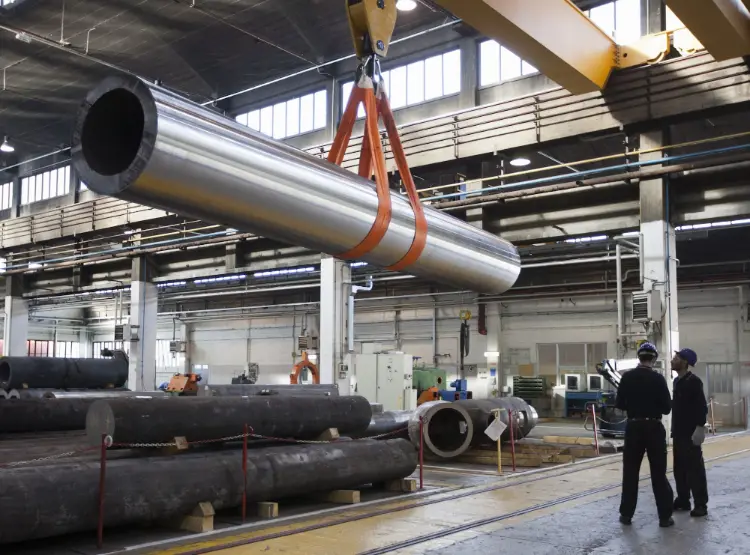
DH40 LSAW Pipe
DH40 LSAW Pipe: Comprehensive Technical Data, Chemical Composition & Mechanical Properties
Explore the detailed material properties, chemical composition, mechanical and physical characteristics of DH40 grade steel for LSAW pipes, designed for shipbuilding and offshore applications.
Normalizing (N), Normalizing Rolling (NR), Thermomechanical Control Process (TMCP), SAW Welding
- Phone : +8618037372205
- Email : [email protected]
- WhatsApp: Contact via Whtsapp
- WeChat: +8618037372205
DH40 LSAW Pipe Introduction
DH40 is a high-strength, normalized structural steel grade primarily used in shipbuilding and offshore engineering. Supplied as a Longitudinal Submerged Arc Welded (LSAW) pipe, it offers excellent weldability and superior notch toughness at sub-zero temperatures. The 'DH' designation signifies its delivery condition (normalized) and guaranteed impact properties at -20°C. Manufactured from thermomechanical control process (TMCP) rolled plates, DH40 LSAW pipes are utilized for critical structural components requiring high integrity, such as offshore jackets, legs of jack-up rigs, and high-pressure conductors. Its fine-grained microstructure ensures a reliable combination of strength and ductility, making it a cornerstone material for marine and structural applications under severe service conditions.
DH40 LSAW Pipe Chemical Composition
The chemical composition of DH40 steel is meticulously controlled to balance high strength, excellent weldability, and superior low-temperature toughness. The main strengthening elements are carbon and manganese, with grain refinement achieved through microalloying with niobium, vanadium, and aluminum. The carbon equivalent (CEV/CEIIW) is strictly limited to ensure excellent field weldability without pre-heating under typical conditions, which is a critical requirement for shipbuilding and offshore construction.
| Chemical Element | Standard Value (Heat Analysis) | Remarks |
|---|---|---|
| Carbon (C) | ≤ 0.18% | Low carbon content for good weldability |
| Silicon (Si) | 0.10 - 0.55% | Deoxidizer in steelmaking |
| Manganese (Mn) | 0.90 - 1.60% | Primary solid solution strengthener |
| Phosphorus (P) | ≤ 0.025% | Strictly controlled to prevent brittleness |
| Sulfur (S) | ≤ 0.020% | Controlled for inclusion modification |
| Aluminum (Al), Acid Soluble | ≥ 0.015% | Grain refinement fine grain practice |
| Niobium (Nb) | 0.02 - 0.05% | Microalloying for grain refinement |
| Vanadium (V) | 0.05 - 0.10% | Strengthening by precipitation |
| Titanium (Ti) | ≤ 0.02% | Grain refinement nitrogen binding |
| Copper (Cu) | ≤ 0.35% | Residual element corrosion resistance |
| Chromium (Cr) | ≤ 0.25% | Controlled to maintain weldability |
| Nickel (Ni) | ≤ 0.40% | Optional, for toughness improvement |
| Molybdenum (Mo) | ≤ 0.08% | Residual element |
| Nitrogen (N) | ≤ 0.012% | Controlled for aging resistance |
| Carbon Equivalent (CEV) | ≤ 0.40% - 0.42% | Critical for ensuring weldability without preheating |
DH40 LSAW Pipe Thermal and Electrical Properties
Physical properties of DH40 steel are characteristic of low-carbon, low-alloy structural steels. These properties are temperature-dependent and are provided here for ambient conditions (typically 20°C). Data is based on standard reference values for this class of material and is essential for designers performing thermal stress analysis, heat transfer calculations, and cathodic protection system design. The values shown are typical for a fully dense, normalized fine-grained steel and are consistent with published data for similar high-strength structural grades.
| Performance Item | Standard Requirement Value | Unit | Test Condition |
|---|---|---|---|
| Density (ρ) | 7850 | kg/m³ | At 20°C |
| Elastic Modulus (E) | 205 | GPa | At 20°C, dynamic/static |
| Shear Modulus (G) | 80 | GPa | At 20°C, calculated |
| Poisson's Ratio (ν) | 0.29 | — | At 20°C, typical for low-alloy steel |
| Thermal Expansion Coefficient (α) | 11.8 | 10⁻⁶/°C | Mean value, 20°C to 100°C |
| Thermal Expansion Coefficient (α) | 12.8 | 10⁻⁶/°C | Mean value, 20°C to 200°C |
| Thermal Expansion Coefficient (α) | 13.6 | 10⁻⁶/°C | Mean value, 20°C to 300°C |
| Thermal Conductivity (λ) | 50 | W/(m·K) | At 20°C |
| Thermal Conductivity (λ) | 46 | W/(m·K) | At 200°C |
| Thermal Conductivity (λ) | 42 | W/(m·K) | At 300°C |
| Specific Heat Capacity | 460 | J/(kg·K) | At 20°C |
| Specific Heat Capacity | 500 | J/(kg·K) | At 100°C |
| Specific Heat Capacity | 550 | J/(kg·K) | At 200°C |
| Electrical Resistivity (ρ_e) | 0.25 | μΩ·m | At 20°C |
DH40 LSAW Pipe Mechanical Properties
Mechanical properties for DH40 LSAW pipe are derived from the specifications for DH40 steel plates/coils used to form the pipe. These properties are verified by transverse and longitudinal tensile testing and Charpy V-notch impact testing at -20°C. The values ensure the structural integrity of the fabricated pipe under high static loads. The minimum energy absorbed at the specified test temperature is crucial for preventing brittle fracture in low-temperature marine environments.
| Performance Item | Standard Required Value | Unit | Test Condition |
|---|---|---|---|
| Yield Strength (ReH) | ≥ 390 | MPa | Transverse or Longitudinal, depending on thickness |
| Tensile Strength (Rm) | 510 - 650 | MPa | Transverse or Longitudinal, depending on thickness |
| Elongation (A) | ≥ 20 | % | Gauge length 5.65√So (A5) |
| Yield to Tensile Ratio (ReH/Rm) | ≤ 0.92 | — | Often a supplementary offshore requirement for deformation capacity |
| Charpy Impact Energy (KV2) | ≥ 31 (Average) | J | Longitudinal test, -20°C |
| Charpy Impact Energy (KV2) | ≥ 22 (Single min.) | J | Longitudinal test, -20°C |
| Charpy Impact Energy (KV2) | ≥ 24 (Average) | J | Transverse test, -20°C |
| Charpy Impact Energy (KV2) | ≥ 17 (Single min.) | J | Transverse test, -20°C |
DH40 LSAW Pipe Complete Equivalent Material Standards and Replaceable Grade Recommendations
| Country/Region | Standard | Grade | Remarks |
|---|---|---|---|
| International | IACS UR W11 | DH40 | Primary standard for ship steel classification societies. |
| Norway/Germany | DNVGL (Now DNV) Rules | NV D40 or VL D40 | Equivalent grade in DNV and former Germanischer Lloyd rules. |
| USA | ABS Rules | ABS DH40 | American Bureau of Shipping certified equivalent. |
| France | BV Rules | BV DH40 | Bureau Veritas certified equivalent. |
| UK | LR Rules | LR DH40 | Lloyd's Register certified equivalent. |
| Italy | RINA Rules | RINA DH40 | Registro Italiano Navale certified equivalent. |
| Japan | NK Rules | NK KD40 | Nippon Kaiji Kyokai (ClassNK) equivalent grade. |
| China | CCS Rules | CCS DH40 | China Classification Society certified equivalent. |
| USA | API 5L / ASTM | X65 with DH40/W11 certifications | Linepipe standard that can be qualified to meet DH40 requirements for offshore structural use. |
DH40 LSAW Pipe Application Introduction
DH40 LSAW pipe is a critical material for high-integrity structures in marine and sub-sea applications. Its high strength allows for weight reduction in large floating structures, while its guaranteed toughness at -20°C ensures safe operation in harsh, cold environments. The LSAW manufacturing method permits the production of thick-walled, large-diameter pipes essential for columns, braces, and conductors. Designers and fabricators prefer this steel for its established track record in standardized design codes and its ready weldability with common consumables.
Product Applications: Jack-up Rig Legs and Spudcans, Fixed Offshore Platform Jackets and Topsides, Floating Production, Storage and Offloading (FPSO) Hull Structures, Subsea Structural Manifolds and Piles, High-pressure Drilling Risers and Marine Conductors, Crane Pedestals and Heavy-lift Equipment Structures
Processed into products: Tubular joint cans (thicker sections at node points of jackets), Main structural legs, chords, and diagonal braces for offshore jackets, Conductor pipes driven into the seabed, Pile sleeves and guide cones, Shafts for large marine mooring winches, Compensator cylinders for heave compensation systems
Application industries: Offshore Oil and Gas Exploration and Production, Shipbuilding (Naval and Commercial), Renewable Energy (Offshore Wind Turbine Foundations), Civil Engineering (Deep Foundation Piles, Bridge Caissons), Port and Harbor Construction (Dolphins, Breasting Beams)
DH40 LSAW Pipe Similar/Comparable Substitute Material Recommendations
The following materials offer comparable performance in terms of strength, toughness, and weldability but differ in applicable standard, delivery condition, or precise chemistry limits. Selection as a substitute requires a full engineering assessment and approval from the project's certifying authority, as the baseline standard and testing requirements (like impact temperature) may differ. For instance, EH36 is a common ship steel with slightly lower strength but similar toughness, while EN 10225 S355G10+N is a dedicated offshore structural steel with additional controls on through-thickness properties (Z-quality).
| Country/Region | Standard | Grade | Remarks |
|---|---|---|---|
| International/Europe | IACS UR W11 / EN 10225 | EH36 / S355G10+N | Lower specified yield strength (355 MPa) but similar toughness at -40°C. A very common general shipbuilding and offshore grade. |
| Europe | EN 10225 | S420G2+M/Q | Direct offshore structural steel standard with 420 MPa yield strength, available with TMCP delivery. |
| USA | API 5L PSL2 | X70 / X65 | Higher strength linepipe grades; can be used for structural purposes if Charpy requirements at low temperatures and CEV limits are met. |
| USA | ASTM A572/A709 | Grade 50 / 50W | General structural steel with 345 MPa yield, lower cost but lacks the specific Charpy requirements and certification of DH40. |
Notes:
LSAW Production Note: The final pipe properties are a function of the base plate and the welding process. The longitudinal weld seam must be tested to meet full joint efficiency, with weld and heat-affected zone (HAZ) micro-hardness and Charpy toughness verified at the specified -20°C test temperature. Supplementary Requirements: For critical offshore applications, supplementary through-thickness tensile testing (Z35 quality) per EN 10164 or ASTM A770 is often specified to prevent lamellar tearing. This requires an additional refining process for ultra-low sulfur content (S < 0.003%). Corrosion Allowance: Like all structural carbon steels, DH40 is not inherently corrosion-resistant and requires an appropriate coating or cathodic protection system in immersion and splash zone environments. Testing and Certification: Material certification is typically to EN 10204 Type 3.1 or 3.2, with full traceability to the original plate mill.
- Share



