
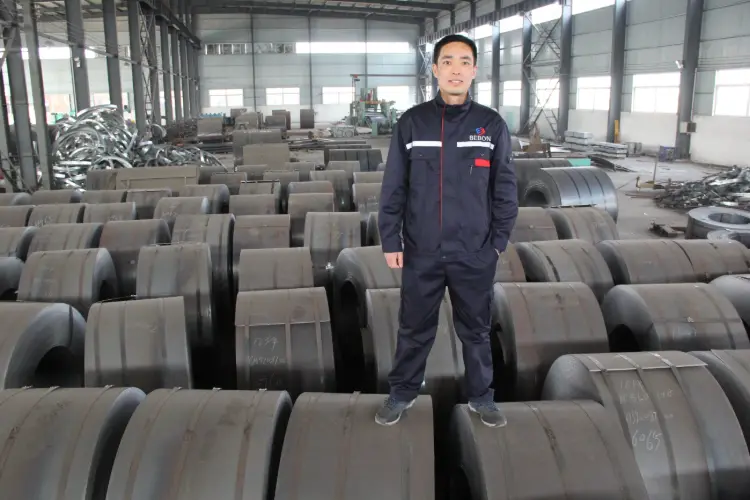
CCS EQ47 Shipbuilding Steel Coil
CCS EQ47 Shipbuilding Steel Coil - High-Strength Hull Structural Plate with 470 MPa Yield
Explore CCS EQ47 shipbuilding steel coil: chemical composition, mechanical properties, thermal data, international equivalents, and applications for hull structures.
Hot rolling, TMCP, QT, cutting, cold forming, welding
- Phone : +8618037372205
- Email : [email protected]
- WhatsApp: Contact via Whtsapp
- WeChat: +8618037372205
CCS EQ47 Shipbuilding Steel Coil Introduction
CCS EQ47 is a high-strength shipbuilding steel grade certificated by China Classification Society (CCS). It offers a minimum yield strength of 470 MPa and excellent toughness at -40°C, meeting the strict requirements for critical hull and offshore structural applications. The steel is typically supplied in coils/plates processed by thermomechanical controlled rolling (TMCP) or quenching and tempering (QT) to achieve fine grain structure and superior weldability.
- Minimum yield strength: 470 MPa
- Excellent low-temperature impact energy (E grade: -40°C)
- Good weldability with controlled carbon equivalent (CE ≤ 0.43%)
- Suitable for highly stressed ship components and Arctic-class vessels
CCS EQ47 Shipbuilding Steel Coil Chemical Composition
The chemical composition of CCS EQ47 is strictly controlled to ensure high strength, toughness and weldability. The following table lists typical limits according to CCS Rules for Materials and Welding, Part 2, Chapter 1.
- Carbon equivalent (CE) is limited to prevent cold cracking.
- Fine-grain element additions (Nb, V, Ti) refine microstructure.
- Low phosphorus and sulfur ensure high cleanliness and ductility.
| Chemical Element | Standard Value (max, unless range) | Remarks |
|---|---|---|
| Carbon (C) | 0.20 | Ladle analysis; max |
| Silicon (Si) | 0.55 | Max |
| Manganese (Mn) | 0.70 – 1.70 | Range |
| Phosphorus (P) | 0.025 | Max |
| Sulfur (S) | 0.025 | Max |
| Aluminium (Alsoluble) | ≥ 0.020 | Acid soluble; min for fine grain |
| Niobium (Nb) | 0.02 – 0.05 | If added |
| Vanadium (V) | 0.05 – 0.10 | If added |
| Titanium (Ti) | 0.01 – 0.02 | If added |
| Copper (Cu) | 0.35 | Max |
| Chromium (Cr) | 0.20 | Max |
| Nickel (Ni) | 0.40 | Max |
| Molybdenum (Mo) | 0.08 | Max |
| Nitrogen (N) | 0.009 | Max when nitrogen-binding elements present; otherwise 0.012 |
| CE (Carbon Equivalent) | 0.43 | Typical max for thickness ≤ 50 mm |
CCS EQ47 Shipbuilding Steel Coil Thermal and Electrical Physical Properties
Physical properties are representative for high-strength low-alloy shipbuilding steels. These values are not specified in CCS standard but are typical for engineering calculations and may vary slightly with specific production route.
- Values at room temperature unless otherwise noted.
- Thermal conductivity and specific heat influence preheat requirement during welding.
| Property | Standard Value | Unit | Test Condition |
|---|---|---|---|
| Density (ρ) | 7850 | kg/m³ | 20°C, typical for steel |
| Elastic modulus (E) | 205 | GPa | 20°C, tensile |
| Shear modulus (G) | 80 | GPa | Estimated from E & ν |
| Poisson's ratio (ν) | 0.3 | – | 20°C |
| Thermal expansion coefficient (α) | 12 × 10⁻⁶ | 1/K | 20–100°C |
| Thermal conductivity (λ) | 50 | W/(m·K) | 20°C |
| Specific heat capacity | 480 | J/(kg·K) | 20°C |
| Electrical resistivity (ρ_e) | 0.2 × 10⁻⁶ | Ω·m | 20°C |
CCS EQ47 Shipbuilding Steel Coil Mechanical Properties
Mechanical tests are carried out according to CCS Rules. Minimum yield and tensile strengths, elongation, bend, and impact toughness are verified for each heat. Impact energy is measured on Charpy V-notch specimens at -40°C for E grade. Values given are for longitudinal test pieces unless noted.
- Tensile testing at room temperature.
- Bend test 180°; d = diameter of bending former, a = specimen thickness.
| Property | Standard Requirement | Unit | Test Condition |
|---|---|---|---|
| Yield strength (ReH) | ≥ 470 | MPa | Thickness ≤ 50 mm, transverse |
| Yield strength (ReH) | ≥ 460 | MPa | Thickness > 50 – 70 mm, transverse |
| Yield strength (ReH) | ≥ 450 | MPa | Thickness > 70 – 100 mm, transverse |
| Tensile strength (Rm) | 570 – 720 | MPa | All thicknesses, transverse |
| Elongation (A5) | ≥ 17 | % | Gauge length = 5.65√S₀, longitudinal |
| Elongation (A5) | ≥ 14 | % | Gauge length = 5.65√S₀, transverse |
| Bend test (180°) | d = 3a | No cracks | Thickness ≤ 25 mm |
| Bend test (180°) | d = 4a | No cracks | Thickness > 25 – 50 mm |
| Impact energy (KV2) | ≥ 31 J (longitudinal) | J | -40°C, Charpy V-notch, T/2 location |
| Impact energy (KV2) | ≥ 24 J (transverse) | J | -40°C, Charpy V-notch, T/2 location |
CCS EQ47 Shipbuilding Steel Coil Completely Equivalent Material Standards and Replaceable Grades
| Country / Region | Standard / Classification Society | Grade | Remarks |
|---|---|---|---|
| International (IACS) | UR W11 | E460 (or EQ47) | IACS unified requirement; yield 460–470 MPa range |
| Norway / Germany | DNV | E47 | DNV rules for ships (identical technical requirements) |
| UK | LR | EH47 | Lloyd's Register; E = -40°C toughness, 47 = min 470 MPa |
| USA | ABS | EQ47 | American Bureau of Shipping; high strength quenched & tempered |
| France | BV | E47 | Bureau Veritas; equivalent to IACS UR W11 |
| South Korea | KR | RE47 | Korean Register; same strength and toughness class |
| Japan | NK (ClassNK) | KE47 | Nippon Kaiji Kyokai; corresponding grade |
| Italy | RINA | E47 | Registered Italian Naval Register |
| Russia | RS | E47 | Russian Maritime Register of Shipping |
| China (alternative) | GB/T 712 | EH47 | National standard for shipbuilding steel, identical composition and mechanicals |
CCS EQ47 Shipbuilding Steel Coil Application Introduction
CCS EQ47 steel coil is primarily utilized in demanding marine and offshore environments where high strength combined with excellent low‑temperature toughness is necessary. Its 470 MPa minimum yield allows reduction of structural weight. Typical applications:
- Highly stressed hull girders
- Sheer strakes and bilge strakes
- Strength deck plating for large container ships
- Arctic-class ship structures (with E-grade toughness)
- Legs and spudcans of jack-up rigs (subject to class approval)
- Offshore wind turbine foundations (transition pieces, monopiles)
Common fabrication processes include plasma/laser cutting, cold forming, and submerged arc welding with appropriate preheat/interpass temperatures (typically 50–100°C) depending on thickness.
Product Applications: Hull plates and stiffeners, Main deck and strength deck components, Bulkheads and watertight doors, Hatch coamings and container ship cell guides, Jack-up leg chords and rack plates, Transition pieces for offshore wind monopiles
Processed into products: Longitudinal frames and main girders, Transverse web frames, Stringers and cargo handling supports, Reinforcement pads and bracket plates, Padeyes and lifting lugs (with additional testing), Fatigue-sensitive connections in dynamically loaded structures
Application industries: Shipbuilding (commercial and naval), Offshore oil & gas platforms and FPSOs, Offshore wind energy, Heavy civil marine structures (ports, jetties), Bridge construction (secondary marine applications)
CCS EQ47 Shipbuilding Steel Coil Similar / Alternative Material Recommendations
| Country / Region | Standard / Classification Society | Grade | Remarks |
|---|---|---|---|
| International | IACS UR W11 | EH46 | Slightly lower yield (min 460 MPa); similar toughness; often interchangeable with reanalysis |
| International | IACS UR W11 | EQ51 | Higher yield (min 510 MPa); for heavier sections, may need upgraded welding procedure |
| China | CCS | EQ43 | Lower strength (min 430 MPa); lighter loaded structures |
| China | CCS | FQ47 | F grade (impact at -60°C); ultra-low-temperature service; higher cost |
| Europe | EN 10025-6 | S690Q | High-strength quenched steel, not specific to ship; equivalent strength, but need additional class approval for marine use |
Notes:
Welding advice: EQ47 requires low-hydrogen welding consumables. Preheat is recommended for thick plates (typically ≥ 30 mm) to 50–100°C. Post-weld heat treatment is not usually required for thicknesses below 50 mm unless specified by the classification society.
Certification: All plates/coils must be supplied with CCS certificate stating heat number, mechanical test results, and chemical analysis. 3rd party inspection to IACS UR W11 is standard.
Corrosion protection: In shipbuilding, EQ47 parts are normally protected by coating and cathodic protection systems; bare steel is not intended for direct seawater immersion without coating.
- Share



