
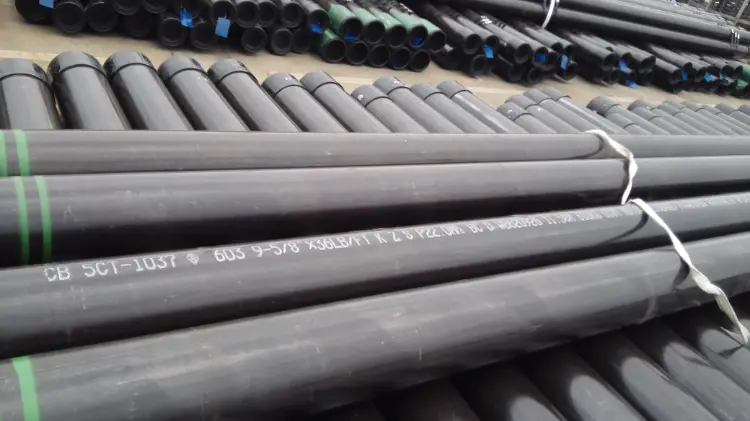
AH40 LSAW Pipe
AH40 LSAW Pipe: High-Strength Shipbuilding and Offshore Steel Pipe Properties & Data
Complete material data for AH40 LSAW pipe including chemical composition, mechanical properties, thermal and electrical characteristics, equivalent grades, and application guide based on official shipbuilding steel standards.
Hot rolling, controlled rolling, normalizing, thermomechanical controlled processing (TMCP). LSAW pipe manufacturing: plate forming, submerged arc welding, possible post-weld heat treatment.
- Phone : +8618037372205
- Email : [email protected]
- WhatsApp: Contact via Whtsapp
- WeChat: +8618037372205
AH40 LSAW Pipe Introduction
AH40 is a high-strength hull structural steel grade under GB/T 712-2011, designed for ship and offshore engineering. It offers a minimum yield strength of 390 MPa, excellent weldability, and low-temperature toughness with impact testing at 0°C. The steel is microalloyed and processed through controlled rolling or normalizing to achieve fine grain and high ductility. LSAW (Longitudinal Submerged Arc Welded) pipes made from AH40 plates are widely used in marine pipelines, offshore platforms, jacket structures, and shipbuilding frameworks. The combination of strength, formability, and crack resistance in seawater environments makes AH40 a preferred choice for critical welded structures.
AH40 LSAW Pipe Chemical Composition
Chemical requirements for AH40 steel according to GB/T 712-2011. The steel uses grain-refining elements (Al, Nb, V, Ti) to ensure fine grain structure and high toughness. Carbon equivalent (Ceq) is controlled for good weldability; typical maximum is 0.40%.
| Element | Specified Value (max. or range) | Remarks |
|---|---|---|
| C | ≤0.18 | |
| Si | ≤0.50 | |
| Mn | 0.90~1.60 | |
| P | ≤0.035 | |
| S | ≤0.035 | |
| Als (acid-soluble Al) | ≥0.015 | For fine grain treatment |
| Nb | ≤0.05 | Microalloying element (optional) |
| V | ≤0.10 | Microalloying element (optional) |
| Ti | ≤0.02 | Microalloying element (optional) |
| Cu | ≤0.35 | |
| Cr | ≤0.20 | |
| Ni | ≤0.40 | |
| Mo | ≤0.08 | |
| N | ≤0.009 | If not fixed by Al |
| Ceq | typically ≤0.40 | Ceq = C + Mn/6 + (Cr+Mo+V)/5 + (Ni+Cu)/15 |
AH40 LSAW Pipe Thermal and Electrical Physical Properties
Physical property data representative of AH40 carbon‑manganese structural steel. Values are typical at room temperature unless a temperature range is specified. These properties depend on composition and heat treatment and serve as reliable engineering references for design calculations.
| Performance Item | Typical Value | Unit | Test Condition |
|---|---|---|---|
| Density (ρ) | 7.85 | g/cm³ | 20°C |
| Elastic modulus (E) | 206 | GPa | 20°C |
| Shear modulus (G) | 80 | GPa | 20°C |
| Poisson's ratio (ν) | 0.3 | 20°C | |
| Thermal expansion coefficient (α) | 11.5 | 10⁻⁶/K | 20–100°C |
| Thermal expansion coefficient (α) | 12.5 | 10⁻⁶/K | 20–200°C |
| Thermal expansion coefficient (α) | 13.5 | 10⁻⁶/K | 20–400°C |
| Thermal conductivity (λ) | 50 | W/(m·K) | 20°C |
| Thermal conductivity (λ) | 46 | W/(m·K) | 100°C |
| Thermal conductivity (λ) | 42 | W/(m·K) | 200°C |
| Thermal conductivity (λ) | 38 | W/(m·K) | 400°C |
| Specific heat capacity (cp) | 460 | J/(kg·K) | 20°C |
| Specific heat capacity (cp) | 500 | J/(kg·K) | 200°C |
| Specific heat capacity (cp) | 580 | J/(kg·K) | 400°C |
| Electrical resistivity (ρe) | 0.15 × 10⁻⁶ | Ω·m | 20°C |
AH40 LSAW Pipe Mechanical Properties
Mechanical properties according to GB/T 712-2011 for AH40. Yield strength, tensile strength, and elongation vary with thickness. Impact tests are performed at 0°C using Charpy V-notch specimens. Bending tests are carried out to verify ductility. The values below apply to longitudinal test pieces unless noted otherwise.
| Performance Item | Standard Requirement | Unit | Test Condition / Remarks |
|---|---|---|---|
| Yield Strength (ReH) | ≥390 | MPa | Plate thickness ≤50 mm |
| Yield Strength (ReH) | ≥340 | MPa | Plate thickness 50 < t ≤ 70 mm |
| Yield Strength (ReH) | ≥320 | MPa | Plate thickness 70 < t ≤ 100 mm |
| Tensile Strength (Rm) | 510~660 | MPa | All thicknesses |
| Elongation after fracture (A) | ≥20 | % | Gauge length 5.65√So, t ≤ 50 mm |
| Elongation after fracture (A) | ≥19 | % | 50 < t ≤ 70 mm |
| Elongation after fracture (A) | ≥18 | % | 70 < t ≤ 100 mm |
| Impact absorbed energy (KV2) | ≥34 | J | 0°C, longitudinal specimen, 2mm V-notch |
| Impact absorbed energy (KV2) | ≥24 | J | 0°C, transverse specimen, 2mm V-notch |
| Bending test (180°) | d=3a | Plate thickness ≤50 mm, mandrel diameter = 3 × specimen thickness | |
| Bending test (180°) | d=3a | Plate thickness 50~100 mm |
AH40 LSAW Pipe Fully Equivalent Material Standards and Replaceable Grade Recommendations
| Country/Region | Standard | Grade | Remarks |
|---|---|---|---|
| China | GB/T 712 | AH40 | High-strength hull structural steel |
| USA | ABS Rules (ASTM A131/A131M) | ABS AH40 | American Bureau of Shipping grade |
| Norway/Germany | DNV Rules | DNV AH40 | Det Norske Veritas hull steel |
| UK | LR Rules | LR AH40 | Lloyd's Register grade |
| France | BV Rules | BV AH40 | Bureau Veritas grade |
| China | CCS Rules | CCS AH40 | China Classification Society grade |
| South Korea | KR Rules | KR AH40 | Korean Register grade |
| Japan | NK Rules | NK AH40 | Nippon Kaiji Kyokai grade |
| Italy | RINA Rules | RINA AH40 | Registro Italiano Navale grade |
AH40 LSAW Pipe Application Introduction
AH40 LSAW pipes are tailored for marine and offshore industrial environments requiring high strength, good weldability, and reliable low‑temperature toughness. The steel's properties make it suitable for structural components subjected to static and dynamic loads in seawater exposure. Typical applications include ship hull stiffeners, platform legs, pipeline supports, and conductor casings. The LSAW process allows production of large‑diameter, thick‑wall pipes with precise geometry, often meeting stringent classification society requirements.
Product Applications: LSAW pipes for piling and foundation structures, Ship hull longitudinal and transverse stiffeners (when using pipe sections), Jacket legs and brace members for offshore platforms, Conductor pipes and drive pipes in subsea installations, Riser pipes for marine riser systems, Dockside crane booms and structural columns
Processed into products: Pipe spools and bends for marine piping networks, Tubular nodes (K‑, Y‑, T‑joints) in jacket construction, Pile sleeves and cluster piles, Deck support columns and modules, Caisson tubes and sump pipes, Anchor pile segments for floating structures
Application industries: Shipbuilding (commercial and naval vessels), Offshore Oil & Gas (platforms, FPSOs, jackets), Marine Engineering & Port Construction, Offshore Wind Energy (turbine foundations, transition pieces), Pipeline Transmission (water, slurry, low‑pressure gas)
AH40 LSAW Pipe Near‑equivalent or Similar Substitute Materials
| Country/Region | Standard | Grade | Remarks |
|---|---|---|---|
| China | GB/T 712 | AH36 | Lower yield strength (min 355 MPa), same impact temperature, used for less demanding structures. |
| China | GB/T 712 | DH40 | Identical strength but impact at -20°C; better low‑temperature toughness, suitable for colder environments. |
| China | GB/T 712 | EH40 | Strength as AH40, impact at -40°C; for Arctic or severe cold applications. |
| China | GB/T 712 | FH40 | Impact at -60°C; highest toughness grade in the H40 series. |
| EU | EN 10025-3 | S420N | Normalized structural steel, min yield 420 MPa, impact -20°C; not a shipbuilding grade but close in strength. |
| EU | EN 10025-4 | S420M/ML | TMCP steel with min yield 420 MPa, impact at -20°C (M) or -50°C (ML); used in offshore structures. |
Notes:
Special requirements: For critical applications, AH40 plates may need through‑thickness tensile testing (Z‑quality) per GB/T 5313 or classification societies rules, especially when thickness exceeds 40 mm. LSAW pipes must follow welding procedure qualifications and non‑destructive testing (ultrasonic, radiographic) as per project specifications. The base material shall comply with the latest edition of the relevant classification society rules when used for marine classification.
- Share



