
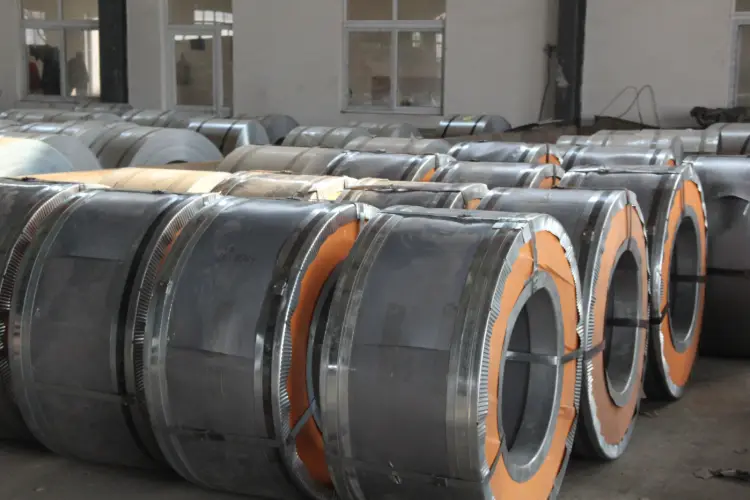
CCS DQ47 Shipbuilding Steel Coil
CCS DQ47 Shipbuilding Steel Coil: 460 MPa Yield Quenched & Tempered High-Strength Hull Plate
Comprehensive technical data for CCS DQ47 shipbuilding steel coil: chemical composition, mechanical and thermal properties, international equivalents, and application recommendations.
Hot rolling + quenching and tempering; suitable for cold forming, hot forming, welding, cutting, and machining
- Phone : +8618037372205
- Email : [email protected]
- WhatsApp: Contact via Whtsapp
- WeChat: +8618037372205
CCS DQ47 Shipbuilding Steel Coil Introduction
CCS DQ47 is a high-strength quenched and tempered shipbuilding steel coil in accordance with the China Classification Society Rules for Materials and Welding, Part 1, Chapter 3. As part of the extra-high strength structural steel series, it provides a minimum yield strength of 460 MPa and is designated for low-temperature service down to -20°C, offering excellent toughness and weldability.
Main characteristics:
- High strength-to-weight ratio
- Superior low-temperature impact toughness (Charpy-V at -20°C)
- Good weldability with controlled carbon equivalent
- Supplied in coil form, typically in quenched and tempered condition
- Widely employed in critical ship hull and offshore structural components
CCS DQ47 Shipbuilding Steel Coil Chemical Composition
The chemical composition of CCS DQ47 is controlled to achieve high strength and excellent low-temperature toughness. Maximum limits apply for impurities (P, S) and microalloying elements are used for grain refinement and precipitation hardening. A minimum Al content is required for deoxidation. Carbon equivalent (CEV) is typically limited to 0.53% (thickness ≤50 mm) for good weldability.
| Element | Standard Value | Remarks |
|---|---|---|
| Carbon (C) | ≤0.20 | |
| Manganese (Mn) | 0.90–1.60 | |
| Silicon (Si) | ≤0.55 | |
| Phosphorus (P) | ≤0.025 | |
| Sulfur (S) | ≤0.025 | |
| Aluminium (Alₜₒₜ) | ≥0.020 | Acid soluble Al |
| Niobium (Nb) | ≤0.05 | |
| Vanadium (V) | ≤0.10 | |
| Titanium (Ti) | ≤0.05 | |
| Copper (Cu) | ≤0.50 | |
| Chromium (Cr) | ≤0.50 | |
| Nickel (Ni) | ≤1.00 | |
| Molybdenum (Mo) | ≤0.50 | |
| Nitrogen (N) | ≤0.012 |
CCS DQ47 Shipbuilding Steel Coil Thermal and Electrical Physical Properties
The following physical properties are typical for high‑strength low‑alloy (HSLA) steels in the quenched and tempered condition. Actual values may vary slightly with exact chemistry and processing, but these data provide reliable engineering estimates for design and simulation.
| Property | Typical Value | Unit | Test Condition |
|---|---|---|---|
| Density (ρ) | approx. 7850 | kg/m³ | Room temperature |
| Young's modulus (E) | approx. 205 | GPa | Room temperature |
| Shear modulus (G) | approx. 80 | GPa | Room temperature |
| Poisson's ratio (ν) | approx. 0.3 | — | Elastic range |
| Thermal expansion coefficient (α) | approx. 12×10⁻⁶ | /K | 20–100°C |
| Thermal conductivity (λ) | approx. 50 | W/(m·K) | Room temperature |
| Specific heat capacity (c) | approx. 460 | J/(kg·K) | Room temperature |
| Electrical resistivity (ρₑ) | approx. 0.2 | µΩ·m | Room temperature |
CCS DQ47 Shipbuilding Steel Coil Mechanical Properties
Mechanical tests are performed in accordance with CCS requirements. Tensile tests use transverse specimens, and impact tests use Charpy‑V notch specimens. Multiple thickness ranges are defined. The steel shall be free from cracks when tested with a 180° bend. All values below are minimum requirements unless a range is given.
| Property | Required Value | Unit | Test Condition |
|---|---|---|---|
| Yield strength (ReH) | ≥460 | MPa | t ≤ 50 mm |
| Yield strength (ReH) | ≥450 | MPa | 50 mm < t ≤ 70 mm |
| Yield strength (ReH) | ≥440 | MPa | 70 mm < t ≤ 100 mm |
| Tensile strength (Rm) | 570–720 | MPa | t ≤ 100 mm |
| Elongation after fracture (A) | ≥17 | % | Gauge length 5.65√S₀, transverse |
| Charpy‑V impact energy (KV₂) | ≥41 (average) | J | At -20°C, longitudinal, t ≤ 50 mm |
| Charpy‑V impact energy (KV₂) | ≥27 (average) | J | At -20°C, transverse, t ≤ 50 mm |
| Charpy‑V impact energy (KV₂) | ≥50 (average) | J | At -20°C, longitudinal, 50 < t ≤ 70 mm |
| Charpy‑V impact energy (KV₂) | ≥34 (average) | J | At -20°C, transverse, 50 < t ≤ 70 mm |
| Charpy‑V impact energy (KV₂) | ≥61 (average) | J | At -20°C, longitudinal, 70 < t ≤ 100 mm |
| Charpy‑V impact energy (KV₂) | ≥41 (average) | J | At -20°C, transverse, 70 < t ≤ 100 mm |
| Bend test (180°) | No cracks | — | Bend diameter 3t (t≤25 mm) or 4t (t>25 mm) |
CCS DQ47 Shipbuilding Steel Coil Completely Equivalent Material Standards and Substitute Grades
| Country / Region | Standard | Grade | Remarks |
|---|---|---|---|
| International (IACS) | IACS UR W11 (Rec. 2020) | DQ47 | Unified requirement adopted by all IACS members |
| China | CCS Rules Pt.1 Ch.3 | DQ47 | Original specification |
| USA | ABS Rules for Materials & Welding | DQ47 | Identical to IACS DQ47 |
| Norway/Germany | DNV GL Rules (now DNV) | VL D47 | Equivalent to DQ47 |
| France | BV NR216 | DH47 | Same as DQ47 |
| United Kingdom | Lloyd's Register Rules | DH47 | Same name, same requirements |
| Italy | RINA Rules | DQ47 | |
| Japan | NKK Rules (NK) | KD47 | K indicates NK, rest same |
| Korea | Korean Register Rules | RD47 | R indicates KR |
| Russia | RMRS Rules | D47 | Approximate match, verify with RMRS |
CCS DQ47 Shipbuilding Steel Coil Application Introduction
CCS DQ47 steel coil is employed in shipbuilding and offshore engineering where high strength and resistance to brittle fracture at low temperatures are essential. Its typical yield strength of 460 MPa allows reduction of steel weight compared to lower grades, improving payload and fuel efficiency. The coiled format is ideal for continuous automated production of stiffeners, frames, and panel lines.
Product Applications: Hull plates and shell plating, Decks and bulkheads, Longitudinal and transverse stiffeners, Web frames and girders, Jack‑up rig legs and spud cans, Ice belt plating for Arctic vessels, Heavily loaded structural nodes
Processed into products: External shell plates (bottom, side, deck plating), Longitudinal stiffeners (bulb flats, angles, Tee bars), Transverse web frames and floor plates, Hatch coaming and coaming stays, Rudder horns and stern frame parts, Brackets, gussets, and knuckle plates, Crane pedestals and heavy‑duty foundation plates
Application industries: Shipbuilding (commercial, naval, specialized vessels), Offshore oil & gas (jack‑up rigs, semi‑submersibles, FPSOs), Marine engineering (floating cranes, wind turbine installation vessels), Heavy‑duty structural fabrication (bridges, pressure vessels where naval regulations apply)
CCS DQ47 Shipbuilding Steel Coil Similar / Substitute Materials
| Country / Region | Standard | Grade | Remarks |
|---|---|---|---|
| International | IACS UR W11 | DH40 | Yield 390 MPa, TMCP or N steel, similar toughness at -20°C |
| International | IACS UR W11 | EH36 | Yield 355 MPa, high‑heat input weldable, lower strength but similar application areas |
| Europe | EN 10025-6 | S460QL | Quenched and tempered construction steel, 460 MPa yield, not class‑approved for shipbuilding unless agreed |
| Europe | EN 10025-4 | S460ML | TMCP steel, 460 MPa yield, more suitable for offshore structures per NORSOK |
| USA | ASTM A514 / A514M | Grade B | Quenched and tempered high‑strength plate, 690 MPa (100 ksi) yield, higher strength but different toughness requirements |
Notes:
- Delivery condition: quenched and tempered (Q+T). Upon agreement, thermomechanical controlled rolling (TMCP) may be accepted for certain thicknesses.
- Carbon equivalent (CEV) usually limited to 0.53% (thickness ≤50 mm) to ensure good weldability; preheating may be required for thicker sections.
- Ultrasonic testing and extra‑toughness certification (e.g., CTOD) can be ordered for critical applications.
- The coil format provides uniformity and productivity; however, flattening and shape control must be considered for subsequent cutting and forming.
- Refer to the latest CCS Rules or IACS UR W11 for complete specification details and supplementary requirements.
- Share



