
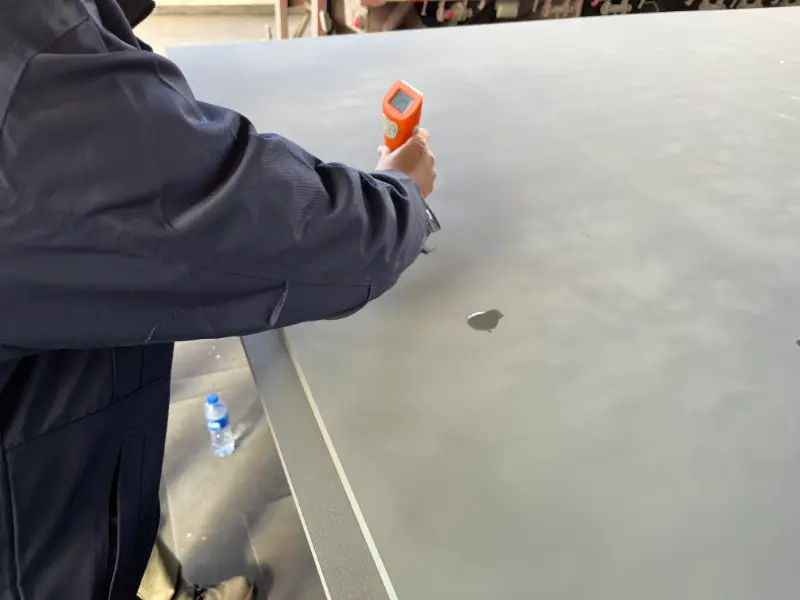
Austenitic 305 (UNS S30500) Stainless Steel Plate/Coil
Austenitic 305 (UNS S30500) Stainless Steel Plate/Coil: Properties, Standards, and Equivalents
Comprehensive technical data for Austenitic 305 (S30500) stainless steel plate/coil, including chemical composition, mechanical and physical properties, international equivalents, and applications.
Hot rolling, Cold rolling, Deep drawing, Stamping, Spinning, Bending, Welding
- Phone : +8618037372205
- Email : [email protected]
- WhatsApp: Contact via Whtsapp
- WeChat: +8618037372205
Austenitic 305 Stainless Steel Plate/Coil Introduction
Austenitic 305 stainless steel (UNS S30500) is a chromium-nickel stainless steel with a low work-hardening rate, specifically designed for severe forming operations such as deep drawing and spinning. Its higher nickel content (10.5–13.0%) compared to Type 304 stabilizes the austenitic phase, reducing cold-work hardening and making it exceptionally formable.
- Excellent corrosion resistance comparable to Type 304 in many environments
- Good weldability by standard fusion and resistance methods
- Non-magnetic in annealed condition; may become slightly magnetic after cold working
- Ideal for products requiring complex shapes with deep draws
Austenitic 305 Stainless Steel Plate/Coil Chemical Composition
Chemical composition of 305 stainless steel as per ASTM A240/A240M. All values in weight percent (mass fraction). Iron constitutes the balance.
| Element | Standard Value | Remarks |
|---|---|---|
| Carbon (C) | ≤ 0.12 | Maximum |
| Manganese (Mn) | ≤ 2.00 | Maximum |
| Phosphorus (P) | ≤ 0.045 | Maximum |
| Sulfur (S) | ≤ 0.030 | Maximum |
| Silicon (Si) | ≤ 1.00 | Maximum |
| Chromium (Cr) | 17.0 – 19.0 | Key for corrosion resistance |
| Nickel (Ni) | 10.5 – 13.0 | Austenite stabilizer; reduces work hardening |
| Iron (Fe) | Balance | Remainder |
Austenitic 305 Stainless Steel Plate/Coil Physical Properties
Typical thermal and electrical properties for 305 stainless steel in the annealed condition. These are reference values; slight variations may occur depending on exact composition and processing.
| Property | Typical Value | Unit | Test Condition |
|---|---|---|---|
| Density (ρ) | 8.0 | g/cm³ | 20°C |
| Elastic Modulus (E) | 193 | GPa | 20°C |
| Shear Modulus (G) | 77 | GPa | 20°C, estimated |
| Poisson Ratio (ν) | 0.29 | — | 20°C |
| Thermal Expansion Coefficient (α) | 17.3 / 18.2 | 10⁻⁶/°C | 0–100°C / 0–500°C |
| Thermal Conductivity (λ) | 16.2 | W/m·K | 100°C |
| Specific Heat Capacity | 500 | J/kg·K | 0–100°C |
| Electrical Resistivity (ρe) | 720 | nΩ·m | 20°C |
Austenitic 305 Stainless Steel Plate/Coil Mechanical Properties
Minimum mechanical properties for annealed 305 stainless steel plate/coil at room temperature as per ASTM A240/A240M. Elongation is measured in 50 mm (2 in.) gauge length.
| Property | Standard Value | Unit | Test Condition |
|---|---|---|---|
| Tensile Strength (Rm) | ≥ 485 (≥ 70) | MPa (ksi) | At room temperature, annealed |
| Yield Strength (Rp0.2) | ≥ 170 (≥ 25) | MPa (ksi) | 0.2% offset, room temperature, annealed |
| Elongation (A) | ≥ 40 | % | In 50 mm (2 in.), at break, annealed |
| Hardness | ≤ 183 HBW / ≤ 88 HRB | HBW / HRB | Annealed condition |
Austenitic 305 Stainless Steel Plate/Coil Equivalent Material Standards and Substitutable Grades
| Country/Region | Standard | Grade | Remarks |
|---|---|---|---|
| USA | ASTM A240/A240M | 305 (S30500) | Base standard |
| European Union | EN 10088-2 | 1.4303 / X5CrNi18-12 | Chemically identical |
| Japan | JIS G4304 | SUS 305 | Close equivalent |
| China | GB/T 3280 | 12Cr18Ni12 | Equivalent grade |
| International | ISO 15510 | X5CrNi18-12 | International standard |
Austenitic 305 Stainless Steel Plate/Coil Application Introduction
305 stainless steel is engineered for applications requiring exceptional formability combined with good corrosion resistance. Its low work-hardening characteristic allows deep draws and complex spins without intermediate annealing.
- Preferred for thin-walled, complex-shaped parts
- Ideal for appliances and food contact equipment
- Used where non-magnetic properties are essential in annealed state
Product Applications: Stainless steel sinks and bowls, Deep-drawn containers and kettles, Spun vessels and pressure tanks, Heat exchanger plates and tubes, Refrigerator liners and doors, Architectural panels and flashings
Processed into products: Sink bowls and countertops, Beer kegs and drums, Drawn cups for vacuum flasks, Welded chemical storage tanks, Cookware bodies (pots, pans), Decorative trim and escutcheons
Application industries: Kitchen equipment and appliances, Food processing and dairy, Chemical and petrochemical, Refrigeration and HVAC, Architecture and construction, Automotive trim (specialty)
Austenitic 305 Stainless Steel Plate/Coil Similar / Alternative Material Recommendations
| Country/Region | Standard | Grade | Remarks |
|---|---|---|---|
| USA | ASTM A240 | 304 (S30400) | Higher work hardening, lower Ni, similar corrosion resistance, more cost-effective for less demanding forming |
| EU | EN 10088-2 | 1.4301 (X5CrNi18-10) | Lower nickel; increases cold-work hardening; often substituted where deep drawing is not critical |
| Japan | JIS G4304 | SUS 304 | Same as 304 |
| USA | ASTM A240 | 302 (S30200) | Higher carbon for slightly higher strength after cold work, less formable |
Notes:
Heat treatment: Annealing at 1010–1120°C followed by rapid cooling (water quench or air cool for thin sections). Workability: Excellent for cold forming; can be spun and deep drawn with minimal springback. Welding: Weldable by all common methods; use 308L or 347 filler for corrosion resistance; low carbon reduces carbide precipitation risk. Magnetism: Non-magnetic in annealed condition; cold work induces slight magnetism. Corrosion: Performs well in oxidizing acids, atmospheric environments, and food contact; not recommended for strong reducing acids or chloride-rich environments above 60°C where stress corrosion cracking may occur.
- Share



