
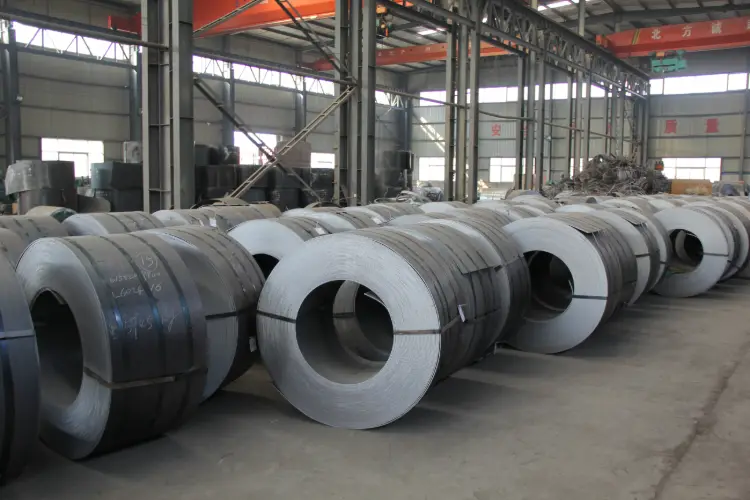
CCS FQ47 Shipbuilding Steel Coil
CCS FQ47 Shipbuilding Steel Coil: High-Strength Quenched & Tempered Marine Grade
Comprehensive datasheet for CCS FQ47 shipbuilding steel coil, including chemical composition, mechanical properties, thermal and electrical performance, and international equivalents.
Quenching and Tempering (Q&T), Thermomechanical Controlled Processing (TMCP) may be agreed
- Phone : +8618037372205
- Email : [email protected]
- WhatsApp: Contact via Whtsapp
- WeChat: +8618037372205
CCS FQ47 Shipbuilding Steel Coil Introduction
CCS FQ47 is a high-strength shipbuilding steel coil grade certified by China Classification Society (CCS) and designed for offshore and marine engineering structures. It belongs to the 460 MPa minimum yield strength category (FH47 level) and is typically supplied in the quenched and tempered (Q&T) condition. The steel offers a balanced combination of high strength, excellent low-temperature toughness down to -60°C, good weldability, and resistance to crack propagation, making it suitable for critical applications such as hulls, decks, and offshore platforms. The 'F' designation indicates fine grain practice and guaranteed impact properties at -60°C, while 'Q' refers to the quenched and tempered delivery state.
CCS FQ47 Shipbuilding Steel Coil Chemical Composition
The chemical composition of CCS FQ47 is characterized by controlled low carbon content to ensure good weldability, and microalloying elements such as niobium, vanadium, and titanium for grain refinement and precipitation strengthening. Sulfur and phosphorus are kept low to ensure cleanliness and toughness. CEV and PCM limits are applied to guarantee weldability and crack resistance.
| Element | Typical Value / Range (%) | Remarks |
|---|---|---|
| C | ≤ 0.18 | Ladle analysis |
| Si | ≤ 0.55 | |
| Mn | 0.90 - 1.60 | May be adjusted depending on thickness |
| P | ≤ 0.025 | |
| S | ≤ 0.025 | |
| Al (acid soluble) | ≥ 0.020 | Minimum fine grain requirement |
| Nb | 0.02 - 0.05 | |
| V | 0.05 - 0.10 | |
| Ti | ≤ 0.02 | |
| Cu | ≤ 0.35 | |
| Cr | ≤ 0.20 | |
| Ni | ≤ 0.40 | |
| Mo | ≤ 0.08 | |
| N | ≤ 0.012 | |
| CEV | ≤ 0.46 | Carbon Equivalent (IIW), typical max. |
CCS FQ47 Shipbuilding Steel Coil Thermal and Electrical Physical Properties
The following properties are typical for this type of quenched and tempered high-strength low-alloy steel at room temperature and are provided for design purposes. Thermal conductivity and thermal expansion are important for welding and service performance. Electrical resistivity is used in corrosion and cathodic protection assessments.
| Property | Typical Value | Unit | Test Condition / Reference |
|---|---|---|---|
| Density (ρ) | 7850 | kg/m³ | At 20°C |
| Elastic modulus (E) | 205 | GPa | Room temperature, tensile |
| Shear modulus (G) | 79 | GPa | Calculated |
| Poisson's ratio (ν) | 0.3 | - | Room temperature |
| Thermal expansion coefficient (α) | 11.5 - 12.5 | 10⁻⁶/K | 20 - 100°C |
| Thermal conductivity (λ) | 45 - 50 | W/(m·K) | At 20°C |
| Specific heat capacity | 460 - 480 | J/(kg·K) | At 20°C |
| Electrical resistivity (ρe) | 0.15 - 0.20 | Ω·mm²/m | At 20°C |
CCS FQ47 Shipbuilding Steel Coil Mechanical Properties
The mechanical properties are guaranteed for the Q&T delivery condition. Yield strength and tensile strength are specified for thicknesses up to 100 mm. Charpy V-notch impact tests are performed at -60°C. All tests are according to CCS Rules. The steel exhibits high strength with good ductility and low-temperature toughness suitable for Arctic and ice-class vessels.
| Property | Required Value | Unit | Test Condition |
|---|---|---|---|
| Yield strength (ReH) | ≥ 460 | MPa | Transverse, t ≤ 100 mm |
| Tensile strength (Rm) | 570 - 720 | MPa | Transverse, t ≤ 100 mm |
| Elongation (A) | ≥ 17 | % | Gauge length 5.65√So, transverse |
| Impact energy (KV2) | ≥ 46 (41 for thickness ≤10 mm) | J | Charpy V-notch, -60°C, longitudinal |
| Bend test (180°) | No cracks | - | Mandrel diameter 4t (t ≤ 20 mm) |
CCS FQ47 Shipbuilding Steel Coil Equivalent Standard Grades and Substitute Recommendations
| Country/Region | Standard | Grade | Remarks |
|---|---|---|---|
| International | IACS UR W11 | FH47 | International Association of Class. Societies |
| China | GB/T 712 | FH460 | Identical technical requirements |
| Europe | EN 10025-4 | S460Q / S460QL | Quenched and tempered condition, low-temperature impact options |
| USA | ASTM A131 / A131M | FH47 | Marine structural steel, -60°C impact |
| South Korea | KS D 3515 / KR | FH47 | Korean Register specification |
CCS FQ47 Shipbuilding Steel Coil Application Introduction
CCS FQ47 is primarily engineered for critical ship and offshore structures where high strength, excellent low-temperature toughness, and weldability are mandatory. It is widely used in the construction of large container ships, bulk carriers, tankers, ice-class vessels, and offshore platforms. The material can be formed, cut, and welded using conventional methods with appropriate preheating and consumables. It is suitable for both newbuilding and repair projects.
Product Applications: Hull plates and stiffeners, Deck plates and hatch coamings, Longitudinal and transverse bulkheads, Column and brace members of offshore jackets, Ice belt and icebreaker hulls, Heavy-lift crane booms and pedestals
Processed into products: Welded shell and structural members, Stiffened panels and girders, Pipe joints and heavy flanges, Transition pieces for monopile wind turbines, Chain plates and anchor handling brackets
Application industries: Shipbuilding and ship repair, Offshore oil & gas platform construction, Marine renewable energy (wind turbine substructures), Heavy engineering and port machinery, Arctic and cold-region infrastructure
CCS FQ47 Shipbuilding Steel Coil Similar or Near-Substitute Materials
| Country/Region | Standard | Grade | Remarks |
|---|---|---|---|
| China | GB/T 712 | EH460, AH460 | Lower impact temperature (-40°C / 0°C), similar strength |
| Europe | EN 10025-4 | S460M/ML | Thermomechanical rolled, may need special agreement for -60°C |
| International | API 2W | Grade 60 (460 MPa YS) | Offshore structural steel, similar toughness class |
| Japan | JIS G 3106 | SM570 (TMC/QT) | Higher tensile (≥570 MPa), adjust impact requirements |
Notes:
- Welding: Low hydrogen welding processes are recommended; preheat temperatures may be required for thick sections.
- Heat treatment: The steel should not be reheated above the tempering temperature after delivery; hot forming should be followed by a new Q&T if needed.
- Testing: All mechanical tests are witnessed by the classification society (CCS); certificates are issued accordingly.
- Coil condition: When supplied as coil, the material retains the same properties; however, edge and surface conditions should be inspected for decarburization or micro-cracking after uncoiling.
- Share



