
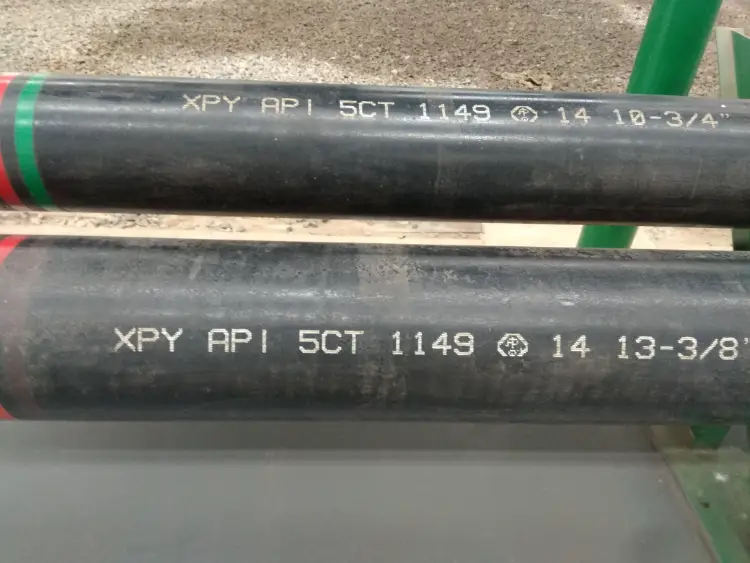
FH32 LSAW Pipe
FH32 LSAW Pipe: High-Strength Shipbuilding Steel for Arctic-Grade Welded Pipes and Offshore Structures
Complete technical data sheet for FH32 LSAW pipe according to IACS UR W11 and major classification society rules. Chemical composition, mechanical properties at -60°C, physical properties, equivalent grades, and application guidance.
Welding (SAW, GMAW, SMAW), cold forming, hot bending, machining, cutting
- Phone : +8618037372205
- Email : [email protected]
- WhatsApp: Contact via Whtsapp
- WeChat: +8618037372205
FH32 LSAW Pipe Introduction
FH32 LSAW pipe is a high-strength, low-temperature hull structural steel delivered as Longitudinal Submerged Arc Welded pipe. The grade 'F' guarantees Charpy V-notch impact toughness down to -60°C, while '32' indicates a minimum yield strength of 315 MPa.
It is widely used in arctic offshore platforms, ice-class vessels, submarine pipelines, and cold-service structural components. The steel is fully killed and fine-grained, typically supplied in normalization rolled, normalized or thermo-mechanically controlled processed (TMCP) condition. Its excellent weldability and low-temperature ductility make it suitable for thick wall LSAW pipes subjected to severe environments. The alloy design includes controlled additions of niobium, vanadium, titanium and aluminium to refine grain structure and enhance notch toughness without compromising weldability.
FH32 LSAW Pipe Chemical Composition
The following chemical limits are as per IACS UR W11 for grade FH32 (thickness ≤ 100 mm). The steel is fully killed and fine-grain treated with adequate aluminium content. Microalloying elements (Nb, V, Ti) may be used singly or in combination to achieve the required mechanical properties. Maximum limits are given unless a range is specified.
| Element | Specified Value (max. or range) | Remarks |
|---|---|---|
| Carbon (C) | ≤ 0.16 % | Ladle analysis |
| Silicon (Si) | 0.10 – 0.50 % | Ladle analysis |
| Manganese (Mn) | 0.90 – 1.60 % | Ladle analysis |
| Phosphorus (P) | ≤ 0.025 % | Ladle analysis |
| Sulfur (S) | ≤ 0.025 % | Ladle analysis |
| Aluminium (Al, acid sol.) | ≥ 0.015 % | For fine-grain practice |
| Niobium (Nb) | 0.02 – 0.05 % | If added |
| Vanadium (V) | 0.05 – 0.10 % | If added |
| Titanium (Ti) | ≤ 0.02 % | If added |
| Copper (Cu) | ≤ 0.35 % | Ladle analysis |
| Chromium (Cr) | ≤ 0.20 % | Ladle analysis |
| Nickel (Ni) | ≤ 0.40 % | Ladle analysis |
| Molybdenum (Mo) | ≤ 0.08 % | Ladle analysis |
| Nitrogen (N) | ≤ 0.012 % | If not bound by Al; otherwise not specified |
FH32 LSAW Pipe Thermal and Electrical Physical Properties
The following values are typical for low-alloy structural steels of this type and are not part of the mandatory specification. They are given for design calculations at room temperature unless otherwise stated. Exact values may vary slightly with production route and slight chemical variations within the FH32 range.
| Property | Typical Value | Unit | Test Condition / Temperature |
|---|---|---|---|
| Density (ρ) | 7.85 | g/cm³ | 20 °C |
| Elastic modulus (E) | 210 | GPa | 20 °C, tension |
| Shear modulus (G) | ~80 | GPa | 20 °C |
| Poisson's ratio (ν) | 0.3 | — | 20 °C |
| Coefficient of thermal expansion (α) | 12 × 10⁻⁶ | K⁻¹ | 20 – 100 °C |
| Thermal conductivity (λ) | 52 | W/(m·K) | 20 °C |
| Specific heat capacity (cp) | 470 | J/(kg·K) | 20 °C |
| Electrical resistivity (ρ_e) | 0.15 | µΩ·m | 20 °C |
FH32 LSAW Pipe Mechanical Properties
Mechanical properties are determined on test pieces taken transverse to the rolling direction for plate or from pipe body. Tensile and impact requirements reflect the minimum values after final delivery condition (N, NR or TMCP). Impact test temperature is -60 °C for grade FH32. Values for thicker sections may have slightly reduced elongation; refer to the relevant classification society rule for exact thickness-dependent values.
| Property | Specified Value | Unit | Test Conditions |
|---|---|---|---|
| Yield strength (ReH) | ≥ 315 | MPa | Room temperature, transverse |
| Tensile strength (Rm) | 440 – 590 | MPa | Room temperature, transverse |
| Elongation (A) | ≥ 22 | % | Gauge length 5.65√S₀, transverse |
| Charpy V-notch impact energy (KV) | ≥ 27 (longitudinal) / ≥ 20 (transverse) | J | -60 °C, average of 3 tests, min single value 70% of average |
| Bend test (if required by pipe standard) | No cracks or defects | — | 180° bending over former, diameter per pipe specification |
FH32 LSAW Pipe Identical Material Standards and Replacement Grades
| Country / Region | Standard / Classification Society | Grade Designation | Remarks |
|---|---|---|---|
| International (IACS) | UR W11 | FH32 | Unified requirement for normal and higher strength hull structural steels |
| USA | ABS (American Bureau of Shipping) | FH32 | Identical to IACS FH32 |
| France | BV (Bureau Veritas) | FH32 | Identical to IACS FH32 |
| China | CCS (China Classification Society) | FH32 | Identical to IACS FH32 |
| Norway/Germany | DNV (Det Norske Veritas) | FH32 | Identical to IACS FH32; formerly DNV FH32 |
| UK | LR (Lloyd's Register) | FH32 | Identical to IACS FH32 |
| Japan | NK (Nippon Kaiji Kyokai) | FH32 | Identical to IACS FH32 |
| Italy | RINA (Registro Italiano Navale) | FH32 | Identical to IACS FH32 |
| Russia | RS (Russian Maritime Register of Shipping) | FH32 | Identical to IACS FH32 |
| South Korea | KR (Korean Register of Shipping) | FH32 | Identical to IACS FH32 |
FH32 LSAW Pipe Application Introduction
FH32 LSAW pipe excels in cryogenic and heavy structural applications where high notch toughness at -60°C and reliable weldability are mandatory. The LSAW manufacturing method permits large-diameter, thick-wall pipes with longitudinal weld seam, ideal for offshore and marine environments. The steel combines good strength (315 MPa yield) with excellent ductility, allowing safe design against brittle fracture in arctic conditions. It is extensively used in structural, mechanical and piping systems that must withstand wave, ice and seismic loads.
Product Applications: Longitudinal Submerged Arc Welded (LSAW) pipes in diameters 16"–64" with wall thickness up to 50 mm, Structural hollow sections for offshore jackets and decks, Piling pipes for quay walls and jetties, Conductor pipes and casing for well drilling, Riser pipes and J-tubes for subsea installations
Processed into products: Jacket legs, braces, and nodes in offshore platforms, Icebreaking bow and stern frame components, Helideck support frames and crane pedestals, Submarine pipeline mainline and shore approach sections, Cold-climate pressure piping for liquefied gas systems, Wind turbine tower internal structural rings and flanges
Application industries: Shipbuilding (ice-class vessels, LNG carriers, arctic shuttle tankers), Offshore oil & gas (jacket platforms, FPSO modules, subsea pipelines, risers), Offshore wind energy (monopile foundations, transition pieces, tower internals), Civil and heavy construction (bridge piling, caissons, cold-region structural pipes), Pipeline transportation (arctic oil & gas trunk lines, flowlines, fire water systems)
FH32 LSAW Pipe Similar / Nearby Alternative Materials
| Country / Standard | Standard | Grade | Similarity and Notes |
|---|---|---|---|
| IACS | UR W11 | EH36 | Higher yield strength (≥355 MPa), impact test at -40°C. Suitable where higher strength but slightly less stringent low-temperature toughness is acceptable. |
| IACS | UR W11 | DH32 | Same yield strength (≥315 MPa), but impact test at -20°C. Cheaper option for moderate cold climates. |
| EN 10225 | EN 10225:2009 | S355G15+N/ +M | Yield ≥355 MPa, impact at -40°C. Used in offshore structures; strength slightly higher, toughness somewhat lower than FH32. |
| ASTM / API | ASTM A131 / API 2H | EH36 / Grade 50 | ASTM A131 EH36 matches IACS EH36; API 2H Gr.50 yield 345-517 MPa, impact at -40°C. May replace FH32 where -60°C is not required and 50 ksi strength is acceptable. |
| EN 10025-3 | EN 10025-3:2004 | S355NL | Normalized fine-grain steel, yield ≥355 MPa, impact -50°C. Conceptually close to FH32 but lacking the specific marine certification. |
Notes:
All data shown are in compliance with the IACS UR W11 and major classification societies' rules. Actual properties on the finished LSAW pipe must be certified by the relevant classification society. Supplementary requirements such as ultrasonic testing (UT), CTOD testing, Z-quality through-thickness properties, or specific welding procedure qualification may apply and should be stated in the purchase specification. For welded pipes, weld seam properties are to meet base metal requirements unless otherwise agreed. The thermal and electrical values are reference only; for critical design, measured parameters on the actual heat should be used.
- Share



