
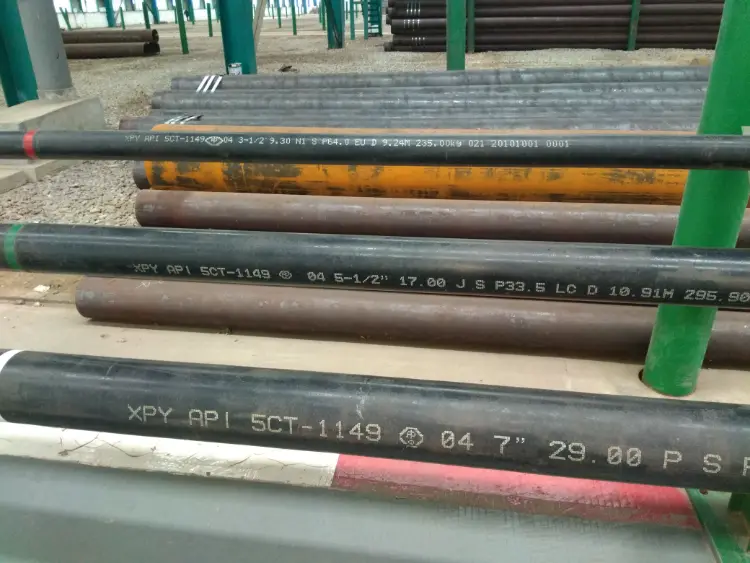
EH32 LSAW Pipe Steel
EH32 LSAW Pipe Steel: High-Strength Shipbuilding Grade for Arctic & Marine Structures
Comprehensive technical data for EH32 steel used in longitudinally submerged arc welded (LSAW) pipes, including chemical composition, mechanical properties, and equivalents.
Welding (SAW, SMAW, GMAW), hot/cold forming, cutting, machining, bending, and normalizing or thermomechanical controlled processing (TMCP) as applicable
- Phone : +8618037372205
- Email : [email protected]
- WhatsApp: Contact via Whtsapp
- WeChat: +8618037372205
EH32 LSAW Pipe Steel Introduction
EH32 is a high-strength shipbuilding structural steel grade primarily used for welded structures in ship and offshore engineering. It is characterized by a minimum yield strength of 315 MPa and excellent low-temperature toughness guaranteed at -40°C. When manufactured as LSAW (Longitudinally Submerged Arc Welded) pipe, EH32 offers superior dimensional accuracy, high weld integrity, and reliable performance in harsh marine environments, making it suitable for hull structures, offshore platforms, and critical piping applications where notch toughness and weldability are essential.
EH32 LSAW Pipe Steel Chemical Composition
Typical limits based on GB/T 712 for EH32. Fine grain practice with aluminium and optional microalloying elements (Nb, V, Ti) improves strength and low-temperature toughness.
- Ceq = C + Mn/6 + (Cr + Mo + V)/5 + (Ni + Cu)/15
- Pcm = C + Si/30 + Mn/20 + Cu/20 + Ni/60 + Cr/20 + Mo/15 + V/10 + 5B
Applied only when specified by the purchaser.
| Element | Standard Value (max, unless range given) | Notes |
|---|---|---|
| C | ≤0.18 | Carbon |
| Mn | 0.90 – 1.60 | Manganese; range for thickness ≤100 mm |
| Si | ≤0.50 | Silicon |
| S | ≤0.035 | Sulphur |
| P | ≤0.035 | Phosphorus |
| Al (total) | ≥0.015 | Total aluminium; required for fine grain practice |
| Nb | ≤0.05 | Niobium; optional microalloy |
| V | ≤0.10 | Vanadium; optional microalloy |
| Ti | ≤0.02 | Titanium; optional microalloy |
| Cr | ≤0.20 | Residual chromium |
| Ni | ≤0.40 | Residual nickel |
| Cu | ≤0.35 | Residual copper |
| Mo | ≤0.08 | Residual molybdenum |
| Ceq | ≤0.38 | Carbon equivalent, typical for 50mm thick; varies with thickness |
| Pcm | ≤0.24 | Crack sensitivity parameter, when specified |
EH32 LSAW Pipe Steel Thermal and Electrical Physical Properties
Room temperature data for EH32 in normalized or TMCP condition. Thermal expansion is average between 20°C and the indicated temperature. Values are based on published data for similar C-Mn structural steels, and may vary slightly depending on final processing.
| Property | Typical Value | Unit | Test Condition / Remarks |
|---|---|---|---|
| Density (ρ) | 7.85 | g/cm³ | At 20°C |
| Elastic modulus (E) | 205 | GPa | At 20°C; dynamic method |
| Shear modulus (G) | 80 | GPa | At 20°C |
| Poisson's ratio (ν) | 0.30 | – | Elastic deformation range |
| Thermal expansion coefficient (α) | 11.7 | 10⁻⁶/K | 20–100°C |
| Thermal expansion coefficient | 12.2 | 10⁻⁶/K | 20–200°C |
| Thermal expansion coefficient | 12.8 | 10⁻⁶/K | 20–300°C |
| Thermal conductivity (λ) | 52 | W/(m·K) | At 20°C |
| Thermal conductivity | 48 | W/(m·K) | At 200°C |
| Specific heat capacity (cp) | 480 | J/(kg·K) | At 20°C |
| Specific heat capacity | 520 | J/(kg·K) | At 200°C |
| Electrical resistivity (ρe) | 0.22 | µΩ·m | At 20°C |
EH32 LSAW Pipe Steel Mechanical Properties
Mechanical properties depend on thickness and testing direction. Data reflects GB/T 712 requirements for EH32 (LSAW pipe is normally produced from TMCP steel plate). Charpy V-notch impact tests are carried out at -40°C for longitudinal and transverse specimens. Tolerances for LSAW pipe may be specified in a separate pipe standard such as API 5L or DNV-OS-F101, depending on application.
| Property | Standard Requirement | Unit | Test Condition / Remarks |
|---|---|---|---|
| Yield strength (ReH) | ≥315 | MPa | Thickness ≤100 mm; transverse tensile test |
| Tensile strength (Rm) | 440 – 590 | MPa | Thickness ≤100 mm; transverse |
| Elongation after fracture (A) | ≥22 | % | Gauge length 5.65√S0 (A5); transverse |
| Charpy impact energy (KV2) | ≥34 | J | At -40°C; longitudinal specimen; minimum average of 3 tests |
| Charpy impact energy (KV2) | ≥24 | J | At -40°C; single minimum value permitted |
| Bend test (diameter of former) | 3t | – | 180° bend; t = specimen thickness; no cracking permitted (up to 100mm) |
| Yield strength | ≥315 (+/- tolerance) | MPa | Alternate: for pipe body in LSAW pipe, according to pipe specification |
EH32 LSAW Pipe Steel Internationally Identical/Equivalent Material Standards & Recommended Substitute Grades
The following classification societies and standards recognise EH32 with identical or nearly identical requirements. These grades are fully interchangeable for shipbuilding and offshore construction under the same thickness and processing conditions.
| Country/Region | Standard | Grade | Remarks |
|---|---|---|---|
| China | GB/T 712-2011 | EH32 | National standard; basis for comparison |
| Norway / International | DNV Rules | EH32 | Det Norske Veritas; identical toughness requirement |
| USA / International | ABS Rules | EH32 | American Bureau of Shipping; equivalent yield and impact |
| China Classification Society | CCS Rules | EH32 | Identical chemistry and mechanical demands |
| UK / International | LR Rules | EH32 | Lloyd's Register; fully interchangeable |
| France / International | BV Rules | EH32 | Bureau Veritas; same strength and toughness class |
| Japan / International | NK Rules | NKEH32 / EH32 | Nippon Kaiji Kyokai; equivalent low-temperature grade |
| Italy / International | RINA Rules | EH32 | Registro Italiano Navale; identical specification |
| Russia / CIS | RS Rules | E32 (or EH32) | Russian Maritime Register of Shipping |
EH32 LSAW Pipe Steel Application Introduction
EH32 LSAW pipe combines the excellent toughness and weldability of EH32 steel with the manufacturing precision of LSAW pipe forming. It is selected when the design requires reliable low-temperature impact properties combined with good structural strength and fabricability. Typical uses span from primary structural members in Arctic vessels to piping in offshore platforms and subsea installations. The LSAW process allows production of large-diameter, thick-walled pipes with tight tolerances and high joint integrity, which are essential for critical structural and pressure-containing applications.
Product Applications: Arctic-class ship hull and ice belt reinforcement pipes, Offshore structural tubular joints (K-joints, Y-joints, T-joints), Jacket legs and bracing members for offshore platforms, Marine riser pipes and J-tubes, Mooring piles and dolphins, Dredging pipe systems, Wind turbine foundation monopiles and transition pieces, Heavy-duty structural columns for cold climate infrastructure
Processed into products: Main deck longitudinals (finished pipe used as structural stiffener), Brace and chord members for offshore jacket structures, Ice-breaking vessel stem and side plates (formed from LSAW pipe), Topside module support frames, Helicopter deck support columns, Mooring line fairlead support pipes, Seawater lift pump casings, Caisson and conductor guide pipes, Bollard and winch foundation pipes
Application industries: Shipbuilding and ship repair (hull stiffeners, deck structures, longitudinal frames), Offshore oil and gas (jackets, topsides, flare booms, conductor pipes, risers), Port and harbor engineering (piling, mooring structures), Wind energy (offshore wind turbine foundations, transition pieces, monopile inserts), Bridge and civil construction (structural tubular elements in cold regions), Arctic and ice-class vessel construction, Marine riser and subsea manifold structures
EH32 LSAW Pipe Steel Similar or Closely Related Alternative Materials
These grades are similar in chemical concept but differ in minimum yield strength, toughness temperature, or manufacturing standard. Substitution requires careful engineering assessment considering strength level, thickness, and design temperature.
| Country/Region | Standard | Grade | Remarks |
|---|---|---|---|
| China | GB/T 712-2011 | DH32 | Same strength level (≥315 MPa), but impact test at -20°C instead of -40°C |
| China | GB/T 712-2011 | FH32 | Same strength, more stringent impact test down to -60°C |
| China | GB/T 712-2011 | EH36 | Higher strength (≥355 MPa) with -40°C impact test; widely used for heavier sections |
| Europe | EN 10025-4 | S355ML | Thermomechanical rolled structural steel; similar strength but wide thickness ranges, tested at -50°C |
| USA/International | ASTM A131 / ABS | EH32 | Same specification; ASTM A131 directly references EH32 |
| ISO | ISO 4950-2 | E355DD | High yield strength flat products; similar chemistry, deliver condition and toughness can be specified |
| Pipeline context | API 5L / ISO 3183 | L290 / X42 | Comparable minimum YS (~290 MPa); often used for LSAW pipes with Charpy condition, but not identical in chemical philosophy |
Notes:
When EH32 is supplied as LSAW pipe, the purchaser should also refer to the applicable pipe dimensional and testing standards (e.g., API 5L, DNV-OS-F101, or ISO 3183) to define tolerances, hydrostatic test requirements, and non-destructive examination (NDE) levels. The base steel shall comply with the chemical and mechanical requirements of EH32 within the final pipe; longitudinal weld metals should be overmatched in strength and satisfy low-temperature toughness criteria at -40°C. For thicknesses above 100 mm, the mechanical property values may need to be agreed upon separately. Post-weld heat treatment (PWHT) may be required for certain thick-wall LSAW pipes to relief residual stresses; parameters shall be verified to avoid loss of strength and toughness.
- Share



