
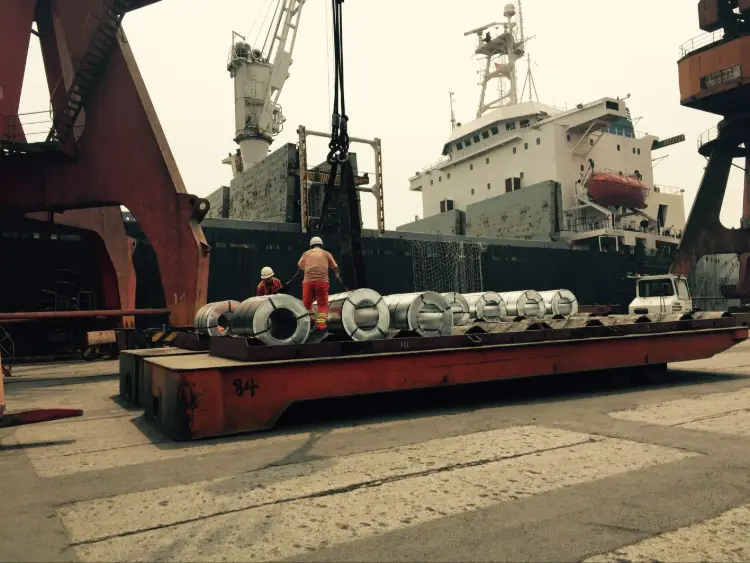
CCS DH40 Shipbuilding Steel Coil
CCS DH40 Shipbuilding Steel Coil: High-Strength Marine Plate for Hull & Offshore Structures
Complete datasheet of CCS DH40 shipbuilding steel coil with chemical composition, mechanical & thermal properties, international equivalents, and detailed application guide.
Hot rolling, Normalizing (N), Thermo-Mechanical Control Process (TMCP), Welding, Cutting, Forming
- Phone : +8618037372205
- Email : [email protected]
- WhatsApp: Contact via Whtsapp
- WeChat: +8618037372205
CCS DH40 Shipbuilding Steel Coil Introduction
CCS DH40 is a high-strength hull structural steel grade certified by the China Classification Society (CCS), designed for shipbuilding and offshore engineering applications. It belongs to the DH series of higher-strength steels, offering a minimum yield strength of 390 MPa and excellent notch toughness at -20°C. This material is typically supplied as hot-rolled coils in normalized (N) or thermo-mechanical control processed (TMCP) condition. DH40 provides a balanced combination of high strength, good weldability, and resistance to brittle fracture, making it suitable for critical structural components such as hull shells, decks, and bulkheads. The steel is fully compliant with IACS UR W11, ensuring consistent performance across international classification Societies.
CCS DH40 Shipbuilding Steel Coil Chemical Composition
Chemical requirements for CCS DH40 steel as specified in CCS Rules for Materials and Welding (IACS UR W11). The values represent ladle analysis; permissible deviations for product analysis are also defined but not shown here. Elements such as Al, Nb, V, Ti are used for grain refinement and strengthening. Maximum limits ensure good weldability and toughness.
| Chemical Element | Standard Value (Mass %) | Remarks |
|---|---|---|
| Carbon (C) | ≤ 0.18 | Ladle analysis |
| Silicon (Si) | ≤ 0.50 | Ladle analysis |
| Manganese (Mn) | 0.90 - 1.60 | Ladle analysis |
| Phosphorus (P) | ≤ 0.030 | Ladle analysis |
| Sulfur (S) | ≤ 0.030 | Ladle analysis |
| Aluminum (Al, acid soluble) | ≥ 0.015 | When used as grain-refining element |
| Niobium (Nb) | ≤ 0.05 | Optional micro-alloying |
| Vanadium (V) | ≤ 0.10 | Optional micro-alloying |
| Titanium (Ti) | ≤ 0.02 | Optional micro-alloying |
| Copper (Cu) | ≤ 0.35 | Residual |
| Chromium (Cr) | ≤ 0.20 | Residual |
| Nickel (Ni) | ≤ 0.40 | Residual |
| Molybdenum (Mo) | ≤ 0.08 | Residual |
| Nitrogen (N) | ≤ 0.009 | When nitrogen-binding elements are added |
| Boron (B) | ≤ 0.0005 | If present |
CCS DH40 Shipbuilding Steel Coil Thermal & Electrical Physical Properties
The following physical properties are typical for normalized or TMCP DH40 steel at room temperature unless otherwise noted. These values are approximate and may vary slightly depending on processing and exact composition. They are useful for design calculations involving thermal and electrical loads.
| Property | Typical Value | Unit | Test Condition |
|---|---|---|---|
| Density (ρ) | 7.85 | g/cm³ | 20 °C |
| Elastic Modulus (E) | 205 | GPa | Room temperature |
| Shear Modulus (G) | 80 | GPa | Room temperature |
| Poisson's Ratio (ν) | 0.29 | — | Room temperature |
| Thermal Expansion Coeff. (α) | 12.0 | 10⁻⁶/K | 20 - 100 °C |
| Thermal Expansion Coeff. (α) | 12.5 | 10⁻⁶/K | 20 - 200 °C |
| Thermal Expansion Coeff. (α) | 13.0 | 10⁻⁶/K | 20 - 300 °C |
| Thermal Conductivity (λ) | 50 | W/(m·K) | 100 °C |
| Specific Heat Capacity | 460 | J/(kg·K) | 20 °C |
| Electrical Resistivity (ρe) | 0.18 | µΩ·m | 20 °C |
CCS DH40 Shipbuilding Steel Coil Mechanical Properties
Mechanical properties for CCS DH40 steel coil/plate, as per CCS Rules. Tensile testing is performed on transverse specimens when width ≥ 600 mm, otherwise longitudinal. Impact test is carried out on longitudinal Charpy V-notch specimens at -20°C. Bend test ensures formability. Values depend on thickness; multiple thickness ranges are shown where applicable.
| Property | Required Value | Unit | Test Condition |
|---|---|---|---|
| Yield Strength (ReH) | ≥ 390 | MPa | Thickness ≤ 100 mm; transverse (width ≥ 600 mm) or longitudinal |
| Tensile Strength (Rm) | 510 - 660 | MPa | Thickness ≤ 100 mm; transverse (width ≥ 600 mm) or longitudinal |
| Elongation (A5) | ≥ 20 | % | Gauge length 5.65√So; longitudinal; thickness ≤ 100 mm |
| Charpy Impact (KV2) | ≥ 27 (avg.) | J | Longitudinal, 10×10 mm specimen, -20 °C |
| Bend Test (180°) | d = 3a | — | Thickness ≤ 25 mm; no cracks |
| Bend Test (180°) | d = 4a | — | Thickness > 25 mm; no cracks |
CCS DH40 Shipbuilding Steel Coil Fully Equivalent Grades under IACS UR W11
| Country/Region | Standard | Grade | Remarks |
|---|---|---|---|
| International | IACS UR W11 | DH40 | Base standard for high strength hull steels |
| USA | ABS Rules | DH40 | American Bureau of Shipping |
| UK | LR Rules | DH40 | Lloyd's Register |
| Norway | DNV Rules | DH40 | Det Norske Veritas |
| France | BV Rules | DH40 | Bureau Veritas |
| Japan | NK Rules | DH40 | Nippon Kaiji Kyokai |
| South Korea | KR Rules | DH40 | Korean Register |
| Italy | RINA Rules | DH40 | Registro Italiano Navale |
| India | IRS Rules | DH40 | Indian Register of Shipping |
| Poland | PRS Rules | DH40 | Polish Register of Shipping |
| Croatia | CRS Rules | DH40 | Croatian Register of Shipping |
| Russia | RS Rules | DH40 | Russian Maritime Register of Shipping |
CCS DH40 Shipbuilding Steel Coil Application Introduction
CCS DH40 steel coil is extensively used in the shipbuilding and marine engineering sectors where a combination of high strength, good weldability, and low-temperature toughness is required. Its typical delivery as coiled plate enables efficient downstream processing for large structural assemblies. The material is suitable for welding with standard shipbuilding consumables, and preheating is generally not required for moderate thicknesses. The following are typical areas of application and products:
Product Applications: Hull shell plates (side shell, bottom shell), Deck plates and stringers, Bulkheads and watertight compartments, Stiffeners and girders, Offshore platform decks and legs, Sheet piles and retaining structures, Wind turbine foundation transition pieces
Processed into products: Ship hull panels, Keel plates, Transverse frames, Longitudinal stiffeners, Bracket plates, Manhole covers, Flare towers and booms
Application industries: Shipbuilding (merchant ships, naval vessels), Offshore oil & gas platforms, Marine & coastal engineering, Heavy fabrication (crane booms, bridges over water), Pressure vessel manufacturing (when approved by CCS)
CCS DH40 Shipbuilding Steel Coil Similar / Alternative Materials
| Country/Region | Standard | Grade | Remarks |
|---|---|---|---|
| China | CCS Rules | EH40 | Higher toughness grade (-40°C Charpy), same strength level |
| China | CCS Rules | DH36 | Lower yield strength (355 MPa), less demanding |
| China | CCS Rules | FH40 | Highest toughness grade (-60°C), same strength level |
| China | CCS Rules | AH40 | Standard toughness (0°C), same strength, less suitable for cold conditions |
| International | IACS UR W11 | EH40 / DH36 / FH40 | Similar grades across all classification societies |
Notes:
All CCS DH40 material must be certified by the China Classification Society (or accepted recognized organization) with inspection documents 3.1 or 3.2 as per EN 10204. The steel is typically supplied in normalized or TMCP condition, with Charpy impact testing mandatory at -20°C. Weldability is excellent using all common arc welding processes; welding consumables should match the strength and toughness of DH40. For thickness above 50 mm, consideration should be given to lamellar tearing resistance (Z-quality). The coil form allows continuous processing such as cut-to-length, slitting, and roll-forming for large-scale production.
- Share



