
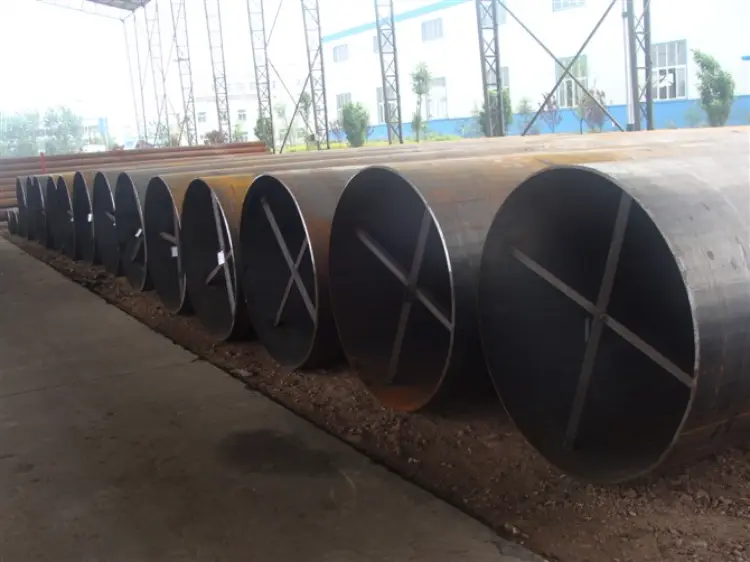
DH32 LSAW Pipe Steel
DH32 LSAW Pipe Steel - Chemical & Mechanical Properties, Equivalents and Applications
Complete material data for DH32 steel used in LSAW (longitudinal submerged arc welded) pipes, including chemical composition, mechanical and physical properties, international equivalent standards, and typical applications.
Thermo-mechanical controlled rolling (TMCP), normalizing, controlled rolling
- Phone : +8618037372205
- Email : [email protected]
- WhatsApp: Contact via Whtsapp
- WeChat: +8618037372205
DH32 LSAW Pipe Steel Introduction
DH32 is a high-strength hull structural steel with a minimum yield strength of 315 MPa and guaranteed low-temperature impact toughness at -20°C. When used to manufacture LSAW pipes, the DH32 grade offers excellent weldability and structural integrity for marine and offshore applications. The designation "D" refers to the impact temperature class (-20°C), and "H32" indicates high-strength shipbuilding steel with a specified minimum yield point of 315 MPa. Manufactured in accordance with classification society rules such as IACS UR W11, DH32 steel pipes are widely employed in ship hulls, offshore platforms, and piling projects. Typical plate thicknesses for pipe forming range from 6 mm to 50 mm, and the material is usually supplied in the normalized or thermomechanically controlled rolled condition.
DH32 LSAW Pipe Steel Chemical Composition
The chemical composition of DH32 steel complies with IACS UR W11 and the rules of major classification societies. The values below are typical maximum limits unless otherwise stated.
- Microalloying elements such as Nb and V are added to refine grain size and enhance strength.
- Aluminum is used for deoxidation and grain refinement; acid-soluble aluminium is mandatory.
- Carbon equivalent (Ceq) is controlled to ensure good weldability and is typically ≤ 0.38%.
| Element | Standard Value (max %) | Remarks |
|---|---|---|
| C | 0.18 | |
| Mn | 0.90 – 1.60 | Range |
| Si | 0.10 – 0.50 | Range |
| P | 0.025 | |
| S | 0.025 | |
| Al (acid soluble) | ≥ 0.015 | Minimum |
| Nb | 0.02 – 0.05 | Typical range |
| V | 0.05 – 0.10 | Typical range |
| Ti | 0.02 | Optional; for grain refinement |
| Cu | 0.35 | |
| Cr | 0.20 | |
| Ni | 0.40 | |
| Mo | 0.08 | |
| N | 0.009 | Or 0.012 depending on specification |
DH32 LSAW Pipe Steel Thermal & Electrical Physical Properties
Physical properties are typical for low-carbon microalloyed steel at ambient temperature unless otherwise noted. These values are not part of mandatory certification but are useful for design calculations.
- Density is approximately 7.85 g/cm³.
- Elastic modulus and shear modulus are average values for structural steel.
- Thermal conductivity and expansion coefficients are provided for room temperature and elevated temperature ranges.
| Property | Typical Value | Unit | Test Condition / Temperature |
|---|---|---|---|
| Density (ρ) | 7.85 | g/cm³ | 20°C |
| Elastic modulus (E) | 205 | GPa | 20°C |
| Shear modulus (G) | 80 | GPa | 20°C |
| Poisson's ratio (ν) | 0.30 | — | 20°C |
| Thermal expansion coefficient (α) | 11.7 × 10⁻⁶ | K⁻¹ | 0–100°C |
| Thermal conductivity (λ) | 52 | W/(m·K) | 20°C |
| Specific heat capacity (cₚ) | 450 | J/(kg·K) | 20°C |
| Electrical resistivity (ρₑ) | 0.18 | μΩ·m | 20°C |
DH32 LSAW Pipe Steel Mechanical Properties
Mechanical properties are verified on test pieces taken from the base metal (plate) used for LSAW pipe production. Requirements are according to IACS UR W11 and classification society rules. Yield strength and tensile strength are determined in the transverse direction. Impact tests are performed on Charpy V-notch specimens at -20°C (longitudinal direction) with a minimum average energy of 31 J. Bend tests are required to ensure ductility and soundness.
| Property | Standard Requirement | Unit | Test Condition |
|---|---|---|---|
| Yield strength (ReH) | ≥ 315 | MPa | t ≤ 50 mm |
| Tensile strength (Rm) | 440 – 590 | MPa | t ≤ 50 mm |
| Elongation (A5) | ≥ 22 | % | Gauge length 5.65√S₀, t ≤ 50 mm |
| Impact energy (KV₂) | ≥ 31 | J | Charpy V-notch, longitudinal, -20°C |
| Bend test (bending angle 180°) | d = 2a | — | Mandrel diameter for t ≤ 25 mm |
| Bend test (bending angle 180°) | d = 3a | — | Mandrel diameter for 25 < t ≤ 50 mm |
DH32 LSAW Pipe Steel Fully Equivalent Material Standards and Replaceable Grade Designations
| Country / Region | Standard / Class Society | Grade | Remarks |
|---|---|---|---|
| International / IACS | IACS UR W11 | DH32 | Common unified requirement |
| China | CCS | DH32 | China Classification Society |
| USA | ABS | DH32 | American Bureau of Shipping |
| Norway / Germany | DNV GL | VL DH32 | Now DNV; may include optional conditions |
| UK | LR | DH32 | Lloyd's Register |
| France | BV | DH32 | Bureau Veritas |
| Japan | NK (ClassNK) | DH32 | Nippon Kaiji Kyokai |
| Italy | RINA | DH32 | Registro Italiano Navale |
| Russia | RMRS | DH32 | Russian Maritime Register of Shipping |
| Korea | KR | DH32 | Korean Register |
DH32 LSAW Pipe Steel Application Introduction
DH32 LSAW pipe is specifically designed for demanding marine and offshore structural applications. The combination of high strength, excellent toughness at sub-zero temperatures, and good weldability makes it suitable for the following specific uses:
- Large-diameter piling pipes for harbor and coastal structures.
- Jacket legs, braces, and structural members in offshore platforms.
- Wind turbine monopile foundations and transition pieces.
- Ship hull longitudinal stiffeners and deck girders as welded components.
Product Applications: LSAW steel pipes (OD 406–1626 mm, WT 6–50 mm), Ship hull plates and sections, Offshore platform structural members, Piling pipes (king piles, combi wall piles), Conductor pipes and casings
Processed into products: Pipe spools and riser components, Structural beams and columns in ship superstructures, Foundation monopiles for wind turbines, Dock gates and floating crane booms, Mooring and towing bollards
Application industries: Shipbuilding and ship repair, Offshore oil & gas, Renewable energy (offshore wind), Port and harbor engineering, Heavy civil construction
DH32 LSAW Pipe Steel Related / Close Substitute Material Recommendations
| Country / Region | Standard / Class Society | Grade | Remarks |
|---|---|---|---|
| International | IACS UR W11 | AH32 | Impact test at 0°C; same strength level |
| International | IACS UR W11 | EH32 | Impact test at -40°C; better low-temperature toughness |
| International | IACS UR W11 | DH36 | Higher yield strength (≥ 355 MPa); impact test at -20°C |
| International | IACS UR W11 | AH36 | Yield ≥ 355 MPa; impact test at 0°C |
| International | API 5L / EN 10208 | X52 / L360 | Comparable strength level for line pipe; different toughness requirements |
Notes:
Welding considerations: DH32 LSAW pipes are welded using a longitudinal submerged arc process; the base material requires a low hydrogen welding procedure to avoid cold cracking. Preheat and interpass temperatures should be controlled according to the carbon equivalent and plate thickness. Post-weld heat treatment (PWHT) is generally not mandatory for this grade.
Supplementary testing: Depending on the project specification, additional tests such as through-thickness tensile (Z-direction), ultrasonic testing of the pipe weld seam, and CTOD tests may be required.
Note on data: All values are based on IACS UR W11 and publicly available classification society rules. Always refer to the latest edition of the relevant class society rule for the detailed specification.
- Share



