
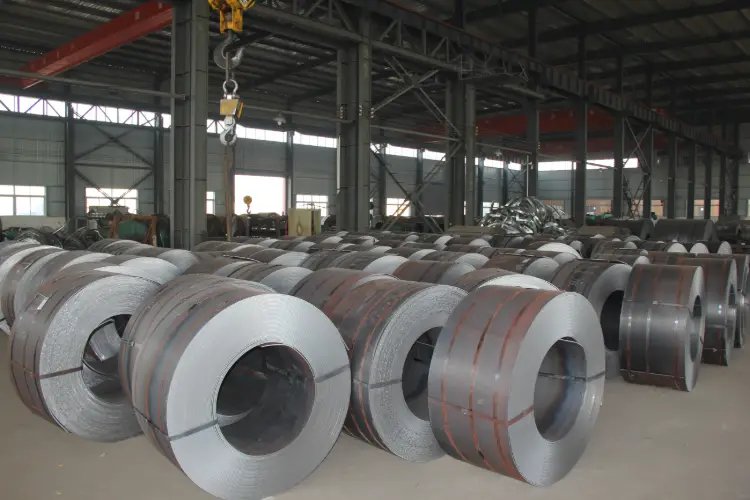
CCS AH40 Shipbuilding Steel Coil
CCS AH40 Shipbuilding Steel Coil: High-Strength Marine Grade Properties & Equivalents
Explore CCS AH40 shipbuilding steel coil—a high-strength hull structural steel certified by China Classification Society. Get chemical composition, mechanical properties, thermal data, international equivalents, and application guide.
Hot rolling, TMCP (Thermo-Mechanically Controlled Process), normalizing, normalizing plus tempering (as agreed)
- Phone : +8618037372205
- Email : [email protected]
- WhatsApp: Contact via Whtsapp
- WeChat: +8618037372205
CCS AH40 Shipbuilding Steel Coil Introduction
CCS AH40 is a high-strength hull structural steel certified by the China Classification Society (CCS). As a thermo-mechanically rolled or normalized steel, it offers a minimum yield strength of 390 MPa, good weldability, and excellent toughness at 0°C, making it ideal for critical ship and offshore structures.
- Excellent combination of strength and ductility
- Reliable low-temperature impact toughness (0°C)
- Strict cleanliness and fine grain practice
- Certified to CCS Rules for Materials and Welding
CCS AH40 Shipbuilding Steel Coil Chemical Composition
The chemical composition of AH40 shipbuilding steel is designed to ensure high strength, good weldability, and notch toughness. Carbon equivalent is controlled to limit hardening in the heat-affected zone. Values comply with GB/T 712-2011 and CCS certification requirements.
- Microalloying with Nb, V, Ti refines grains and improves strength
- Maximum P and S are kept low for cleanliness
- Aluminum is added for deoxidation and grain refinement
- Carbon equivalent Ceq = C + Mn/6 + (Cr+Mo+V)/5 + (Ni+Cu)/15 typically ≤0.40%
| Element | Standard Value (max, or range) | Remarks |
|---|---|---|
| C | ≤0.18% | Carbon; strength and weldability |
| Si | ≤0.50% | Silicon; deoxidizer |
| Mn | 0.90 – 1.60% | Manganese; strength and toughness |
| P | ≤0.030% | Phosphorus; controlled for low-temperature toughness |
| S | ≤0.030% | Sulfur; low for cleanliness |
| Al (acid soluble) | ≥0.015% | Aluminum; grain refinement |
| Nb | ≤0.05% | Niobium; grain refinement, precipitation strengthening |
| V | ≤0.10% | Vanadium; precipitation strengthening |
| Ti | ≤0.02% | Titanium; grain refinement |
| Cu | ≤0.35% | Copper; atmospheric corrosion resistance |
| Cr | ≤0.20% | Chromium; hardenability control |
| Ni | ≤0.40% | Nickel; toughness improvement |
| Mo | ≤0.08% | Molybdenum; optional for thick gauges |
CCS AH40 Shipbuilding Steel Coil Thermal and Electrical Physical Properties
Physical property data are typical for low-carbon microalloyed shipbuilding steel at room temperature. Actual values may vary slightly with heat treatment and thickness.
- Density is standard for carbon-manganese steels
- Thermal expansion is consistent with similar alloys
- Electrical resistivity enables cathodic protection calculations
| Property | Standard Value | Unit | Test Condition |
|---|---|---|---|
| Density (ρ) | 7850 | kg/m³ | 20°C |
| Elastic Modulus (E) | 200 – 210 | GPa | 20°C |
| Shear Modulus (G) | ~80 | GPa | 20°C (estimated) |
| Poisson's Ratio (ν) | 0.3 | — | 20°C |
| Thermal Conductivity (λ) | 50 – 55 | W/(m·K) | 20°C |
| Specific Heat Capacity (cp) | ~460 | J/(kg·K) | 20°C |
| Thermal Expansion Coefficient (α) | 11.5 | 10⁻⁶ /°C | 20–100°C |
| Thermal Expansion Coefficient (α) | 12.5 | 10⁻⁶ /°C | 20–200°C |
| Thermal Expansion Coefficient (α) | 13.3 | 10⁻⁶ /°C | 20–300°C |
| Electrical Resistivity (ρe) | 0.15 – 0.25 | μΩ·m | 20°C |
CCS AH40 Shipbuilding Steel Coil Mechanical Properties
Mechanical properties are verified at room temperature unless otherwise noted. The minimum yield strength is 390 MPa, and Charpy V-notch impact test is performed at 0°C to ensure adequate fracture toughness.
- Tensile testing according to ISO 6892-1 or GB/T 228
- Bend test ensures formability and soundness
- Impact test values differ for longitudinal and transverse directions
| Property | Standard Requirement | Unit | Test Condition |
|---|---|---|---|
| Yield Strength (ReH) | ≥390 | MPa | Room temperature; applies to thickness ≤100 mm |
| Tensile Strength (Rm) | 510 – 660 | MPa | Room temperature |
| Elongation after fracture (A) | ≥20 | % | Gauge length 5.65√S0; thickness ≤50 mm |
| Elongation after fracture (A) | ≥20 | % | Thickness 50–70 mm |
| Elongation after fracture (A) | ≥19 | % | Thickness 70–100 mm |
| Bend Test (180°) | d = 3a | — | Bend diameter a = specimen thickness; t ≤50 mm |
| Bend Test (180°) | d = 4a | — | t 50–70 mm; no cracks |
| Charpy Impact (KV2) 0°C | ≥34 (average), ≥24 (single) | J | Longitudinal; t ≤50 mm |
| Charpy Impact (KV2) 0°C | ≥24 (average), ≥17 (single) | J | Transverse; t ≤50 mm |
CCS AH40 Shipbuilding Steel Coil Complete Equivalent Standards and Replaceable Grades
| Country/Region | Standard | Grade | Remarks |
|---|---|---|---|
| China | CCS Rules for Materials and Welding | AH40 | China Classification Society certified |
| China | GB/T 712-2011 | AH40 | National standard, identical technical requirements |
| International | IACS UR W11 | AH40 | International Association of Classification Societies unified requirement |
| Norway/Germany | DNV GL Rules | AH40 | DNV GL certified shipbuilding steel |
| United Kingdom | Lloyd's Register Rules | AH40 | LR certified grade |
| France | Bureau Veritas Rules | AH40 | BV certified grade |
| United States | ABS Rules | AH40 | American Bureau of Shipping certified grade |
| South Korea | KR Rules | AH40 | Korean Register certified grade |
| Japan | NK Rules | AH40 | ClassNK certified grade |
| Italy | RINA Rules | AH40 | RINA certified grade |
CCS AH40 Shipbuilding Steel Coil Application Introduction
CCS AH40 steel is widely used in marine and offshore construction where a combination of high strength and reliable notch toughness at 0°C is mandatory. Its excellent weldability and formability make it suitable for automated panel line production.
- Class-approved material for hull and structural components
- Thicknesses up to 100 mm depending on shipyard requirements
- Compatible with all major welding consumables
Product Applications: Hull shell plates (side, bottom, deck, bulkhead), Longitudinal and transverse stiffeners, Web frames and girders, Superstructure and deckhouse panels, Offshore platform legs and bracings, Bilge keels and keel plates, Ship sections and pre-fabricated modules
Processed into products: Hull plating (rolled coil then cut to size), Longitudinals and stringers, Transverse frames and floors, Deck beams and bulkhead plates, Brackets and doubler plates, Stiffeners and stiffening rings, Collision bulkheads, Foundations for machinery and equipment
Application industries: Shipbuilding (bulk carriers, tankers, container ships, LNG carriers), Marine & Offshore Engineering (jack-up rigs, semi-submersibles, FPSO), Port & Harbor Construction (dock gates, caissons, sheet piling), Oil & Gas (offshore platform decks, flare booms, conductor supports), Bridge and Civil Engineering (coastal bridges, ferry terminals)
CCS AH40 Shipbuilding Steel Coil Similar / Alternative Materials Recommendation
| Country/Region | Standard | Grade | Remarks |
|---|---|---|---|
| China | GB/T 712-2011 / CCS | DH40 | Higher toughness with impact test at -20°C; otherwise same strength |
| China | GB/T 712-2011 / CCS | EH40 | Impact test at -40°C for arctic service |
| China | GB/T 712-2011 / CCS | FH40 | Impact test at -60°C for extreme low temperature |
| China | GB/T 712-2011 / CCS | AH36 | Lower strength (yield ≥355 MPa) but similar applications; may be thickened to compensate |
| Europe | EN 10025-4 | S420M/ML | Thermo-mechanically rolled structural steel, similar strength but not marine-certified unless additional requirements met |
| International | API 2H/2W | Grade 50 | Offshore structural steel plates, similar strength, specific for offshore platforms |
Notes:
CCS AH40 steel is typically supplied with classification society survey and stamping. Ultra-sonic testing (UT), Z-direction testing, and through-thickness properties may be specified according to CCS rules or purchaser's requirements. Welding must follow approved welding procedure specifications (WPS) with low-hydrogen electrodes and appropriate preheat/interpass temperatures. Normalizing or TMCP delivery condition shall be clearly indicated on the mill certificate.
- CEV typically ≤0.40% for good weldability
- Optionally available as hot-rolled coil (HRC) or cut-to-length plates
- Surface inspection and dimensional tolerances per CCS and international standards
- Share



