
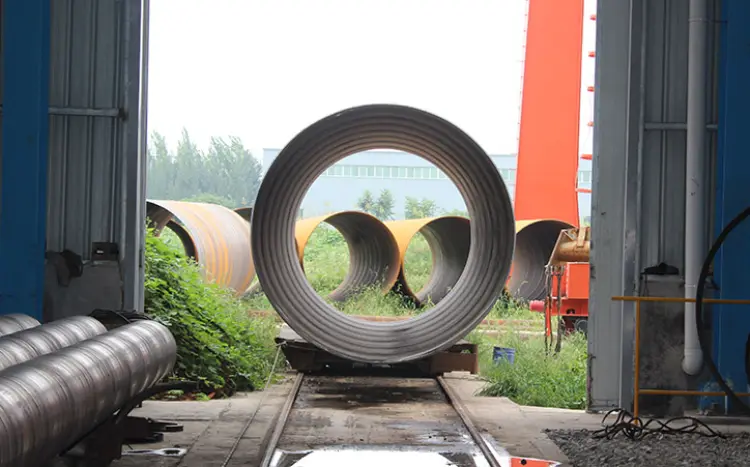
AH32 Shipbuilding Steel LSAW Pipe
AH32 Shipbuilding Steel Grade Data Sheet for LSAW Pipe Applications
Detailed material properties of AH32 steel used in LSAW pipes, including chemical composition, mechanical and thermal properties, international equivalents, and application guide.
Hot rolling, controlled rolling, normalizing, welding (including LSAW), cutting, cold bending
- Phone : +8618037372205
- Email : [email protected]
- WhatsApp: Contact via Whtsapp
- WeChat: +8618037372205
AH32 Shipbuilding Steel LSAW Pipe Introduction
AH32 is a high-strength hull structural steel grade defined by major classification societies (e.g., ABS, DNV, LR) for shipbuilding and offshore engineering. It offers a minimum yield strength of 315 MPa and good weldability, making it suitable for welded structures such as longitudinal submerged arc welded (LSAW) pipes. Key characteristics:
- Controlled chemistry with low carbon equivalent for excellent weldability
- Fine grain structure through controlled rolling or normalizing
- Guaranteed impact toughness at 0°C
- Good formability for cold bending and pipe forming
AH32 LSAW pipes are widely used in offshore platform piles, jacket legs, and structural piping systems demanding reliable low-temperature toughness and strength.
AH32 Shipbuilding Steel LSAW Pipe Chemical Composition
The chemical composition of AH32 steel conforms to the requirements of classification societies for hull structural steels. Fine grain practice requires aluminium addition. Residual elements are kept low to maintain weldability and toughness. Note: additional microalloying elements (Nb, V, Ti) may be used at the discretion of the manufacturer but are not mandatory.
| Element | Standard Value (max, unless range) | Remarks |
|---|---|---|
| Carbon (C) | ≤ 0.18 | For all thicknesses; typical 0.10–0.15 |
| Silicon (Si) | 0.15 – 0.50 | Required for deoxidation |
| Manganese (Mn) | 0.90 – 1.60 | Higher Mn for thicker plates |
| Phosphorus (P) | ≤ 0.035 | Maximum |
| Sulfur (S) | ≤ 0.035 | Maximum |
| Aluminium (total Al) | ≥ 0.015 | Minimum for fine grain practice |
| Carbon Equivalent (CEV) | Typ. < 0.38 | (Optional, for guidance) CEV = C + Mn/6 + (Cr+Mo+V)/5 + (Ni+Cu)/15 |
AH32 Shipbuilding Steel LSAW Pipe Thermal and Electrical Physical Properties
Physical properties are typical for carbon-manganese structural steel. Values can vary slightly with composition and processing but are representative for AH32 grade. These properties are useful for design calculations involving heat transfer, thermal stresses, and electrical applications.
| Property | Typical Value | Unit | Test Condition / Temperature |
|---|---|---|---|
| Density (ρ) | 7850 | kg/m³ | Room temperature |
| Modulus of Elasticity (E) | 205 | GPa | Room temperature |
| Shear Modulus (G) | 79.3 | GPa | Room temperature |
| Poisson's Ratio (ν) | 0.30 | — | Room temperature |
| Thermal Expansion Coeff. (α) | 11.7 × 10⁻⁶ | /K | 0 – 100 °C |
| Thermal Conductivity (λ) | 50 | W/(m·K) | 20 °C |
| Specific Heat Capacity | 460 | J/(kg·K) | 20 °C |
| Electrical Resistivity (ρ_e) | 0.20 × 10⁻⁶ | Ω·m | 20 °C |
AH32 Shipbuilding Steel LSAW Pipe Mechanical Properties
Mechanical properties are specified for products up to 50 mm thickness according to classification society rules. AH32 is characterised by minimum yield strength of 315 MPa. Impact testing is performed at 0°C with minimum energy of 34 J in longitudinal direction. Tensile test: transverse specimens may show slightly higher strength values.
| Property | Standard Requirement | Unit | Test Condition |
|---|---|---|---|
| Yield Strength (ReH) | ≥ 315 | MPa | Ambient temperature, plate thickness ≤ 50 mm |
| Yield Strength (ReH) | ≥ 315 | MPa | For thickness > 50 mm, subject to additional agreement |
| Tensile Strength (Rm) | 440 – 590 | MPa | Ambient temperature |
| Elongation (A5) | ≥ 22 | % | Gauge length 5.65√So, longitudinal specimen |
| Impact Energy (KV2) | ≥ 34 (longitudinal) | J | Test temperature 0°C, Charpy V-notch |
| Impact Energy (KV2) | ≥ 24 (transverse) | J | Test temperature 0°C, Charpy V-notch |
| Bend Test (Mandrel dia.) | 2t (t = specimen thickness) | mm | 180° bending; no cracks |
AH32 Shipbuilding Steel LSAW Pipe Fully Equivalent Material Standards and Replaceable Grades
| Country / Region | Standard | Grade | Remarks |
|---|---|---|---|
| International (IACS) | UR W11 | AH32 / A32 | Common IACS requirement |
| USA | ABS Rules | AH32 | American Bureau of Shipping |
| Norway / Germany | DNV GL Rules | NV A32 | Now DNV |
| UK | LR Rules | AH32 | Lloyd's Register |
| France | BV Rules | AH32 | Bureau Veritas |
| China | CCS Rules | AH32 | China Classification Society |
| Japan | NK Rules | KA32 | Nippon Kaiji Kyokai |
| Korea | KR Rules | RA32 | Korean Register |
| Italy | RINA Rules | AH32 | Registro Italiano Navale |
AH32 Shipbuilding Steel LSAW Pipe Application Introduction
AH32 steel is specifically developed for marine and offshore structures where medium strength and good weldability are required. LSAW pipe fabricated from AH32 plates is extensively used in demanding projects. Key applications include:
Product Applications: Longitudinally submerged arc welded (LSAW) pipes, Spiral welded pipes, Structural beams and columns, Ship plates and profiles, Offshore jacket legs and bracing, Piling pipes for marine terminals, Deck plates for bridges
Processed into products: Jacket legs and braces for offshore platforms, Conductor pipes and risers (with additional corrosion allowance), Piling pipes (primary and secondary piles), Hull bottom and side shell plating, Stiffeners and web frames in ship structures, Transition pieces for offshore wind towers, Tubular nodes and welded joints
Application industries: Shipbuilding and repair (hull, deck, bulkheads), Offshore oil & gas platforms, Wind energy (offshore wind turbine foundations), Marine engineering and port construction, Pressure vessel and storage tank industry (moderate temperature), Bridge and civil construction where corrosion resistance is improved by coatings
AH32 Shipbuilding Steel LSAW Pipe Similar / Proximate Substitute Materials with Comparable Performance
| Country / Region | Standard | Grade | Analysis / Remarks |
|---|---|---|---|
| All IACS members | Classification Rules | DH32 | Same strength, impact test at -20 °C (higher toughness requirement); used where lower design temperature is needed. |
| All IACS members | Classification Rules | EH32 | Yield & tensile same as AH32; impact at -40 °C. Suitable for Arctic service. |
| All IACS members | Classification Rules | FH32 | Impact test at -60 °C; higher alloy cost; extreme toughness. |
| Europe | EN 10025-2 | S355J2+N | Structural steel with similar yield strength (355 MPa) and impact at -20 °C; not certified for marine but mechanically close. |
| Europe | EN 10025-4 | S355ML | Thermomechanically rolled steel with similar strength; may be considered in some offshore applications. |
Notes:
LSAW pipe specific notes: LSAW (Longitudinal Submerged Arc Welding) is a manufacturing process for large-diameter, thick-walled pipes using AH32 steel plates. Post-weld heat treatment (PWHT) is typically not required if proper welding procedures are followed. The finished pipe may be delivered as-welded or after normalising, depending on the classification society's requirements.
Welding: Low hydrogen welding consumables are recommended. Preheat temperature depends on thickness and carbon equivalent; typically 50–100 °C for thicknesses up to 50 mm.
Tolerances: Dimensions and tolerances for LSAW pipe should conform to API 5L, DNV-OS-F101, or customer specifications.
- Share



