
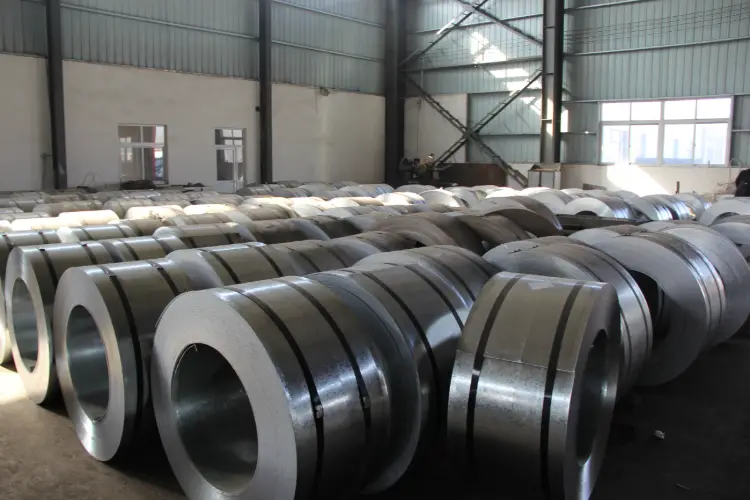
CCS FH36 Shipbuilding Steel Coil
CCS FH36 Shipbuilding Steel Coil - High-Strength Structural Steel for Extreme Marine Environments
Comprehensive technical data for CCS FH36 shipbuilding steel coil, including chemical composition, mechanical properties at room and low temperature, physical properties, and international equivalents per IACS UR W11.
Welding, cold forming, cutting, bending
- Phone : +8618037372205
- Email : [email protected]
- WhatsApp: Contact via Whtsapp
- WeChat: +8618037372205
CCS FH36 Shipbuilding Steel Coil Introduction
CCS FH36 is a high-strength shipbuilding structural steel certified by the China Classification Society (CCS), designed for critical ship hull and offshore structures requiring excellent weldability and toughness at sub-zero temperatures down to -60°C. It belongs to the 36 ksi (355 MPa) yield strength category and offers a minimum tensile strength of 490 MPa. The steel is fully killed and usually delivered in normalized or thermomechanical rolled condition. Key features:
- Excellent low-temperature impact toughness (≥34 J at -60°C)
- Good weldability with controlled carbon equivalent
- Grain refinement by microalloying (Nb, V, Ti)
- Consistent through-thickness properties
- Available in coil, plate, and cut-to-length products
CCS FH36 Shipbuilding Steel Coil Chemical Composition
The chemical composition meets CCS Rules and IACS UR W11 for FH36 grade. Fine grain practice is achieved through aluminum and microalloying additions. Note: Carbon equivalent (CEV) typically ≤0.39% for weldability. Residual elements are strictly controlled.
| Chemical Element | Standard Value (wt%) | Remarks |
|---|---|---|
| Carbon (C) | ≤0.18 | max |
| Silicon (Si) | ≤0.50 | max |
| Manganese (Mn) | 0.90 – 1.60 | range |
| Phosphorus (P) | ≤0.035 | max |
| Sulfur (S) | ≤0.035 | max |
| Aluminum (Al, acid soluble) | ≥0.015 | min for fine grain |
| Niobium (Nb) | 0.02 – 0.05 | optional; V+Nb+Ti ≤0.12% |
| Vanadium (V) | 0.05 – 0.10 | optional |
| Titanium (Ti) | ≤0.02 | optional |
| Copper (Cu) | ≤0.35 | residual |
| Chromium (Cr) | ≤0.20 | residual |
| Nickel (Ni) | ≤0.40 | residual |
| Molybdenum (Mo) | ≤0.08 | residual |
| Nitrogen (N) | ≤0.009 | if not fixed by Al/Ti |
| Carbon Equivalent (CEV) | Typically ≤0.39 | Ce = C+Mn/6+(Cr+Mo+V)/5+(Ni+Cu)/15 |
CCS FH36 Shipbuilding Steel Coil Physical and Electrical Properties
Physical properties are typical for normalized C-Mn high-strength steels and are not part of the mandatory specification. Values are provided for design reference. Note: Actual properties may vary slightly with composition and heat treatment.
| Property | Standard Value | Unit | Test Condition |
|---|---|---|---|
| Density (ρ) | 7850 | kg/m³ | Room temperature |
| Modulus of Elasticity (E) | 205 | GPa | Room temperature |
| Shear Modulus (G) | 80 | GPa | Calculated, approx. |
| Poisson's Ratio (ν) | 0.30 | – | Room temperature |
| Thermal Expansion Coefficient (α) | 11.5 | 10⁻⁶/K | 20 – 100°C |
| Thermal Conductivity (λ) | 50 | W/(m·K) | Room temperature |
| Specific Heat Capacity (cp) | 460 | J/(kg·K) | Room temperature |
| Electrical Resistivity (ρe) | 0.20 | μΩ·m | Room temperature |
CCS FH36 Shipbuilding Steel Coil Mechanical Properties
Mechanical properties according to CCS Rules, valid for thicknesses ≤50 mm in longitudinal direction unless specified. Note: Impact test temperature is -60°C for FH36. Elongation for thickness >40 mm may be reduced by 1% per 5 mm increase.
| Property | Specification | Unit | Test Condition |
|---|---|---|---|
| Yield Strength (ReH) | ≥355 | MPa | Room temperature, transverse |
| Tensile Strength (Rm) | 490 – 620 | MPa | Room temperature |
| Elongation (A5) | ≥21 | % | Gauge length 5.65√S₀, thickness ≤50 mm |
| Impact Energy (KV, longitudinal) | ≥34 | J | -60°C, V-notch (Charpy) |
| Impact Energy (KV, transverse) | ≥24 | J | -60°C, V-notch (Charpy) |
| Bend Test (180°) | No cracks | – | Bend diameter 3a (a = specimen thickness), thickness ≤25 mm |
CCS FH36 Shipbuilding Steel Coil Exact Equivalent Standards and Replaceable Grades
All classification societies that follow IACS UR W11 offer an equivalent FH36 grade. These materials are identical in chemical and mechanical requirements and can be used interchangeably subject to the inspecting body's acceptance.
| Country/Region | Standard/Classification Society | Grade | Remarks |
|---|---|---|---|
| International (IACS) | IACS UR W11 | FH36 | Base standard for all class equivalents |
| USA | ABS | FH36 | American Bureau of Shipping |
| Norway/Germany | DNV | FH36 | Det Norske Veritas (now DNV GL) |
| UK | LR | FH36 | Lloyd's Register |
| France | BV | FH36 | Bureau Veritas |
| South Korea | KR | FH36 | Korean Register |
| Japan | NK | FH36 | Nippon Kaiji Kyokai (ClassNK) |
| Italy | RINA | FH36 | Registro Italiano Navale |
| India | IRS | FH36 | Indian Register of Shipping |
CCS FH36 Shipbuilding Steel Coil Application Introduction
CCS FH36 is tailored for structures subjected to high stress and Arctic-grade temperatures. It is widely used in the shipbuilding and offshore sectors. Key application guidelines:
- Preheating and interpass temperature control are essential for thick sections.
- The steel can be welded with all conventional methods (SMAW, SAW, FCAW, GMAW) using low-hydrogen consumables.
- Cold forming is possible with generous bending radii; hot forming must be followed by normalizing.
Product Applications: Ship hulls and decks, Offshore platform legs and bracings, Arctic tankers and LNG carriers, FPSO (Floating Production Storage and Offloading) units, Polar research vessels
Processed into products: Longitudinal stiffeners and girders, Shell and bottom plating, Bulkhead plates, Deck stringers, Transverse web frames, Hatch coamings and corner pieces, Rudder horns and stern frames
Application industries: Shipbuilding, Offshore oil & gas platforms, Naval vessels, Ice-class ships and icebreakers, Heavy marine structures
CCS FH36 Shipbuilding Steel Coil Similar / Alternative Materials with Comparable Performance
These grades offer similar strength but differ in guaranteed low-temperature toughness or minor compositional limits. They may substitute FH36 in less severe environments, provided design conditions allow.
| Country/Region | Standard | Grade | Remarks |
|---|---|---|---|
| International | IACS UR W11 | EH36 | Same strength (355 MPa), impact tested at -40°C instead of -60°C |
| International | IACS UR W11 | DH36 | 355 MPa yield, impact tested at -20°C |
| International | IACS UR W11 | AH36 | 355 MPa yield, impact tested at 0°C |
| International | IACS UR W11 | FH40 | Higher strength (390 MPa min), -60°C impact; may require redesign |
| Europe | EN 10025-4 | S355ML | Thermomechanical rolled, -50°C; slightly lower toughness guarantee |
| Europe | EN 10025-6 | S460QL | Quenched and tempered, much higher strength, careful welding needed |
Notes:
Additional Information:
- FH36 steel coil thickness typically ranges from 6 to 50 mm. Wider dimensions are available as plate.
- The grade is often supplied with absolute quality verification (e.g., ultrasonic testing per ASTM A578 or EN 10160) for critical applications.
- When ordering, specify delivery condition, impact test temperature, and any supplementary requirements (e.g., through-thickness properties Z35 per EN 10164).
- Consult the latest CCS Rules for detailed tolerances and testing frequencies.
- Share



