
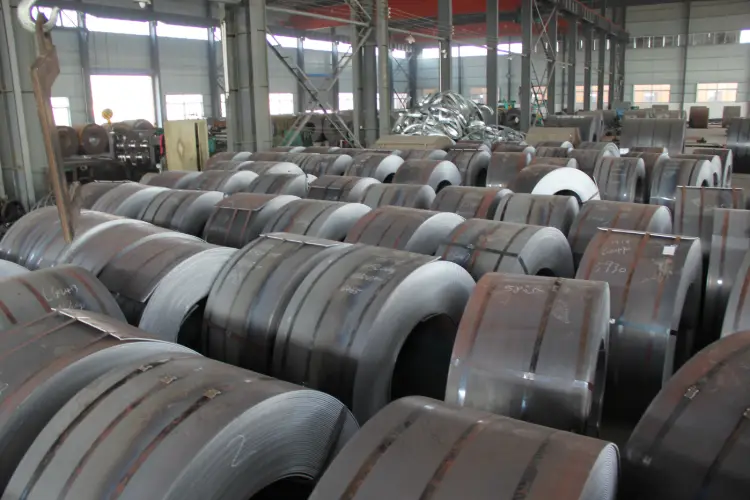
CCS EH40 Shipbuilding Steel Coil
CCS EH40 Shipbuilding Steel Coil – High Strength Hull Structural Material Data
Comprehensive technical data for CCS EH40 shipbuilding steel coil, including chemical composition, mechanical properties, thermal and electrical physical properties, international equivalent grades, and application guidance. All data based on CCS Rules for Materials and Welding.
Hot rolling, Controlled rolling, Normalizing, TMCP (Thermo-Mechanical Control Process), Quenching and Tempering (optional)
- Phone : +8618037372205
- Email : [email protected]
- WhatsApp: Contact via Whtsapp
- WeChat: +8618037372205
CCS EH40 Shipbuilding Steel Coil Introduction
CCS EH40 is a high-strength hull structural steel grade certified by China Classification Society (CCS), designed for shipbuilding and offshore engineering. It belongs to the E-grade (high toughness) category with a minimum yield strength of 390 MPa. This steel is typically supplied as hot-rolled coils, plates, or sections and can be delivered in normalized, TMCP, or controlled-rolled condition.
- Excellent low-temperature impact toughness (≥34 J at -40°C)
- Good weldability with proper preheat and consumable selection
- High strength-to-weight ratio for structural efficiency
- Compliant with CCS Rules for Materials and Welding, and can be substituted with equivalent grades from other major classification societies
CCS EH40 Shipbuilding Steel Coil Chemical Composition
The chemical composition of CCS EH40 is specified in the CCS Rules for Materials and Welding. The ladle analysis limits ensure good weldability, strength, and low-temperature toughness.
- Maximum carbon content is restricted to maintain weldability.
- Sufficient manganese content contributes to strength and toughness.
- Microalloying elements such as Nb, V, Ti can be added individually or in combination for grain refinement and precipitation strengthening.
- Residual elements like Cr, Ni, Cu are controlled within acceptable limits.
- Carbon equivalent (CEQ) is often specified by the purchaser for weldability control.
| Element | Specification (mass %) | Remarks |
|---|---|---|
| Carbon (C) | ≤ 0.18 | |
| Manganese (Mn) | 0.90 – 1.60 | |
| Silicon (Si) | 0.10 – 0.50 | |
| Phosphorus (P) | ≤ 0.025 | |
| Sulfur (S) | ≤ 0.025 | |
| Aluminum (Al) total | ≥ 0.015 | Acid-soluble aluminum; grain refinement |
| Niobium (Nb) | 0.02 – 0.05 | If added alone or in combination |
| Vanadium (V) | 0.05 – 0.10 | If added alone or in combination |
| Titanium (Ti) | 0.007 – 0.02 | If added alone or in combination |
| Copper (Cu) | ≤ 0.35 | Residual element |
| Chromium (Cr) | ≤ 0.20 | Residual element |
| Nickel (Ni) | ≤ 0.40 | Residual element |
| Molybdenum (Mo) | ≤ 0.08 | Residual element |
| Nitrogen (N) | ≤ 0.009 | If not fixed by Al or Ti |
| Nb+V+Ti | ≤ 0.12 | Sum of microalloying elements |
CCS EH40 Shipbuilding Steel Coil Thermal and Electrical Physical Properties
The following physical properties are typical reference values for low-alloy structural steels and can be applied to CCS EH40 grade. Slight variations may occur depending on the exact chemical composition and heat treatment condition.
- Density is similar to that of pure iron.
- Modulus of elasticity and shear modulus are typical for ferritic steel.
- Thermal expansion coefficient and thermal conductivity are important for welding distortion analysis and heat transfer calculations.
- Electrical resistivity is relevant for corrosion protection and grounding.
| Property | Typical Value | Unit | Test Conditions / Remarks |
|---|---|---|---|
| Density (ρ) | 7.85 | g/cm³ | At 20°C |
| Modulus of elasticity (E) | 205 | GPa | At 20°C |
| Shear modulus (G) | 79.3 | GPa | At 20°C, calculated from E and Poisson ratio |
| Poisson's ratio (ν) | 0.29 | - | At 20°C |
| Thermal expansion coefficient (α) | 12.0 | 10⁻⁶/K | From 20°C to 100°C |
| Thermal conductivity (λ) | 50 | W/(m·K) | At 20°C |
| Specific heat capacity (c) | 460 | J/(kg·K) | At 20°C |
| Electrical resistivity (ρ_e) | 0.20 – 0.25 | μΩ·m | At 20°C |
CCS EH40 Shipbuilding Steel Coil Mechanical Properties
Mechanical properties of CCS EH40 are determined on test pieces in accordance with CCS rules. The values apply to products in delivery condition (e.g., normalized or TMCP) and for thicknesses up to the specified range.
- Minimum yield strength (ReH) is 390 MPa.
- Tensile strength (Rm) ranges from 510 to 660 MPa.
- Elongation (A5) is minimum 20% for longitudinal specimens.
- Charpy impact test is performed at -40°C with minimum absorbed energy of 34 J in longitudinal direction.
- Bend test requires 180° bending over a former diameter of 3t (t = specimen thickness) without cracking.
| Property | Specified Value | Unit | Test Conditions / Remarks |
|---|---|---|---|
| Yield strength (ReH) | ≥ 390 | MPa | Longitudinal, for thickness ≤ 50 mm |
| Tensile strength (Rm) | 510 – 660 | MPa | Longitudinal |
| Elongation (A5) | ≥ 20 | % | Gauge length 5.65√S₀, longitudinal, thickness ≤ 50 mm |
| Charpy impact energy (KV₂) | ≥ 34 | J | At -40°C, longitudinal. Single value minimum may be 70% of average. |
| Bend test (180°) | No cracks | - | Former diameter = 3t (t = specimen thickness) |
CCS EH40 Shipbuilding Steel Coil Completely Equivalent Material Standards and Substitutable Grades
The following international grades are recognized as equivalent to CCS EH40 in terms of chemical composition, mechanical properties, and classification society approval for high strength hull structural steel. They can be substituted directly under relevant classification rules.
| Country / Region | Standard / Rule | Grade | Remarks |
|---|---|---|---|
| International | IACS Member Societies | EH40 | High strength ship steel, E grade |
| USA | ABS Rules | EH40 | American Bureau of Shipping |
| UK | LR Rules | EH40 | Lloyd's Register |
| Norway/Germany | DNV Rules | E40 | Det Norske Veritas (now DNV GL) |
| France | BV Rules | EH40 | Bureau Veritas |
| Japan | NK Rules | KE40 | Nippon Kaiji Kyokai (ClassNK) |
| Korea | KR Rules | REH40 | Korean Register |
| Italy | RINA Rules | E40 | Registro Italiano Navale |
| Russia | RS Rules | E40 | Russian Maritime Register of Shipping |
CCS EH40 Shipbuilding Steel Coil Application Introduction
CCS EH40 steel is extensively used in the marine and offshore industry where high strength combined with excellent low-temperature toughness is required.
- It is suitable for heavily loaded structural components in ship hulls, ice-strengthened vessels, and offshore platforms operating in cold environments.
- The steel exhibits good formability and weldability when proper preheating and low-hydrogen welding consumables are employed.
- Typical delivery forms include hot-rolled coils and plates that can be further processed by cutting, cold forming, and welding to manufacture structural elements.
Product Applications: Ship deck plates and shell plates, Bottom and side shell stiffeners, Transverse and longitudinal bulkheads, Hatch coamings and upper deck structures, Offshore platform legs, nodes, and braces, Cold-formed sections and welded beams
Processed into products: Stiffened panel assemblies, Welded girders and frames, Watertight doors and manhole covers, Foundation plates for machinery and cranes, Reinforcement rings for cylindrical structures, Fatigue-sensitive cruciform joints
Application industries: Shipbuilding and ship repair, Offshore oil & gas platforms and FPSOs, Marine engineering and port machinery, Construction of ice-class vessels, Large-scale structural steelwork in cold climate regions
CCS EH40 Shipbuilding Steel Coil Similar / Substitute Materials with Close Performance
These grades exhibit similar strength and toughness levels or can be used under certain conditions as alternatives to EH40. Selection should consider specific toughness requirements (test temperature) and project specifications.
| Country / Region | Standard / Rule | Grade | Remarks |
|---|---|---|---|
| International | CCS Rules | DH40 | Same strength, impact at -20°C instead of -40°C |
| International | CCS Rules | AH40 | Same strength, impact at 0°C |
| International | CCS Rules | EH36 | Higher toughness (E grade) but lower strength (min YS 355 MPa) |
| International | CCS Rules | FH40 | Same strength, impact at -60°C, more stringent than EH40 |
Notes:
- Actual properties may vary depending on product thickness and specific manufacturing route. Consult the mill certificate for precise values.
- Weldability: Preheating and interpass temperature control are recommended for thick sections to avoid hydrogen-induced cracking. Carbon equivalent (CEQ) is typically limited to 0.40–0.43% on product analysis.
- Corrosion resistance: For prolonged service in seawater, protective coatings or cathodic protection should be applied.
- Material certification must include chemical composition, tensile test, and Charpy V-notch impact test at -40°C as per CCS requirements.
- Share



