
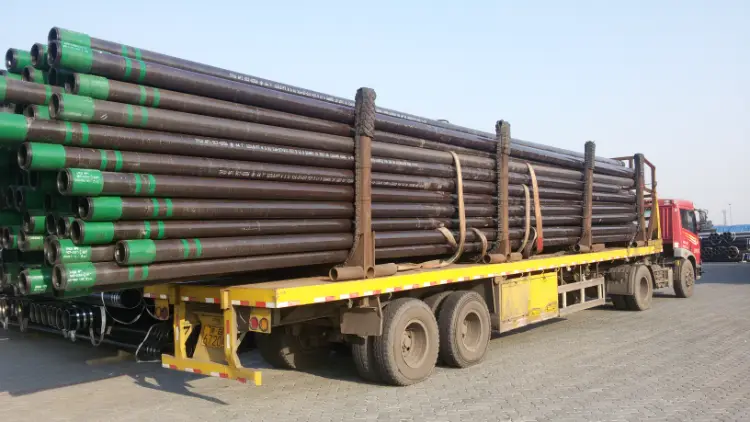
AH36 LSAW Pipe
AH36 LSAW Pipe: High-Strength Shipbuilding Steel Material Data & Equivalents
Detailed material properties for AH36 steel used in LSAW pipe: chemical composition, mechanical, thermal and electrical physical data according to ABS, DNV, LR and other classification society standards.
TMCP (Thermo-Mechanical Controlled Processing), Normalizing, As-Rolled; Welding for pipe fabrication
- Phone : +8618037372205
- Email : [email protected]
- WhatsApp: Contact via Whtsapp
- WeChat: +8618037372205
AH36 LSAW Pipe Introduction
AH36 steel is a high-strength structural steel grade primarily used in shipbuilding and offshore engineering. When manufactured into LSAW (Longitudinal Submerged Arc Welding) pipe, it provides excellent weldability, toughness, and resistance to harsh marine environments. The steel is micro-alloyed with Nb, V, Ti to achieve fine grain structure and meets the requirements of all major classification societies.
- Minimum yield strength: 355 MPa
- Excellent low-temperature impact toughness (0°C, energy ≥34J)
- Controlled chemistry with low carbon equivalent for improved weldability
- Available in TMCP, normalized, or as-rolled condition
AH36 LSAW Pipe Chemical Composition
The chemical composition conforms to ABS Rules for Building and Classing Steel Vessels and other IACS member standards. Control of grain refining elements such as Al, Nb, V, Ti is mandatory. Carbon equivalent (CEV) is typically kept below 0.38% to ensure good weldability.
| Element | Typical Requirement | Remarks |
|---|---|---|
| C | ≤0.18% | Carbon – low level for weldability |
| Mn | 0.90% – 1.60% | Manganese; minimum may be reduced to 0.70% if grain refining elements are present |
| Si | 0.10% – 0.50% | Silicon – deoxidizer |
| P | ≤0.035% | Phosphorus |
| S | ≤0.035% | Sulfur |
| Al (total) | ≥0.015% | Acid-soluble aluminum; for grain refinement |
| Nb | 0.02% – 0.05% | Niobium (optional grain refiner) |
| V | 0.05% – 0.10% | Vanadium (optional grain refiner) |
| Ti | ≤0.02% | Titanium; can be used for grain refinement |
| Cu | ≤0.35% | Copper – for corrosion resistance if specified |
| Cr | ≤0.20% | Chromium |
| Ni | ≤0.40% | Nickel |
| Mo | ≤0.08% | Molybdenum |
| N | ≤0.012% | Nitrogen |
AH36 LSAW Pipe Thermal & Electrical Physical Properties
Physical properties are typical for carbon-manganese structural steel at room temperature unless otherwise indicated. Values are suitable for design calculations but may vary with actual processing and temperature.
| Property | Typical Value | Unit | Test Condition |
|---|---|---|---|
| Density (ρ) | 7.85 | g/cm³ | 20°C |
| Elastic Modulus (E) | 205 | GPa | 20°C, static |
| Shear Modulus (G) | 79 | GPa | 20°C |
| Poisson's Ratio (ν) | 0.3 | – | Elastic range |
| Thermal Expansion (α) | 11.5 x 10⁻⁶ | /K | 20-100°C |
| Thermal Expansion (α) | 12.5 x 10⁻⁶ | /K | 20-300°C |
| Thermal Conductivity (λ) | 50 | W/(m·K) | 100°C |
| Specific Heat Capacity (c) | 460 | J/(kg·K) | Ambient |
| Electrical Resistivity (ρₑ) | 0.15 – 0.25 | µω·m | 20°C |
AH36 LSAW Pipe Mechanical Properties
Mechanical properties are determined on transverse or longitudinal test pieces from the plate/pipe wall. Absorbed energy values apply to Charpy V-notch impact test at 0°C for the standard AH36 grade. Bending test is often required for weld approval.
| Property | Requirement | Unit | Test Condition |
|---|---|---|---|
| Yield Strength (ReH) | ≥355 | MPa | Ambient, thickness ≤100 mm |
| Tensile Strength (Rm) | 490 – 620 | MPa | Ambient |
| Elongation (A5) | ≥21 | % | Gauge length 5.65√S0; thickness ≤50 mm |
| Elongation (A5) | ≥20 | % | Thickness >50 mm to 70 mm |
| Charpy Impact (KV, longitudinal) | ≥34 | J | 0°C |
| Charpy Impact (KV, transverse) | ≥24 | J | 0°C |
| Bend Test (180°) | d = 3a | – | Mandrel diameter; a = specimen thickness, t ≤25 mm |
| Bend Test (180°) | d = 4a | – | t >25 mm |
AH36 LSAW Pipe Completely Equivalent Material Standards & Substitutable Grades
| Country / Region | Standard | Grade | Remarks |
|---|---|---|---|
| International (IACS) | IACS UR W11 | AH36 | Common standard for all classification societies |
| USA / Global | ASTM A131 / A131M | Grade AH36 | Structural steel for ships |
| USA | ABS Rules | AB/AH36 | American Bureau of Shipping |
| Norway / Germany | DNV Rules | DNV AH36 | Now DNVGL, unified standard |
| UK | LR Rules | LR AH36 | Lloyd's Register |
| France | BV Rules | BV AH36 | Bureau Veritas |
| China | CCS Rules / GB 712 | CCS AH36 / AH36 | China Classification Society / Chinese national standard |
| Japan | NK Rules | NK AH36 | ClassNK (Nippon Kaiji Kyokai) |
| Korea | KR Rules | KR AH36 | Korean Register |
| Italy | RINA Rules | RINA AH36 | Registro Italiano Navale |
| Russia | RMRS Rules | RS AH36 | Russian Maritime Register of Shipping |
AH36 LSAW Pipe Application Introduction
AH36 LSAW pipe is extensively used in marine and offshore environments. Its combination of strength, weldability and toughness makes it ideal for primary structural members, pressure containment and fluid transport where saltwater corrosion needs to be managed.
Product Applications: Large-diameter LSAW pipes for marine risers, jackets, and conductors, Structural tubulars for offshore platforms (legs, braces), Piles and foundation tubes for bridges and marine structures, Ship body sections (keels, stringers), Ballast and cargo piping systems
Processed into products: Flange connections and welding neck flanges for pipelines, Pipe supports and structural attachments, Manifold and subsea spools, Tubular nodes and K-joints in offshore structures, Casing and conductor pipes for well construction
Application industries: Shipbuilding (hull, bulkheads, decks), Offshore oil & gas platforms, Marine and coastal construction, Port and harbor structures, Renewable energy (offshore wind foundations), Pressure vessel and storage tank fabrication
AH36 LSAW Pipe Similar / Alternative Materials with Close Properties
| Country / Region | Standard | Grade | Remarks |
|---|---|---|---|
| International | IACS / ASTM A131 | AH32 | Lower yield strength (315 MPa min), same toughness (0°C), suitable for less demanding structures |
| International | IACS / ASTM A131 | DH36 | Same strength, improved low-temperature toughness (-20°C), used when operating in colder waters |
| International | IACS / ASTM A131 | EH36 | Same strength, excellent toughness at -40°C, for critical and arctic applications |
| International | IACS / ASTM A131 | AH40 | Higher strength (390 MPa min), 0°C toughness, for weight-optimized designs |
| Europe | EN 10025-4 | S355ML / S355G10+M | Thermo-mechanically rolled structural steel for offshore structures with equivalent strength but different impact test temperatures |
| China | GB 712 | DH36 | Chinese standard with -20°C impact requirement |
Notes:
Welding Considerations: Low carbon equivalent (typically <0.38) permits cold welding without preheat up to moderate thickness. For thick sections or hydrogen-restricted service, preheat and low-hydrogen consumables are recommended. Corrosion Protection: Above-water exposure requires coating systems; cathodic protection is commonly used subsea. Mechanical properties may be verified by the relevant classification society surveyor.
- Share



