
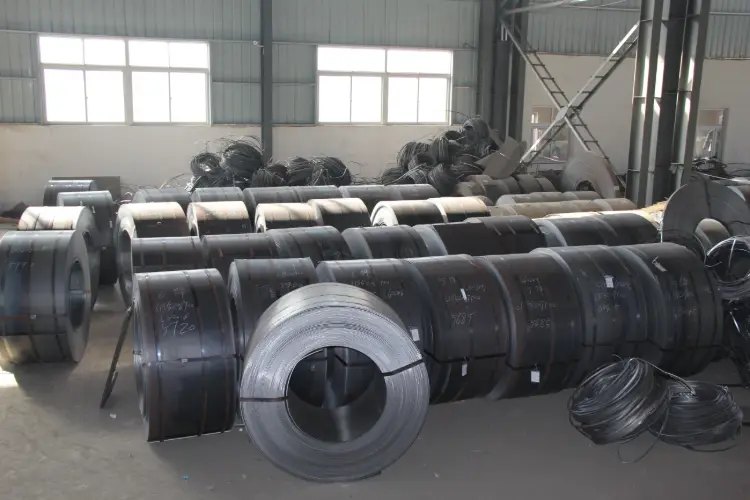
CCS FH40 Shipbuilding Steel Coil
CCS FH40 Shipbuilding Steel Coil - Certified High-Strength Plate for Arctic-Grade Hull Structures
Explore certified CCS FH40 shipbuilding steel coil properties, chemical composition, mechanical data, international equivalents, and application guidelines for extreme-duty marine engineering.
Hot rolling, controlled rolling, thermo-mechanical controlled processing (TMCP), normalizing, quenching and tempering (depending on thickness and purchaser requirements)
- Phone : +8618037372205
- Email : [email protected]
- WhatsApp: Contact via Whtsapp
- WeChat: +8618037372205
CCS FH40 Shipbuilding Steel Coil Introduction
CCS FH40 is a high-strength shipbuilding structural steel grade certified by the China Classification Society (CCS). Belonging to the normalized or thermo-mechanically controlled rolled (TMCP) fine-grain steel family, it offers a minimum yield strength of 390 MPa and guaranteed impact toughness at -40°C.
- Designed for critical hull girders, decks, and bottom structures of large vessels and offshore platforms operating in cold/arctic waters.
- Excellent weldability due to low carbon equivalent (typically ≤0.40%) and fine grain practice.
- Available as hot-rolled coils and plates, the material complies with CCS Rules and also meets the requirements of GB 712-2011 (Grade FH40).
- Comprehensive through-thickness properties make it suitable for heavy plate applications requiring Z-quality.
CCS FH40 Shipbuilding Steel Coil Chemical Composition
The chemical composition meets the requirements of CCS Rules for FH40 high-strength hull structural steel and GB 712-2011. Residual elements are strictly controlled to ensure weldability and low-temperature toughness.
| Chemical Element | Specified Max/Min (%) | Remarks |
|---|---|---|
| C | ≤0.16 | Carbon equivalent Ceq typically ≤0.40% (Ceq = C + Mn/6 + (Cr+Mo+V)/5 + (Ni+Cu)/15) |
| Si | ≤0.50 | Deoxidiser; higher Si may be agreed |
| Mn | 0.90 – 1.60 | Improves strength and toughness |
| P | ≤0.025 | Maximum for ladle analysis |
| S | ≤0.025 | Maximum for ladle analysis |
| Als (acid-soluble Al) | ≥0.015 | Fine grain practice; total Al typically 0.020–0.050% |
| Nb | 0.02 – 0.05 | Grain refiner and precipitation strengthener |
| V | 0.05 – 0.10 | Optional microalloy |
| Ti | ≤0.02 | Grain refinement; can be added up to 0.02% |
| Cu | ≤0.35 | Residual element; can improve corrosion resistance |
| Cr | ≤0.20 | |
| Ni | ≤0.40 | Beneficial for low-temperature toughness |
| Mo | ≤0.08 | |
| N | ≤0.012 | If not bound by Al, Ti, Nb; typically ≤0.009% when microalloyed |
CCS FH40 Shipbuilding Steel Coil Thermal and Electrical Physical Properties
The following physical constants are typical for FH40 steel at room temperature and are not mandatory specification requirements. They can be used for design calculations.
| Property | Typical Value | Unit | Test Condition / Remarks |
|---|---|---|---|
| Density (ρ) | 7.85 | g/cm³ | At 20°C |
| Modulus of Elasticity (E) | 206 | GPa | At 20°C |
| Shear Modulus (G) | 80 | GPa | Calculated from E and Poisson's ratio |
| Poisson's Ratio (ν) | 0.30 | — | At 20°C |
| Thermal Expansion Coefficient (α) | 12.0 ×10⁻⁶ | /K | Mean coefficient 20–100°C |
| Thermal Conductivity (λ) | 52 | W/(m·K) | At 20°C |
| Specific Heat Capacity | 460 | J/(kg·K) | At 20°C |
| Electrical Resistivity (ρ_e) | 0.23 ×10⁻⁶ | Ω·m | At 20°C |
CCS FH40 Shipbuilding Steel Coil Mechanical Properties
The properties apply to as-delivered TMCP/normalized plates. Impact values refer to longitudinal Charpy V-notch tests at -40°C. Values according to CCS Rules and GB 712-2011 (for thickness ≤50 mm unless stated).
| Property | Specified Value | Unit | Test Condition |
|---|---|---|---|
| Yield Strength (ReH) | ≥390 | MPa | Transverse, t ≤50 mm |
| Yield Strength (ReH) | ≥375 | MPa | Transverse, 50 < t ≤70 mm |
| Yield Strength (ReH) | ≥355 | MPa | Transverse, 70 < t ≤100 mm |
| Tensile Strength (Rm) | 510 – 650 | MPa | Transverse, t ≤100 mm |
| Elongation (A) | ≥20 | % | Gauge length L0=5.65√S0, t ≤50 mm |
| Elongation (A) | ≥19 | % | t >50 mm |
| Impact Energy (KV2) | ≥41 (long.) | J | Charpy V, -40°C, longitudinal, average of 3 specimens |
| Impact Energy (KV2) | ≥27 (trans.) | J | Charpy V, -40°C, transverse, average of 3 specimens |
| Bending Test (d= bend diameter, a= thickness) | d=3a (180°) | t ≤25 mm, no cracks |
CCS FH40 Shipbuilding Steel Coil Fully Equivalent Standards and Substitute Grades
| Country/Region | Standard | Grade | Remarks |
|---|---|---|---|
| China | GB 712-2011 | FH40 | Identical in technical requirements, endorsed by CCS |
| International | IACS UR W11 | H40 (F temperature class) | Unified requirement basis |
| USA | ABS Rules | EH40 | American Bureau of Shipping – same strength/low-temp category |
| Norway/Germany | DNV Rules | NV E40 | DNV GL classification (now DNV) – full equivalence |
| UK | LR Rules | EH40 | Lloyd's Register – equivalent |
| France | BV Rules | EH40 | Bureau Veritas – equivalent |
| South Korea | KR Rules | REH40 | Korean Register – equivalent |
| Japan | NK Rules | KE40 | Nippon Kaiji Kyokai (ClassNK) – equivalent |
| Italy | RINA Rules | REH40 | Registro Italiano Navale – equivalent |
| Russia | RS Rules | E40 (F) | Russian Maritime Register of Shipping – equivalent |
CCS FH40 Shipbuilding Steel Coil Application Introduction
FH40 steel coils and plates are specifically developed for primary structures of ships and offshore units subjected to low ambient temperatures and heavy loading. They are used where both high strength and reliable brittle fracture resistance are required. Typical end uses include:
Product Applications: Container ships (hull girder, hatch coaming), Tankers (VLCC, product carriers), Bulk carriers, Drilling rigs and FPSO hulls, Icebreakers and polar supply vessels
Processed into products: Main deck plates, Bottom shell and bilge strake, Side shell and sheer strake, Longitudinal and transverse bulkheads, Keel and keelson, Hatch corner plates and coamings, Heavy brackets and stiffeners
Application industries: Shipbuilding (commercial and naval vessels), Offshore oil & gas (fixed and floating platforms), Marine engineering (dock gates, lock gates, heavy lifting barges), Ice-strengthened and Arctic-class vessels
CCS FH40 Shipbuilding Steel Coil Similar / Alternative Materials with Close Properties
| Country/Region | Standard | Grade | Remarks |
|---|---|---|---|
| China | GB 712-2011 | EH40 | Impact at -20°C instead of -40°C; lower cost for non-arctic service |
| China | GB 712-2011 | FH36 | Lower minimum yield (355 MPa); still excellent low-temp toughness |
| International | EN 10025-4 | S420ML | Thermo-mechanically rolled structural steel – similar strength, energy ≥27J at -50°C; may replace with engineering assessment |
| International | API 2W | Grade 50 (CP) | Offshore structural steel for cold climate – properties close to FH40 with additional Z-quality options |
Notes:
- FH40 can be ordered with additional requirements such as Z35 through-thickness tensile test (per CCS Rules) for restrained welded joints.
- When ordering coils, the purchaser should specify if any further processing (cut-to-length, shot blasting, primer coating) is needed.
- Welding consumables should be matched to the strength grade and low-temperature toughness; preheat may be required depending on thickness and carbon equivalent.
- For thicknesses above 50 mm, the tensile requirements are slightly adjusted and ultrasonic testing (UT) per EN 10160 or equivalent is recommended.
- Share



