
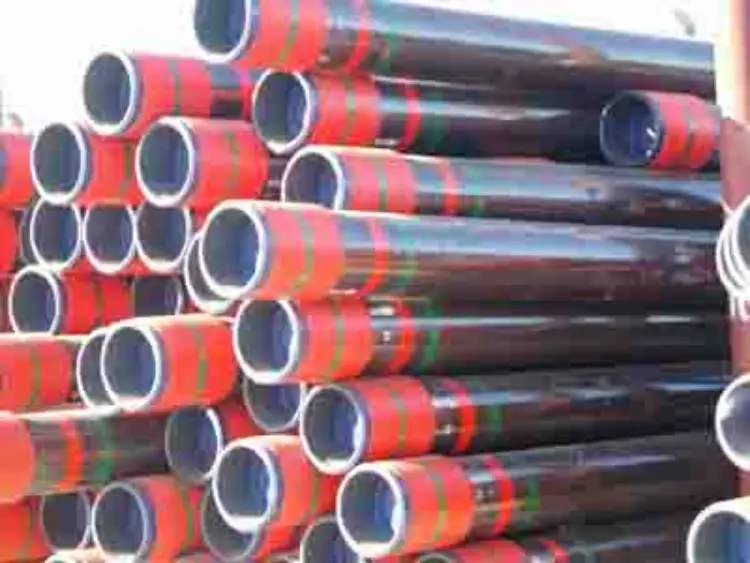
DH36 Shipbuilding Steel for LSAW Pipes
DH36 Shipbuilding Steel for LSAW Pipes - Properties, Equivalents & Applications
Explore DH36 high-strength shipbuilding steel used in longitudinal submerged arc welded (LSAW) pipes. Detailed chemical composition, mechanical properties, thermal and electrical characteristics with official standard references.
Hot rolling, controlled rolling (TMCP), normalising; pipe forming and welding (LSAW)
- Phone : +8618037372205
- Email : [email protected]
- WhatsApp: Contact via Whtsapp
- WeChat: +8618037372205
DH36 Shipbuilding Steel for LSAW Pipes Introduction
DH36 is a high-strength shipbuilding structural steel grade with a minimum yield strength of 355 MPa, widely used in ship hulls, offshore structures, and large-diameter LSAW (Longitudinal Submerged Arc Welded) pipes. It belongs to the family of Grade D36 ship plates according to classification society rules (ABS, DNV, LR, etc.). The steel offers a balanced combination of strength, weldability, and excellent low-temperature toughness, which is mandatory for marine and cryogenic applications. Typical delivery condition is hot-rolled or controlled-rolled, sometimes normalised, ensuring uniform mechanical properties across thicknesses up to 150 mm.
- Yield strength: ≥355 MPa
- Tensile strength: 490–620 MPa
- Charpy impact energy: ≥27 J at -20°C (longitudinal)
- Low carbon equivalent facilitating welding without preheat
DH36 Shipbuilding Steel for LSAW Pipes Chemical Composition
Typical chemical composition of DH36 shipbuilding steel according to ABS/IACS rules. The steel is microalloyed with niobium, vanadium, or titanium to achieve fine grain and high strength. Carbon equivalent (CEV) is kept low for good weldability.
- CEV = C + Mn/6 + (Cr+Mo+V)/5 + (Ni+Cu)/15 typically ≤ 0.38%
- Aluminum is added as a deoxidiser and grain refiner.
| Element | Specified Value (%) | Remarks |
|---|---|---|
| Carbon (C) | ≤0.18 | Maximum |
| Silicon (Si) | ≤0.50 | Maximum |
| Manganese (Mn) | 0.90 – 1.60 | Range |
| Phosphorus (P) | ≤0.035 | Maximum |
| Sulfur (S) | ≤0.035 | Maximum |
| Aluminum (Al) acid soluble | ≥0.015 | Minimum |
| Niobium (Nb) | 0.02 – 0.05 | Optional microalloy |
| Vanadium (V) | 0.05 – 0.10 | Optional microalloy |
| Titanium (Ti) | ≤0.02 | Optional, typical max |
| Copper (Cu) | ≤0.35 | Residual |
| Chromium (Cr) | ≤0.20 | Residual |
| Nickel (Ni) | ≤0.40 | Residual |
| Molybdenum (Mo) | ≤0.08 | Residual |
| Calcium (Ca) | >0.001 | For inclusion shape control |
DH36 Shipbuilding Steel for LSAW Pipes Thermal and Electrical Physical Properties
Physical properties of DH36 steel are typical for ferritic-pearlitic structural steels. These values are representative and may slightly vary depending on the exact temper condition.
- Density is used for weight calculations.
- Moduli are essential for structural analysis and pipe deflection calculations.
- Thermal expansion and conductivity influence welding procedure and heat treatment.
| Property | Typical Value | Unit | Conditions |
|---|---|---|---|
| Density (ρ) | 7.85 | g/cm³ | 20°C |
| Elastic modulus (E) | 205 | GPa | 20°C |
| Shear modulus (G) | 80 | GPa | 20°C (estimated) |
| Poisson's ratio (ν) | 0.3 | — | 20°C |
| Thermal expansion coefficient (α) | 12.0 × 10⁻⁶ | K⁻¹ | 20–100°C |
| Thermal conductivity (λ) | 47 | W/(m·K) | 20°C |
| Specific heat capacity | 460 | J/(kg·K) | 20°C |
| Electrical resistivity (ρe) | 0.20 | μΩ·m | 20°C |
DH36 Shipbuilding Steel for LSAW Pipes Mechanical Properties
Mechanical properties of DH36 steel plates used for LSAW pipes. Requirements are based on transverse test specimens unless otherwise noted.
- Yield and tensile properties apply to thicknesses up to 150 mm; values may be slightly adjusted for thicker sections.
- Charpy V-notch impact test is performed at -20°C, longitudinal orientation; the minimum absorbed energy is 27 J (ABS) or 34 J (some other rules).
- Bend test is carried out with a former diameter of 3t over 180° without cracking.
| Property | Specified Requirement | Unit | Test Conditions |
|---|---|---|---|
| Yield strength (ReH) | ≥355 | MPa | Transverse, t ≤ 100 mm |
| Yield strength (ReH) | ≥355 | MPa | Transverse, 100 < t ≤ 150 mm |
| Tensile strength (Rm) | 490 – 620 | MPa | Transverse, t ≤ 100 mm |
| Tensile strength (Rm) | 490 – 620 | MPa | Transverse, 100 < t ≤ 150 mm |
| Elongation after fracture (A) | ≥21 | % | Gauge length 5.65√So, transverse |
| Charpy impact energy (KV2) | ≥27 | J | Longitudinal, -20°C (ABS min.) |
| Bend test (d=3a) | No cracks | — | 180° bending, former dia. 3 × thickness |
DH36 Shipbuilding Steel for LSAW Pipes Exactly Equivalent Material Standards and Substitutable Grades
| Country / Region | Standard | Grade / Designation | Remarks |
|---|---|---|---|
| International (IACS) | UR W11 | DH36 | Base requirement for all IACS members |
| USA / ABS | ABS Rules | DH36 | Fully equivalent |
| Norway / DNV | DNV Rules | DH36 | Fully equivalent |
| UK / LR | Lloyd's Register Rules | DH36 | Fully equivalent |
| France / BV | Bureau Veritas Rules | DH36 | Fully equivalent |
| Japan / NK | ClassNK Rules | DH36 | Fully equivalent |
| Korea / KR | Korean Register Rules | DH36 | Fully equivalent |
| China / CCS | CCS Rules | DH36 | Fully equivalent |
| Italy / RINA | RINA Rules | DH36 | Fully equivalent |
| Europe | EN 10025-4 | S355G2+M | Partially equivalent; DH36 has tighter control on grain refinement and toughness for marine use |
DH36 Shipbuilding Steel for LSAW Pipes Application Introduction
DH36 steel in plate form is the primary raw material for manufacturing LSAW (Longitudinal Submerged Arc Welded) pipes used in demanding marine and offshore projects. Its combination of high strength, excellent weldability, and guaranteed low-temperature toughness allows safe operation in harsh environments.
- Plates are formed by JCOE or UOE process and welded longitudinally.
- Pipes are typically supplied with anti-corrosion coating and ends prepared for welding.
Product Applications: LSAW line pipes (API 5L grades derived from DH36 plates), Ship hull plates and stiffeners, Offshore structural tubulars and legs, Jacket braces and conductor pipes, Wind turbine monopiles, Structural beams and columns
Processed into products: Pipe bends and elbows, Flanges and tees, Reducers, Structural nodes (cast or welded), Pile shoes and driving caps, Wye pieces and manifolds
Application industries: Shipbuilding and marine engineering, Offshore oil and gas exploration/production, Civil engineering and construction (deep foundations, piling), Water transmission and wastewater treatment, Renewable energy (offshore wind turbine monopiles and jackets), Pipeline transport (oil, gas, slurry)
DH36 Shipbuilding Steel for LSAW Pipes Similar / Close Substitution Materials
| Country / Region | Standard | Grade | Remarks |
|---|---|---|---|
| International | IACS | EH36 | Higher toughness (-40°C), same strength range; suitable for lower temperature applications. |
| International | IACS | AH36 | Lower toughness (0°C), same strength; only for less demanding service conditions. |
| USA | ASTM A572/A572M | Grade 50 [345], Grade 55 [380] | Slightly different yield requirement; may substitute after engineering assessment. |
| USA | API 2H | Grade 50 | For offshore structural tubulars; CEV and toughness must be verified. |
| Europe | EN 10025-3 | S355N/NL | Normalised fine-grain steel with similar strength; impact temperatures may differ. |
| Japan | JIS G 3106 | SM490YA | 490 MPa class steel; check notch toughness for DH36 equivalency. |
Notes:
For LSAW pipes manufactured from DH36 plates, the base metal mechanical properties must comply with the plate specification, while the weld seam must be qualified per welding procedure specification (WPS). The pipe dimensional tolerances and hydrotest requirements follow the relevant pipeline standard (e.g., API 5L, DNV-ST-F101). Supplementary testing such as CTOD or HIC may be required for sour service. All data provided is based on official classification society rules and is for information only; specific material certificates must be consulted for actual supply conditions.
- Share



