
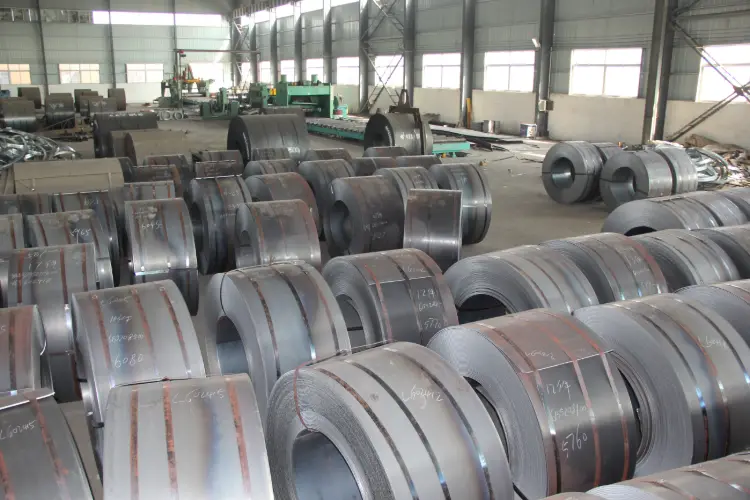
CCS AQ47 Shipbuilding Steel Coil
CCS AQ47 Shipbuilding Steel Coil - High Strength Hull Structural Steel for Extreme Marine Environments
Detailed material data for CCS AQ47 shipbuilding steel coil, covering chemical composition, mechanical and physical properties, international equivalents, and application guidance. Compliant with CCS Rules and IACS UR W11.
Thermomechanical controlled processing (TMCP), normalizing, controlled rolling and accelerated cooling (CR-ACC)
- Phone : +8618037372205
- Email : [email protected]
- WhatsApp: Contact via Whtsapp
- WeChat: +8618037372205
CCS AQ47 Shipbuilding Steel Coil Introduction
CCS AQ47 is a high-strength shipbuilding steel coil classified by the China Classification Society (CCS) in accordance with IACS UR W11. It belongs to the 460 MPa yield strength class and is designed for critical structural components of large seagoing vessels, including ultra-large container ships and polar-class vessels. With a minimum yield strength of 460 MPa and tensile strength between 570 and 720 MPa, AQ47 offers an excellent combination of strength, toughness, and weldability. The material is typically supplied in thermomechanically rolled (TMCP) or normalized condition to achieve fine-grained microstructure and guaranteed low-temperature impact toughness at 0 °C. Its low carbon equivalent (Ceq) ensures good weldability without excessive preheating, while microalloying elements such as niobium, vanadium, and titanium provide precipitation strengthening and grain refinement. This steel meets the stringent requirements of classification societies worldwide, facilitating global acceptance in marine construction.
CCS AQ47 Shipbuilding Steel Coil Chemical Composition
The chemical composition of CCS AQ47 follows the requirements of IACS UR W11 for AH47 grade. As a fine-grain microalloyed steel, it controls carbon content for weldability and uses grain-refining elements such as Nb, V, Ti. Ladle analysis limits are specified; product analysis may be subject to standard tolerances.
| Element | Specification Value | Remarks |
|---|---|---|
| Carbon (C) | ≤ 0.21% | Max |
| Manganese (Mn) | 0.80 - 1.70% | Range |
| Silicon (Si) | 0.10 - 0.55% | Range |
| Phosphorus (P) | ≤ 0.030% | Max |
| Sulfur (S) | ≤ 0.030% | Max |
| Chromium (Cr) | ≤ 0.25% | Residual (optional addition allowed) |
| Nickel (Ni) | ≤ 0.40% | Residual (optional addition allowed) |
| Molybdenum (Mo) | ≤ 0.08% | Residual (optional addition allowed) |
| Copper (Cu) | ≤ 0.35% | Residual (optional addition allowed) |
| Aluminum (Al) | ≥ 0.015% total Al | Grain refining |
| Niobium (Nb) | 0.02 - 0.05% | Microalloying (optional) |
| Vanadium (V) | 0.05 - 0.12% | Microalloying (optional) |
| Titanium (Ti) | ≤ 0.05% | Microalloying (optional) |
| Nitrogen (N) | ≤ 0.009% | Max |
| Carbon Equivalent (Ceq) | ≤ 0.40% | Ceq = C + Mn/6 + (Cr+Mo+V)/5 + (Ni+Cu)/15 |
CCS AQ47 Shipbuilding Steel Coil Thermal and Electrical Physical Properties
Typical physical properties for CCS AQ47 steel are derived from low-alloy carbon steel data and are relevant for engineering calculations. No specified limits are given by the ship classification standard; values serve as practical references.
| Property | Typical Value | Unit | Test Condition |
|---|---|---|---|
| Density (ρ) | 7.85 | g/cm³ | 20 °C |
| Modulus of Elasticity (E) | 205 | GPa | Room temperature |
| Shear Modulus (G) | 80 | GPa | Room temperature |
| Poisson's Ratio (ν) | 0.29 | - | Room temperature |
| Thermal Expansion Coefficient (α) | 12.0 | 10⁻⁶/K | 20 - 100 °C |
| Thermal Expansion Coefficient (α) | 13.5 | 10⁻⁶/K | 20 - 400 °C |
| Thermal Conductivity (λ) | 50 | W/(m·K) | 20 °C |
| Thermal Conductivity (λ) | 45 | W/(m·K) | 100 °C |
| Specific Heat Capacity (c) | 460 | J/(kg·K) | 20 °C |
| Electrical Resistivity (ρ_e) | 0.25 | µΩ·m | 20 °C |
CCS AQ47 Shipbuilding Steel Coil Mechanical Properties
Mechanical properties are verified according to IACS UR W11. AQ47 exhibits high yield and tensile strength combined with adequate ductility and impact toughness at 0 °C. Properties are valid for products up to 100 mm thickness. Bend test requirements apply for specified thickness ranges.
| Property | Specified Value | Unit | Test Condition |
|---|---|---|---|
| Yield Strength (ReH) | ≥ 460 | MPa | t ≤ 100 mm, transverse or longitudinal |
| Tensile Strength (Rm) | 570 - 720 | MPa | t ≤ 100 mm |
| Elongation (A) | ≥ 17 | % | Gauge length 5.65√So, t ≤ 50 mm |
| Elongation (A) | ≥ 16 | % | 50 mm < t ≤ 100 mm |
| Charpy Impact (KV) | ≥ 34 | J | Longitudinal, 0 °C, t ≤ 50 mm |
| Charpy Impact (KV) | ≥ 24 | J | Longitudinal, 0 °C, 50 mm < t ≤ 70 mm |
| Charpy Impact (KV) | ≥ 27 | J | Longitudinal, 0 °C, 70 mm < t ≤ 100 mm |
| Bend Test (180°) | d = 3a | - | t ≤ 50 mm, static bending |
| Bend Test (180°) | d = 4a | - | 50 mm < t ≤ 100 mm |
CCS AQ47 Shipbuilding Steel Coil Completely Equivalent Material Standards and Substitutable Grades
| Country/Region | Standard | Grade | Remarks |
|---|---|---|---|
| International | IACS UR W11 | AH47 | Direct equivalent, identical mechanical and chemical requirements |
| USA | ABS (American Bureau of Shipping) | AH47 | Identical to IACS AH47, fully interchangeable |
| Norway/Germany | DNV GL (now DNV) | AH47 | Same specification, often marked as VL AH47 |
| United Kingdom | LR (Lloyd's Register) | AH47 | Equivalent grade for marine applications |
| France | BV (Bureau Veritas) | AH47 | Interchangeable per IACS unified requirements |
| Japan | NK (Nippon Kaiji Kyokai) | AH47 | Same as IACS AH47 |
| South Korea | KR (Korean Register) | AH47 | Equivalent to AH47 under IACS |
| Italy | RINA (Registro Italiano Navale) | AH47 | Recognized equivalent |
CCS AQ47 Shipbuilding Steel Coil Application Introduction
CCS AQ47 steel coil is primarily used for large, high-stress ship structures where high strength-to-weight ratio is critical. Its excellent weldability and good toughness allow efficient fabrication of complex marine components.
Product Applications: Main deck and bottom shell plating of ultra-large container ships, Longitudinal and transverse bulkheads, Main frames, webs, and stiffeners, Cargo tank structures for LPG/LNG carriers (special approval may apply), Offshore crane booms and heavy-lift equipment
Processed into products: Hull shell plates and coil-formed structural elements, Flame-cut inner bottom and deck stiffeners, Welded T-profiles and bulb profiles for longitudinal strengthening, Deep frames and stringers, Hatch coaming bases and corner brackets
Application industries: Shipbuilding and marine engineering, Offshore platform and wind turbine installation vessel construction, Large container ship and bulk carrier manufacturing, Polar-class vessel hulls requiring high strength at low temperature, Bridge and heavy civil structures where marine classification is required
CCS AQ47 Shipbuilding Steel Coil Similar / Comparable Alternative Material Recommendation
| Country/Region | Standard | Grade | Remarks |
|---|---|---|---|
| International | IACS UR W11 | AH36 | High strength steel with lower yield strength (≥ 355 MPa), widely used for general ship construction |
| International | IACS UR W11 | AH40 | Intermediate strength grade (≥ 390 MPa), offers balance between strength and cost |
| International | IACS UR W11 | DH47 | Similar strength but with better toughness at -20 °C (D-grade), suitable for thicker plates or colder environments |
Notes:
Weldability: AQ47 steel is designed with low carbon equivalent for good weldability. Preheating is usually not required for thin plates but may be necessary for thicker sections or low ambient temperatures. Formability: Cold forming and hot forming are possible; for severe forming, intermediate stress relief may be needed. Corrosion protection: Standard marine coating systems are recommended. Availability: The coil form is typically offered up to 12–15 mm thickness; thicker plates are commonly supplied as plates. Additional testing, such as through-thickness (Z-direction) tensile testing, can be agreed upon at the time of order.
- Share



